





 Portuguese
  English
  Spanish
  6 min of reading
  2 comments


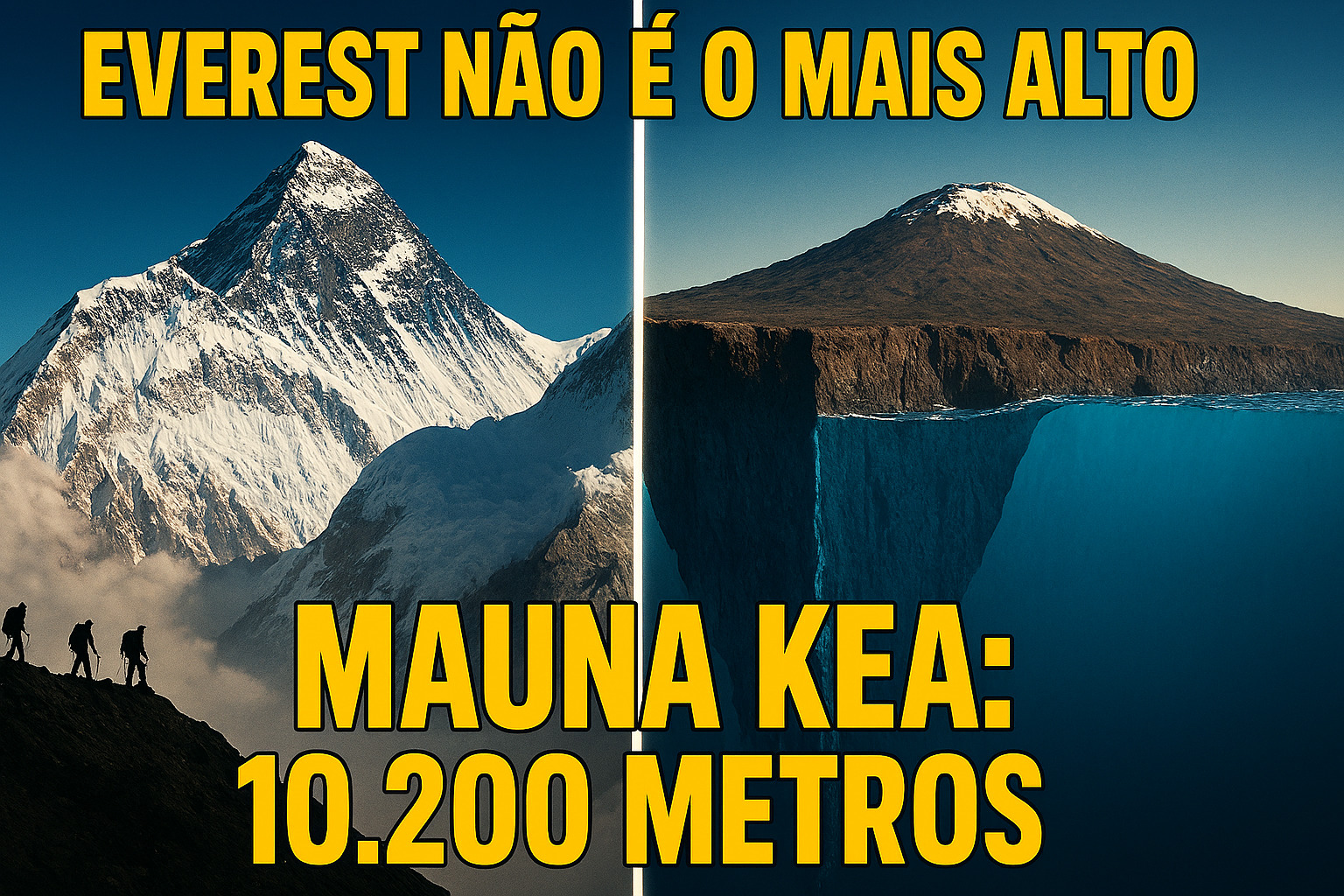


Measurement From The Ocean Floor To The Top, Mauna Kea (Hawaii), Is The Mountain That Exceeds 10,200 Meters, Surpassing Everest In Actual Height And Redefining The Concept Of The Highest Mountain On The Planet.
For decades, the world has been taught in school that Everest is the highest mountain on Earth. With its 8,848.86 meters above sea level, it reigns supreme in the collective imagination as the “roof of the planet.” But geographic and geological science reveals a fact that completely changes this logic: when the measurement is taken from the actual base to the top, rather than from sea level, there is a mountain that exceeds 10,200 meters in total height, Mauna Kea – easily surpassing Everest in structural dimension. This information, confirmed by surveys from the United States Geological Survey and NOAA, completely redefines the concept of “the highest mountain in the world.”
The difference lies in the measurement criteria. While Everest is the highest point in relation to sea level, this specific mountain is the highest from its actual base at the ocean floor to its summit, forming the largest vertical colossus ever identified on the planet.
The Difference Between “Highest” And “Elevated”
The most common error in popular interpretation is the confusion between two distinct technical concepts:
-
The Argentine government celebrates the lowest poverty rate in 7 years, but experts warn that the methodology has changed, real wages have fallen, unemployment has risen, and the number of people on the streets of Buenos Aires has increased by 57% since Milei took office.

-
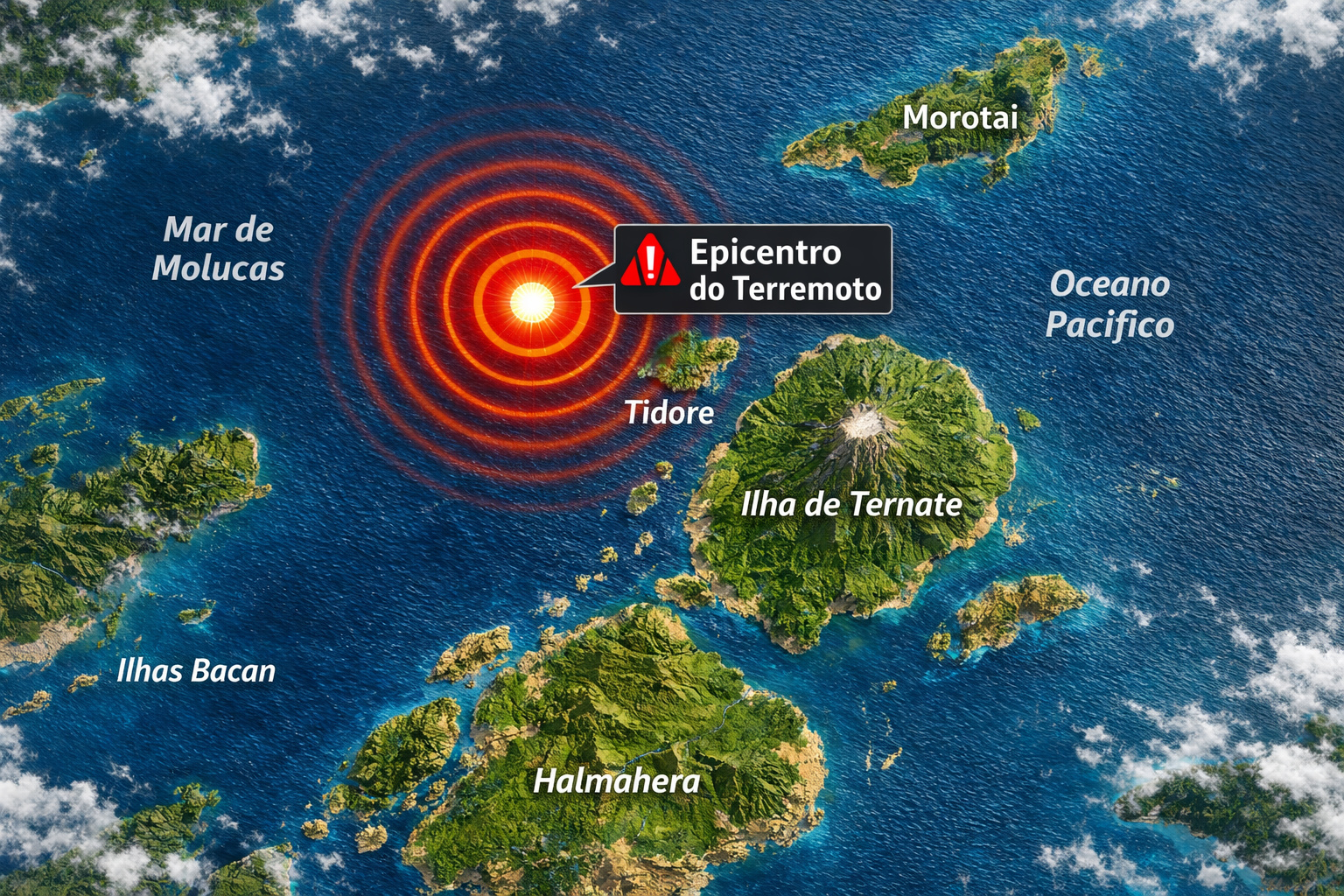
7.8 magnitude earthquake in Indonesia frightens the population, triggers tsunami alert, and hits an island with over 200,000 inhabitants this Thursday.
-
Google will finally let you change that embarrassing Gmail address you created in your teenage years without losing any accounts, logins, or old emails: the feature is already available in the United States.

-
Heading to Brazil in a Bonanza F33 single-engine aircraft: a couple departs from Florida on a visual flight, makes technical stops in the Caribbean to refuel and organize paperwork, and begins the staged crossing until they reach the country.


- Altitude: height in relation to sea level.
- Actual Height: total distance from the base of the structure to the top.
Everest wins hands down in the altitude criterion. No other point on the Earth’s crust is as high above the average sea level. However, Mauna Kea, which redefines this ranking, wins in the total structural height criterion, because its base is not on firm ground but thousands of meters below sea level.


When the depth of the ocean floor and the elevation above the surface are added together, the result exceeds 10.2 kilometers of continuous vertical drop, something that no continental mountain can match.
Mauna Kea: Colossus That Rises From The Ocean Floor
This mountain does not rise from plateaus or continental bases, as is the case with Everest in the Himalayas. It rises directly from the ocean floor, in a region where the depth exceeds 5,000 meters below sea level.
From this submerged point, its volcanic structure continuously grows until it emerges from the surface and reaches over 4,200 meters above sea level. The sum of these two parts, the submerged and the visible, creates the largest mountain structure on the planet in absolute height terms.
In terms of natural engineering, it is equivalent to stacking:
- one whole Everest;
- plus another building over 1,300 meters on top.
A Giant Built By Volcanoes Over Millions Of Years
The Mauna Kea mountain was not formed by continental folding, as is the case with the great mountain ranges of the Earth. Its origin is volcanic. Over millions of years, successive eruptions released enormous volumes of basaltic lava that solidified on the ocean floor, layer after layer.
Each eruption added new meters to the structure. Slowly, the mountain grew upward, broke the ocean surface, and continued to rise until it reached its current shape. The process was so constant and voluminous that it created the largest individual mountain on the planet in mass, volume, and actual height combined.
From a geological point of view, it is considered:
- one of the largest volcanic structures ever recorded;
- one of the most massive isolated formations in the Earth’s crust;
- one of the most extreme examples of the constructive power of volcanism.
Why Everest Remains Famous Even Though It Is Shorter In Overall Height
Everest remains the most famous for three main reasons:
- It is the highest point on the planet above sea level, the most intuitive criterion for the public.
- It is on firm ground, allowing climbs, expeditions, and direct visual records.
- It has become a global cultural and sporting symbol, since the first ascents in the 20th century.
In contrast, the mountain that surpasses Everest in structural height is largely submerged, which limits its presence in popular imagination. Much of its structure is invisible to the human eye, hidden beneath kilometers of water.
The Largest Mountain In The World Is Also One Of The Largest Volcanoes On The Planet
In addition to being the largest mountain in actual height, this structure is also among the largest volcanoes in the world by accumulated volume. Its body occupies such an extensive area that it partially sinks the Earth’s crust under its own weight, a phenomenon known as isostatic subsidence.
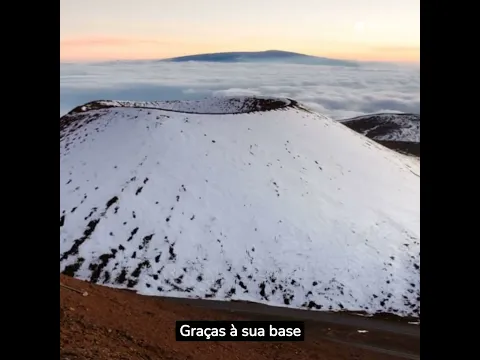
This sinking means that, if the crust did not give way under the pressure of the volcano, the mountain could be even taller than it already is. In other words: the planet literally curves its own surface to support the weight of this giant.
Direct Comparison: Mauna Kea Versus Everest
In approximate numbers:
- Everest: 8,848.86 meters above sea level.
- Largest Mountain In Actual Height Mauna Kea: Over 10,200 meters from base to top.
The difference exceeds 1,300 meters, an amount equivalent to:
- four times the height of the Eiffel Tower stacked;
- more than many of the tallest buildings in the world;
- almost the altitude of entire cities like La Paz or Bogotá.
In other words: if it were possible to “transfer” this mountain from the ocean floor to firm ground without altering its base, it would surpass any other known mountain in absolute height.
The Scientific Role Of This Mountain In The Study Of Earth
This formation is a natural laboratory for various areas of knowledge:
- Geology, for revealing the growth of volcanoes in ocean environments;
- Plate Tectonics, for demonstrating how weight affects the crust;
- Volcanology, for being an extreme example of basaltic volcanism;
- Oceanography, for its interaction with currents and underwater pressure.
Instruments installed in its structure continuously monitor:
- microearthquakes;
- magma movement;
- thermal variations;
- deformations in the crust.
All this helps to understand not only this mountain but also the internal workings of the planet.
A Giant That Completely Changes The Logic Of Geography
For centuries, geography has taught that the largest mountain in the world is the one with the highest peak in relation to sea level. This rule is practical but incomplete. When adopting the actual base as a reference, the ranking changes radically.
This new criterion shows that:
- The Earth has mountains that are much taller than previously thought;
- Much of these structures are hidden beneath the oceans;
- The underwater relief is even more extreme than the continental one.
This means that our planet is much more “vertical” than it appears when observed only from sea level upward.
What This Data Changes In The Human Imaginary
Knowing that the highest mountain in the world is not the most famous completely alters the perception of the planet’s grandeur. Everest remains the highest point on the globe, but it is not the largest colossus in actual height.
This fact reinforces a powerful scientific truth: The Earth’s greatest extremes are often hidden where humans least see — at the bottoms of the oceans.
Why Mauna Kea Will Never Be Climbed From The “Foot” To The Top
Unlike continental mountains, this structure cannot be climbed from its actual base because the start of the mountain is thousands of meters below the ocean surface, in a zone where:
- pressure exceeds hundreds of atmospheres;
- there is no sunlight;
- the temperature is extremely low;
- direct human presence is unfeasible without submersibles.
Thus, it will never be possible to make a complete ascent from base to top as one does with Everest. Most of its height will always remain physically inaccessible to humans.
The highest mountain in the world in actual height does not dominate school books, does not appear in climbers’ photos, and is not conquered by historical expeditions. Still, it is the largest vertical colossus ever produced by nature on the planet.
With over 10,200 meters of continuous drop, it surpasses Everest when the criterion is total structural dimension, rather than just altitude above sea level.
This fact alone is enough to turn upside down the way humanity perceives the great mountains of Earth. The true giant of the planet is not visible on the horizon. It begins in the depths of the ocean and rises to touch the sky.









Só porque o TRUMP quer
NÃO VALE, desde o fundo do oceano.
PERDEU!!
EVEREST TOP of the World!!
Esta ideia torta tem a cara do STF/ Judiciário e mostra que tudo pode ser distorcido conforme conveniência.