





 Portuguese
  English
  Spanish
  3 min of reading
  0 comments


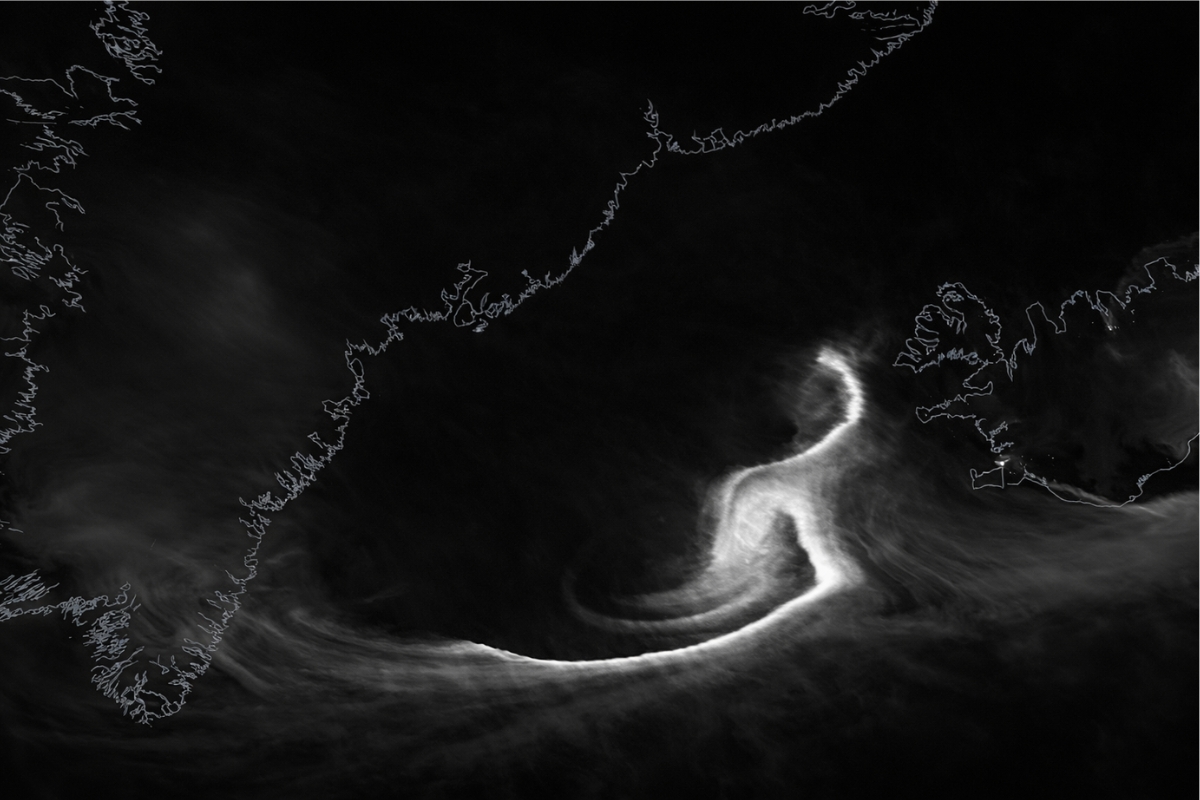
Satellite Recorded A Bright Flash Over Greenland And The North Atlantic On February 16, 2026, Drawing Attention To Space Weather
A bright flash recorded over Greenland drew attention as it advanced from the east of Canada to the North Atlantic during a geomagnetic storm observed on February 16, 2026. The phenomenon appeared from space and gained importance as it revealed how solar changes can reach large areas of the planet.
The episode also reinforces a strategic point that often goes unnoticed. Even when the intensity is not at its highest, this type of event can affect power grids, communications, and satellites, increasing vigilance regarding the interaction between the Sun and the Earth’s atmosphere.
Satellite Captured The Flash In The Middle Of The Night
The images were obtained by the Suomi NPP satellite, which recorded the expansion of the aurora borealis in a band that moved from the east of Canada to the North Atlantic. The scenario was observed under conditions of moderate solar activity.
-
Scientists reveal a new method using solar light that transforms plastic into vinegar and could change the game against pollution, converting waste into a sustainable solution with future global impact.

-
3,500-year-old tear discovered reveals a textile technique much more advanced than previously thought in the Bronze Age.

-
One of the largest manufacturers of military ammunition in the world is Brazilian and has just signed an agreement with the Navy to develop national ammunition for the frigates built in Santa Catarina that will protect the Blue Amazon.

-
Scientists are baffled by hundreds of perfect circles that have emerged on the seabed in Scotland, formed by living seagrass meadows, and no one can explain whether it is nature self-organizing or something completely unknown to science.


The recording was made by an instrument capable of detecting night light in wavelengths ranging from green to near-infrared. In the orbital view, the scene appears in grayscale, although on the surface, green tones with reddish and purple variations predominate.
Northern Glow Spans Iceland and Canada
Although the aurora borealis, or northern lights, is most often observed in March and September, it can appear at other times of the year if conditions are right. For instance, in February 2026, a minor geomagnetic storm produced a striki… pic.twitter.com/jdt99KLIwM— Cerebral Overload (@CbrOvld) February 22, 2026
System Separates Urban Light, Moonlight, And Atmospheric Emissions
The sensor used for monitoring can distinguish urban lighting, moon reflection, and atmospheric emissions. This allows for more accurate identification of what truly forms part of the observed phenomenon in the sky.
In practice, this filter helps avoid confusion between different light sources and improves the quality of image readings. The result is a clearer view of the aurora and its actual reach over the region.
Storm Started At G1 Level And Later Advanced To G2
According to NOAA, the U.S. agency that monitors weather and oceans, during the early hours, the geomagnetic storm was at G1 level, the lowest on a scale that goes up to G5. Hours later, the disturbance evolved to G2, classified as moderate.
This type of event usually increases aurora visibility at high latitudes. It can also cause small fluctuations in power grids and minor impacts on satellites, keeping the topic on the radar of those monitoring infrastructure and technology.
Solar Flow Expanded The Area Affected By The Phenomenon
The intensification was likely associated with a coronal hole and a fast solar wind flow. When this happens, the so-called auroral oval can descend further south than normal.
With this shift, the visible glow spreads over a larger area. It was this displacement that helped to expand the geographic reach of the phenomenon detected by the instruments in orbit.
Mission Launched In Alaska Aims To Map Electric Currents
The episode coincided with the Gneiss mission, which launched two sounding rockets on February 10 from the Poker Flat Research Range, in Alaska. The goal is to reconstruct electric currents associated with the auroras in three dimensions.
This type of investigation helps to better understand the dynamics of space weather. It also provides important data to anticipate effects that may impact technological systems and sensitive operations.
Space Weather Monitoring Gains Strategic Importance
Each geomagnetic storm, even when not reaching the most severe levels, expands knowledge about the Earth’s upper atmosphere. This has scientific value but also influences the assessment of technological risks in an increasingly satellite-dependent and connected scenario.
The glow that advanced over Greenland and the North Atlantic shows that phenomena seen as distant can have concrete reflections. When space becomes active, the pressure reaches infrastructure and alters strategic readings.





-

-

-

3 pessoas reagiram a isso.