





 Portuguese
  English
  Spanish
  6 min of reading
  0 comments


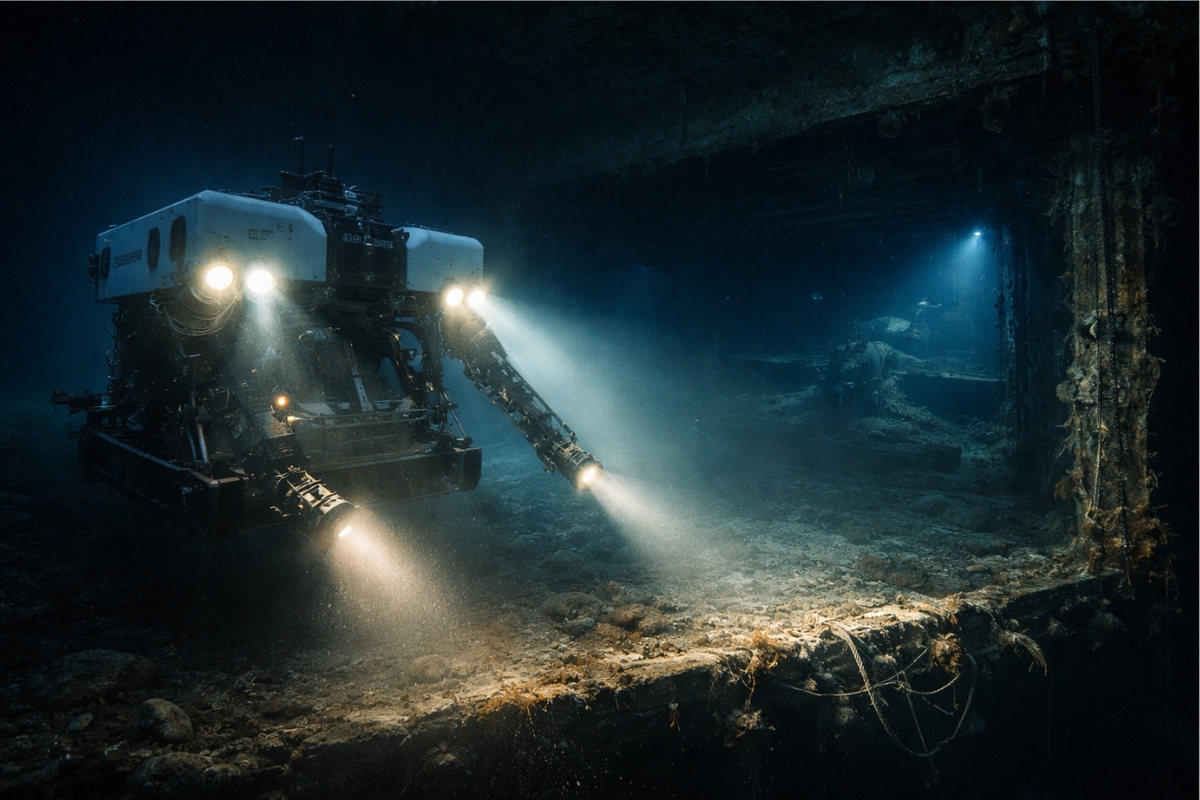
Sunk after the Battle of Midway and located at almost 5 kilometers deep, the aircraft carrier USS Yorktown has just revealed new indications in an exploration that surprised even the researchers by what it still conserves inside
More than eight decades after sinking in the waters of the Pacific, the aircraft carrier USS Yorktown has regained prominence thanks to a new underwater exploration conducted in April 2025. What seemed to be just another historical inspection ended up revealing surprising discoveries in one of the least studied areas of the ship: its hangar.
The most impactful data was not only that the interior of the vessel still preserved objects of enormous historical value, but also that many of them appeared in an extraordinarily preserved state. In a single mission, researchers found a service automobile, remnants of military aircraft, and even a hand-painted mural, hidden for over 80 years at almost 5,000 meters deep.
Why the USS Yorktown continues to be so important
The USS Yorktown (CV-5) was one of the most relevant aircraft carriers of the United States Navy during the first phase of World War II. It entered service in 1937 and participated in decisive battles in the Pacific front, including the Battle of the Coral Sea and, shortly after, the famous Battle of Midway.
-
At 100 years old, an elderly man who dreamed of “making it to the newspaper” finally shares his story, reaching his centenary with children, grandchildren, great-grandchildren, and great-great-grandchildren, moving his family with a life of hard work, farming, honesty, and without vices.

-
Germany proposes silent propellers to solve a centuries-old problem: the damage caused in the ocean by ship noise.
-
What the Public House of Julius Caesar was like inside in the Roman Forum: layout, atrium with compluvium and impluvium, tablinium and peristyle, and the scandal of the Bona Dea, revealed in an AI recreation.

-
While digging a trench next to a pool in Germany, workers found more than 1,500 silver coins from 1320 in the rubble, revealing a treasure buried for over 700 years.


Its role in Midway was crucial. Although it had suffered serious damage days before, the ship was emergency repaired in Pearl Harbor in record time and sent back into combat. During the battle, its aircraft helped strike the Japanese fleet, but the Yorktown itself was hit by bombs and torpedoes, finally sinking on June 7, 1942, after the attack by the Japanese submarine I-168.

The mission of 2025: exploration technology at the limit
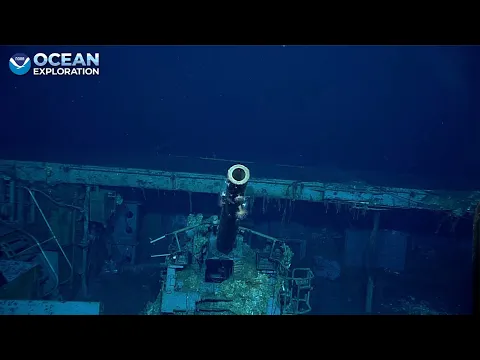
The new expedition was carried out by NOAA Ocean Exploration aboard the ship NOAA Ship Okeanos Explorer, using the remotely operated vehicle Deep Discoverer. The goal was to study both the archaeological state of the wreck and the marine life that now inhabits the structure of the vessel, located within the Papahānaumokuākea National Marine Monument.
What made this mission special was its ability to observe for the first time with such precision the ship’s hangar without altering the site. It was a non-invasive exploration, based on high-resolution video, deep lighting, 3D photogrammetry, and very controlled maneuvers to document the interior without touching or removing objects.

The most unexpected discovery: a car inside the hangar
Among all the discoveries, the one that most puzzled experts was the presence of a car in the hangar of the aircraft carrier. The images suggest that it is a 1941 Ford Super Deluxe “Woody”, a preliminary identification based on features such as the split windshield, the shape of the rear windows, the chrome of the fenders, and other details of the front.
It was also possible to read a plate with the inscription “SHIP SERVICE”, indicating that the vehicle was intended for internal service functions of the ship. The big question is obvious: what was a car of this type still doing on board in the midst of a war scenario, and why was it not thrown overboard during desperate attempts to lighten the ship and save it after the attacks?

A small detail that opens big historical questions
The presence of the automobile is not just a simple visual curiosity. In fact, it opens new lines of investigation about the logistics and daily life aboard American aircraft carriers in 1942. Such a vehicle could have been used by officers, for supply, internal transport, or support tasks in port before departing for combat.
Its presence inside the hangar, even after the damage suffered and the emergency operations prior to Midway, suggests that it was not a minor element. This type of discovery humanizes the wreck: it reminds us that, in addition to planes, bombs, and armored steel, the Yorktown also carried common objects of a crew that lived, worked, and moved under extreme conditions.
Planes frozen in time inside the aircraft carrier
Another of the major discoveries of the mission was the confirmation of several aircraft inside the ship. NOAA identified at least three Douglas SBD Dauntless dive bombers in the hangar area and near the aircraft carrier’s elevator system. One of them still had a 500-pound bomb installed on its launch rack.
This data, by itself, is already extraordinary. It not only demonstrates the level of preservation of the site but also offers a nearly frozen image of the combat pace that the Yorktown experienced in its final hours. The hangar, more than just an internal cover, thus transforms into an intact capsule of the naval air warfare of the Pacific.

The technical value of these aircraft
The SBD Dauntless were a key piece in the American victory at Midway. They were dive bombers designed to strike enemy ships with great precision, and their effectiveness was demonstrated in attacks against Japanese aircraft carriers such as the Kaga and the Akagi. Finding these aircraft inside the Yorktown allows for the study of how they were distributed, stored, and armed during full operation.
The exploration also helped confirm that a wing documented in 2023 belonged to a Grumman F4F Wildcat, the main carrier-based fighter of the U.S. Navy at that stage of the war. Additionally, other folded or stored wings appeared, likely spare parts, which provide valuable information about maintenance, repair, and availability of aerial material on board.
A hand-painted mural that survived the ocean

If the car surprised and the planes impressed, the most exciting discovery was probably a hand-painted mural inside the ship. The work, titled “A Chart of the Cruises of the USS Yorktown”, appeared in the interior of the elevator shaft number 2 and showed a world map with the routes taken by the vessel.
The value of this mural goes far beyond its decorative aspect. It is a direct mark of the ship’s identity and the visual culture of its crew. In a total war environment, this type of painting also served as collective memory, unit pride, and a reminder of the shared history of those who lived on the aircraft carrier.
A battlefield and an ecosystem at the same time
The NOAA mission was not only of archaeological interest. At this extreme depth, the hull of the Yorktown also became a complex underwater ecosystem. Researchers documented anemones, tube worms, and jellyfish, including a striking red jellyfish that may correspond to a species not yet formally described.
This contrast is fascinating: a symbol of war destruction transformed over time into a refuge for abyssal life. From a scientific point of view, the wreck is both a military historical heritage and a natural biological laboratory. Therefore, its study requires a balance between archaeology, conservation, and cutting-edge ocean research.
Why this discovery changes the way we look at the USS Yorktown

Until now, the Yorktown was remembered mainly for its strategic role in Midway. However, the exploration of April 2025 showed it in a different light: not only as a major military protagonist but as a space where direct traces of life, urgency, and chaos from those days in June 1942 still survive.
The car in the hangar, the still-armed planes, the stored parts, and the hand-painted mural transform the wreck into something much closer and tangible. It is no longer just a ship lost at the bottom of the ocean, but an intact material archive of modern warfare, preserved in silence for over 80 years and now rediscovered with 21st-century technology.
A wreck that has not finished telling its story
NOAA is already working with three-dimensional models and photogrammetry material obtained during more than eight hours of recording. This will allow for a more detailed study of the arrangement of the hangar, the position of the objects, and the pace of structural deterioration of the wreck. Everything indicates that the discoveries of 2025 are just the beginning of a new stage of investigation.
After more than eight decades under the Pacific, the USS Yorktown continues to challenge historians, archaeologists, and naval experts. And perhaps this is the most powerful revelation of all: even in the darkest depths of the ocean, some ships still have the ability to rewrite history.




Seja o primeiro a reagir!