





 Portuguese
  English
  Spanish
  5 min of reading
  14 comments


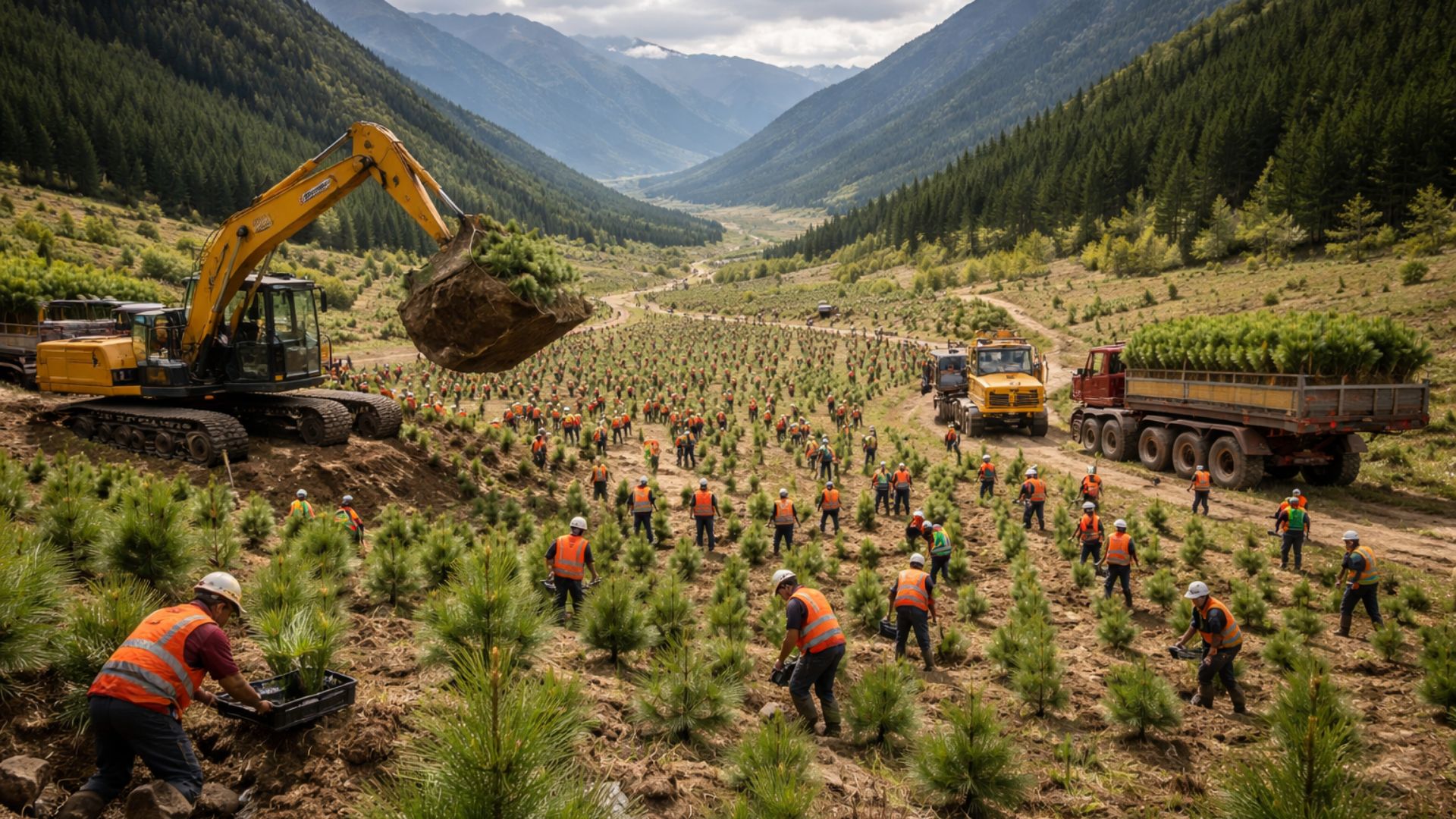


Pines Escaping Planted Areas Advance into Open Landscapes, Alter the Water Balance, and Become a National Challenge in New Zealand. Public Control Program Mobilizes Recurring Resources and Large-Scale Operations, While Studies Indicate a Decline in Water Yield in Affected Basins.
What began as planting conifers for productive purposes and ground cover has turned into an environmental and economic problem that today mobilizes continuous public resources in New Zealand.
In various regions, pines escaping from planted areas and spreading on their own — locally known as “wilding conifers” — have come to form dense patches, pressuring water availability in sensitive basins and requiring large-scale control actions funded by the government.
What Are “Wilding Conifers” and Why Have They Become a Public Policy Issue
The term “wilding conifers” does not refer to planned planting, but to conifers that establish themselves outside managed areas and advance into open landscapes.
-
A couple who only has Sundays free has built a hand-dug pool, a hamburger joint, a dance hall, and a playground in their own home without hiring a mason, and even with breaks due to accidents and the pandemic, the work has never truly stopped.

-
Furniture made with aluminum and glass does not warp and has become an alternative to replace MDF in Brazil.

-
Finland, the happiest country in the world, wants to hire 140,000 technology professionals and is eyeing Brazilians: visas are issued in just two weeks and salaries with a 37-hour workweek are surprising.

-
Mr. Mário reveals the technique of the caipira papaya: he cuts the fruit in half, discards the seeds from the tip, and plants the ones from the back to increase the chance of a productive female tree.



The Ministry of Primary Industries (MPI), through Biosecurity New Zealand, treats the issue as a long-term problem within ongoing management programs, with national guidelines and the division of territory into management units to plan and execute control.
Water in Basins and the Effect of the Advance of Conifers
The impact on water is one of the central points behind the public response.
Documents and analyses associated with the management strategy indicate that the progressive occupation by conifers can decrease the “water yield” of the basins, that is, the portion of rainfall that actually turns into runoff and feeds watercourses and reservoirs.
The logic outlined in these materials involves processes such as interception of rain by the canopy and increased evapotranspiration, which reduces the water that flows into rivers and for groundwater recharge.
What Do Basin Studies Indicate about Water Yield
The figures cited in basin studies help to illustrate why the issue moved from a technical realm to the public policy agenda.
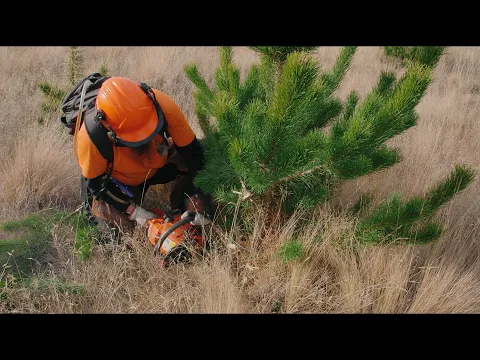

A reference report on the subject gathers results from New Zealand hydrology studies in basins and records significant reductions in annual water yield when previously open areas are replaced by pine forests, with variations depending on location and rainfall regime.
Hydropower and Water Availability in Public Debate
Water pressure is also linked to economic uses.
In a public address, the Parliamentary Commissioner for the Environment (PCE) stated that the expansion of these conifers in basins connected to hydropower generation systems could reduce water yield and affect availability across the entire system.
This relationship is one reason for the debate over who benefits from control and how different sectors can contribute to sustain it.
National Strategy and Long-Term Control Program
The institutional response took shape with a national strategy and, subsequently, with a dedicated program.
The PCE records that the National Wilding Conifer Control Programme was established following the development of the management strategy, and the government maintains the issue within the scope of biosecurity and plant pest control.
Public Investment and Large-Scale Operation
In practice, this translates to money and on-the-ground operations.

The MPI’s official website reports that from July 2020 to June 2021, the work of the program and its partners consumed almost NZ$ 40 million, with control activities carried out on 817,000 hectares.
In a report from the same agency, the structure of “management units” organizes geographical areas to plan actions and prioritize regions, and operational coverage has been expanded to cover most of the known infestation area.
When discussing funding, the government’s own communication reveals the scale of investment.
In an official statement published on the Beehive website, New Zealand states that since 2016, the government has invested over NZ$ 150 million in the national control program, in addition to additional contributions from partners and communities.
The same set of information appears detailed on the program’s ecosystem pages, which also mention the existence of annual base funding and complementary contributions from different sources.
When “Green” Does Not Mean More Water
The case draws attention because it subverts a common sense in environmental policies: not all increases in tree cover are automatically synonymous with local water gains.
Research and scientific communication materials in New Zealand describe that among the negative effects considered from the advance of these conifers is precisely the reduction of water yield, alongside landscape transformations and pressures on plant ecosystems.
How Control Is Planned and the Role of Prevention
Public management, in turn, is not limited to indiscriminately cutting trees; the effort is described as a set of decisions about where to act first, how to prevent reinfestation, and how to reduce sources of spread.

The MPI reports, for example, research work to enhance detection through image analysis and changes in policy orientation to reduce the risk of spread from new plantings, signaling that control depends on both operation and prevention.
Another relevant layer of the issue is the cost of “not acting.”
Cost-benefit studies produced in the context of management support that the advance of these conifers can generate cumulative economic and environmental losses, and treat maintaining water yield as a relevant argument to justify ongoing investment in control.
At the same time, the existence of a national strategy does not eliminate the local challenge: different regions need to adapt planning, choose priority areas, and execute operations persistently, as the reinvasion dynamic is a permanent risk.
Therefore, New Zealand’s public policy has consolidated as a long-term program, with governance structure, data, and recurring funding, rather than a one-off “clean-up” action.
The episode has also become an international reference by showing how a tree associated with planting and economic use can become, out of place and out of management, a pressure factor on water at the basin scale.
In a scenario where several countries discuss reforestation, carbon capture, and forest expansion, New Zealand’s experience helps to distinguish between planned planting and biological invasion, and positions water balance as a criterion as concrete as the aesthetics of “green” seen from above.
If part of the world bets on planting trees to improve the environment, what should be the minimum rule to avoid that “green” becomes, in practice, a silent dispute for water within the basins?








You have to plan a symbiotic relationship to control weather systems when it comes to water and trees.
Cut, process then sell to China. Hire loggers from the Philippines and they will solve it in no time.
This is absolutely wrong. Instead you should do one thing, just spray keffir arially to add microbes in soil. They will promote growth of the plants and increase the water label.
As well as prevent the conifers from dieback , which is causing mass death of canfifers all over the globe.
https://1drv.ms/w/c/2054c0ae2fa2a13d/IQCRuq00ulnkQZi34oAu49WLAWnj-5yGqwhifYIvVbF_nBM?e=OTqPgj
I really feel very bad to see the video.
I can explain why it is wrong, if you are interested .