





 English
  Francês
  Alemão
  Italiano
  Japonês
  Norueguês
  Portuguese
  Spanish
  3 min of reading


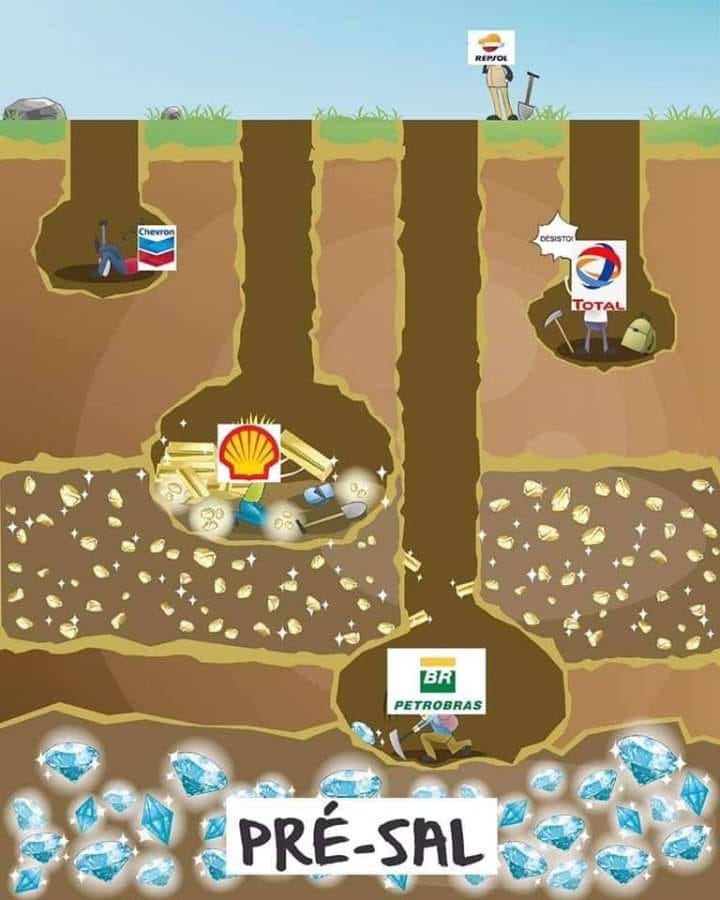
An Image with the Following Message: “Should Petrobras Be Privatized?” Is Being Shared on Social Media and Has Caused Diverse Opinions
The message alludes to or criticizes that while Petrobras invested in technology and mobilized financial resources in the billions, private oil companies were reluctant to risk their capital in something that was merely speculative. Below we see Repsol, Chevron, Total, Shell, and Petrobras.

After Petrobras confirmed the potential of a new hydrocarbon exploration frontier, known as the PRE-SALT, there was a mobilization of global oil companies to acquire production slices in Brazilian basins, mainly in the Santos Basin. In fact, this has been happening through the last Oil Auctions promoted by the ANP (National Petroleum Agency).
-
Government unlocks R$ 554 million for a highway that has been requested for decades and accelerates the duplication of BR.

-
Without bricks, without cement, and without endless construction: the cardboard house that is assembled in modules and can be moved.

-
Billions of barrels on the equatorial margin could lead Amapá to double its oil production in Brazil — the state aims to enter the route of companies in the Campos Basin, attract investments, and boost jobs and businesses in the oil and gas sector.

-
Without bricks, without cement, and without endless construction: the cardboard house that is assembled in modules and can be moved.

Due to the financial crisis triggered by corruption scandals that began in 2014, Petrobras ended up creating a Divestment Program, whose objective was to sell onshore/offshore assets that no longer provided financial return and focus exclusively on the PRE-SALT.
In the 2018 presidential race, candidate Jair Messias Bolsonaro, among other narratives, made the privatization of state-owned companies one of the main promises of his government. In 2019, as president, he decided to backtrack on the privatization of the state company, believing that the state is “strategic for the government,” but Bolsonaro and Minister Paulo Guedes are trying to privatize some of its subsidiaries in 2019.
Other Factors That Led Petrobras to This Point
With the decrease in local content and the Brazilian currency against the commercial dollar (BRL x USD) at an average exchange rate above R$ 3.50, oil companies have prioritized orders for offshore units, such as FPSOs, from Asian shipyards, whose products and services, especially labor, are cheap and cover production costs more quickly.
On the other hand, the Brazilian shipbuilding industry has been struggling and trying to diversify its order books, since most orders were made by Petrobras and there is no forecast of new orders for Brazilian shipyards for large vessels and production units, at least for the moment.
The Discovery of the Pre-salt Involved Petrobras and Foreign Companies
Petrobras, together with other foreign companies, discovered the pre-salt in 2006. In 2010, it actually started the oil extraction process in the Jubarte field, located in the Campos Basin.
Many expectations were created after Petrobras confirmed the commercial viability of this new exploratory frontier; the entire chain of the oil industry mobilized. The exploration of the pre-salt was expensive, but the cost of the barrel easily exceeding US$ 100 more than covered the costs of production and research.
With the corruption scandals, the state-owned company lost market value and incurred substantial losses. After suffering impeachment, former President Dilma Rousseff was replaced by Michel Temer, who signaled a broader opening of the exploration market to foreign companies. With the end of Petrobras’ obligation to explore all offshore Brazilian oil assets, the state-owned company began to rediscover its value (in shares and in the financial market) through auctions and production sharing, thus avoiding its sale, which had been imminent at the time.
So far, there has been no indication from the current government regarding any topic related to the privatization of Petrobras.





Seja o primeiro a reagir!