





 Portuguese
  English
  Spanish
  5 min of reading
  0 comments



At the Peak of Pre-Salt, the Brazilian State-Owned Company Reached a Market Value That Surpassed Disney and McDonald’s Combined, Leading the Regional Ranking
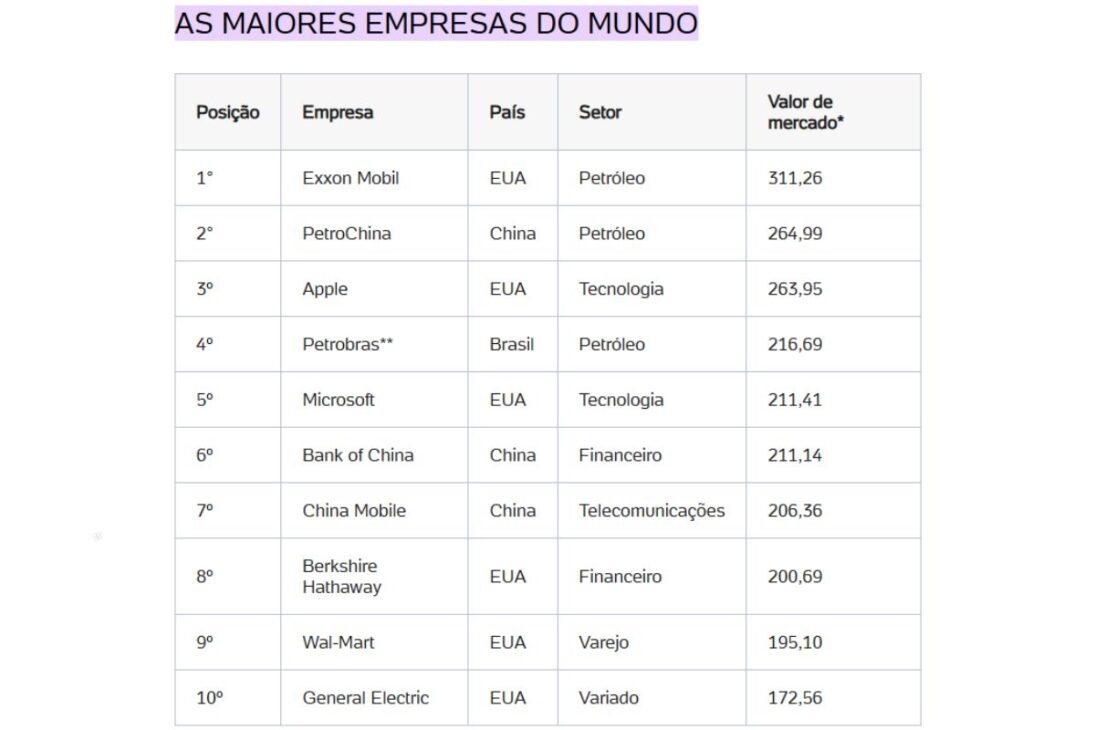
The trajectory of Petrobras illustrates how the largest company in Latin America can rise rapidly with strategic discoveries and fall just as quickly in the face of reputational and market shocks. In the pre-salt cycle, between 2008 and 2009, the company reached a historic peak in valuation and economic impact, valuing more than Disney and McDonald’s combined, driven by giant reserves and technology in ultra-deep waters.
At the same time, the state-owned company saw its value fluctuate with the drop in oil prices and the revelation of corruption schemes years later. The Petrobras case is educational for understanding the relationship between public policy, governance, and investor expectations, without losing sight of the real production and cash base that supports any oil company.
From the Announcement of Pre-Salt to the Top of the Continent
The discovery of pre-salt, announced from 2006 onwards, reshaped expectations about Brazil’s capacity to become a relevant oil exporter.
-
Spain surprises the world by erecting 62 artificial dunes, mixing sand with natural remains of posidonia, and causing the structure to lose only 1.4% of its volume in 1 year.

-
With 16 Bulava missiles, improvements in acoustic stealth, and a design focused on silent patrols, Russia’s nuclear submarine was born to ensure Moscow’s invisible retaliation and has become one of the pillars of its maritime strength.

-
‘Populous’ city in Rio among the worst in Brazil in national ranking and exposes silent development crisis.

-
Couple buys house in the South Zone of São Paulo, opens a hidden door in the garage, and finds a secret wine cellar with dozens of old wines forgotten since the 1970s.
Petrobras dominated exploration technology in shallow water, positioning it to capture technical and financial value from this new horizon.
In 2009, the company was classified as a regional sales leader, according to Exame, with over 100 billion dollars, establishing itself as a reference in Latin America.
This boost was accompanied by an ambitious investment plan and the largest share offering in the world at the time, in 2010.
The move reinforced the perception that the state-owned company would be a global player in the oil and gas sector while high barrel prices elevated revenues and margins.
At its peak, Petrobras’ capitalization surpassed global consumption and entertainment marks, according to UOL, becoming the fourth largest company in the world, a symbolic milestone of the euphoria associated with pre-salt.
Why Was the Valuation So High?
The valuation combined fundamentals and narrative. On one hand, voluminous and high-quality reserves beneath the ocean floor, coupled with productivity gains.
On the other hand, the rise in international oil prices during the period boosted profits across the sector.
This combination generated capital flow for the state-owned company, which was already recognized for its deep water engineering.
The long-term expectation played a decisive role. The market priced in years of future production at an accelerated pace, which increased the premium embedded in the shares.
Meanwhile, the perception that the state would strengthen the company’s role in strategic areas bolstered the confidence of some investors.
It was the combination of reserves, high barrel prices, and a global appetite for risk in emerging markets.
The Cycle Shift: Scandals, Prices, and Governance
Starting in 2014, simultaneous shocks reversed the curve. The sharp drop in oil prices reduced revenues and pressured results, affecting the entire sector.
At the same time, Operation Car Wash exposed governance weaknesses and billion-dollar losses, shaking confidence.
The market repriced political and operational risk, and the company lost value rapidly.
There were also effects from pricing policies and asset reevaluation, which compressed margins and required accounting adjustments.
For investors, it became clear that growth with capital-intensive investments requires management discipline, robust compliance, and transparency, especially in state-owned companies subject to interference.
Petrobras entered a cycle of deleveraging and focused on core business to rebuild credibility.
Restructuring and Return to Predictability
In the following years, the company strengthened compliance mechanisms, sold non-strategic assets, and prioritized more profitable projects, especially in the already mature and competitive pre-salt region.
Production gained predictability and costs fell, sustaining a new phase of cash generation and distribution of results.
The state-owned company remained among the largest Brazilian companies by market value, although the title of the most valuable in Latin America has alternated over time with technology and digital retail companies.
The narrative shifted from mere euphoria or crisis to a balance between financial discipline, a lean portfolio, and the challenges of energy transition.
What This Story Reveals About Value, Risk, and Public Policy
The Petrobras case shows that narratives drive prices in the short term, but recurring cash flow, low costs, and solid governance determine the sustainability of value in the long term.
In cyclical sectors, such as oil and gas, exposure to commodity prices amplifies gains and losses.
It also teaches that public policies should reduce uncertainties rather than expand them.
When rules, investment targets, and control mechanisms are clear, the cost of capital decreases, and more productive projects thrive.
The energy transition enters as a new vector, requiring planning to balance oil profitability with investments in low carbon and new technological paths.
Summary Timeline
Rise. Pre-salt discovered, high oil prices, investment expansion, and record share offerings, with Petrobras on top regionally in sales and market value.
Shock. Falling barrel prices, corruption revelations, accounting losses, and questions about governance and pricing policies.
Reaction. Strengthened compliance, divestitures, focus on higher-return assets, and operational recovery based on pre-salt.
The Now and Next Steps
Today, the company remains relevant to the Brazilian economy, with a portfolio concentrated on competitive assets and attention to cycle risks.
The agenda includes transparency, regulatory stability, and disciplined capital allocation, pillars to maintain cash generation across different barrel price scenarios.
On the horizon, weigh decisions on energy transition, diversification, and dividend policy, topics that directly influence risk perception and market appetite.
The past experience is a warning to balance ambition and prudence, preserving value for society and shareholders.
Petrobras proved that it can reach the top when it aligns world-class reserves, technical efficiency, and institutional predictability.
It also demonstrated the cost of governance failures and external shocks. The challenge now is to sustain results in a world that demands accessible energy while simultaneously reducing carbon emissions.
Do you think Petrobras should accelerate investments in low carbon or maintain maximum focus on pre-salt while it remains highly profitable? How to balance dividends, investment, and energy transition without repeating past mistakes? Leave your analysis in the comments. We want to hear from those closely following the topic.








-

-

3 pessoas reagiram a isso.