





 Portuguese
  English
  Spanish
  4 min of reading
  0 comments


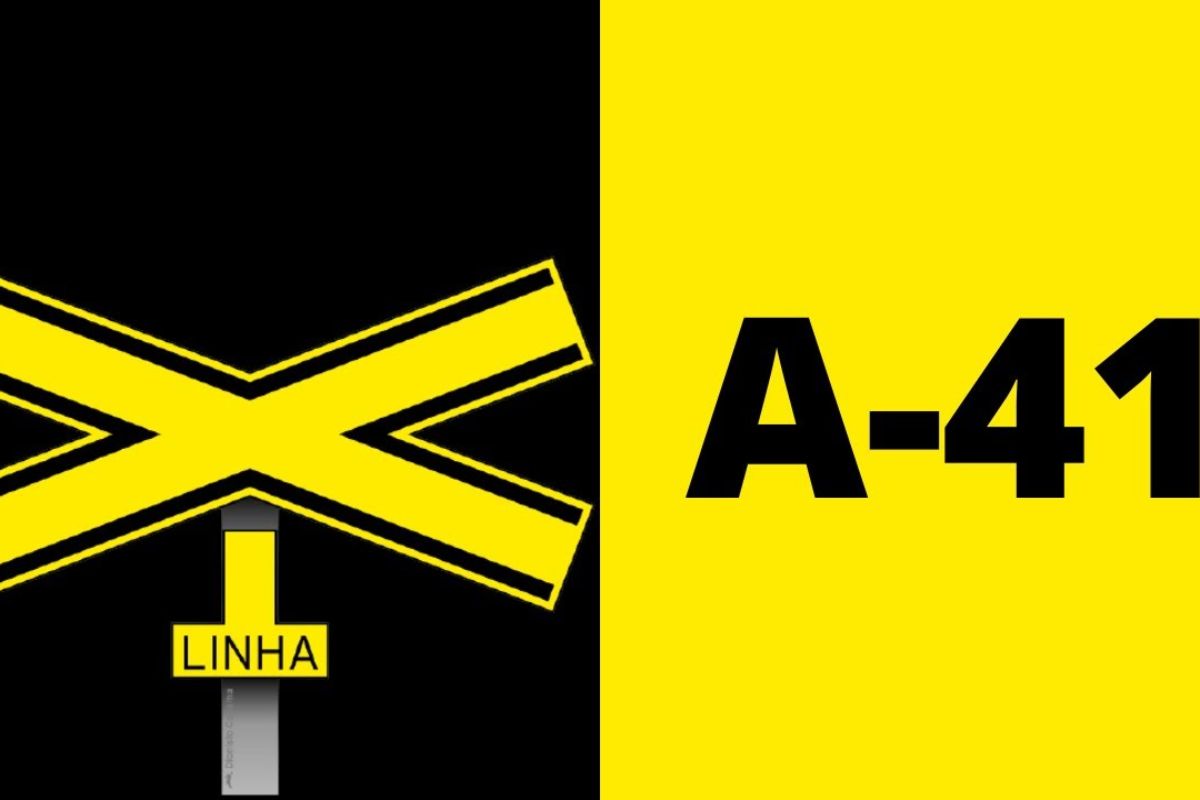
Did You See a Traffic Sign in Yellow Shaped Like an ‘X’ and Were Unsure About Its Meaning? We Unravel the Cross of Saint Andrew (A-41) and the Crucial Rules for Crossing Railways Safely in Brazil.
A traffic sign in yellow with a large black ‘X’ in the center often grabs attention and raises questions among many drivers. Is it a warning for a dangerous crossing or does it indicate something much more specific that requires heightened attention?
This article aims to clarify this fundamental question for road safety. We will detail the meaning of sign A-41, officially known as the Cross of Saint Andrew. It alerts to a very particular type of danger: the presence of crossings with railway lines.
Deciphering the Cross of Saint Andrew: The Traffic Sign A-41
The traffic sign in question is the warning sign A-41, officially named “Cross of Saint Andrew”. Its meaning is clear and vital: it warns the driver about the existence, further ahead, of a level crossing with railway lines. The Brazilian Traffic Code (CTB) specifies that sign A-41 generally indicates a road-rail crossing without a barrier (gate).
-
With more than 635,000 doctors, Brazil sees competition increasing in large cities, and recent graduates are competing for shifts at an accelerated pace while the countryside still faces shortages.

-
The world’s first octopus farm wants to open in the Canary Islands and is already provoking an international reaction: the plan aims to produce 3,000 tons per year.

-
Drought may be creating stronger superbugs in the soil and helping antibiotic resistance reach hospitals, warns a study highlighting a problem that could grow alongside extreme weather.

-
The biggest scam in history: Napoleon’s France deceived the United States by selling them a territory that was Spanish.


Visually, it is distinctive: it has the shape of a cross with equal arms (resembling an “X”), with a yellow background and the edges and the “X” symbol in black. This unique shape aims to highlight the gravity of the alert among other warning signs, which are usually diamond-shaped.
It Is Not Just Any Crossing: The Specificity of the Railway Alert
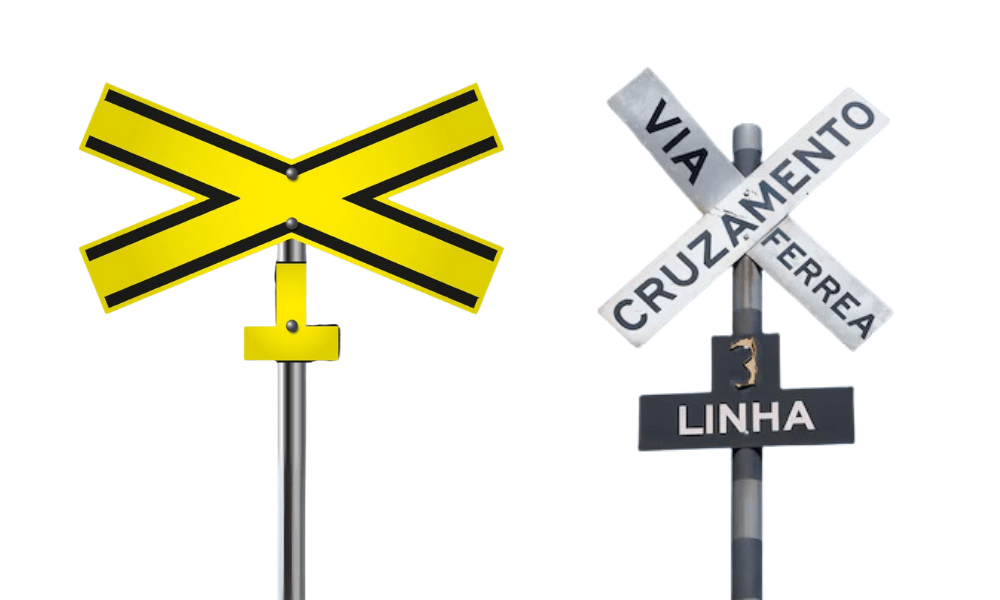
It is crucial not to confuse sign A-41 with a generic “dangerous crossing” warning, such as sign A-6 (“Intersection of Ways”), which signals the intersection between two roadways. Sign A-41 is exclusive to crossings with railway lines, where the imminent danger is a collision with a train – an event with the potential for drastically more severe consequences due to the mass and inertia of the railway compositions. The unique design of the Cross of Saint Andrew seeks to create an immediate mental association with “railway danger”.
Stop, Look, Listen: The Mandatory Conduct in the Presence of Sign A-41
The presence of sign A-41 is directly linked to a fundamental legal requirement for safety. Article 212 of the Brazilian Traffic Code establishes as a serious offense “Failing to stop the vehicle before crossing a railway line”. Therefore, upon sighting sign A-41, stopping is not optional; it is mandatory.
The correct procedure is to: completely stop the vehicle before the railway line (or the stopping line, if there is one). Then, the driver should carefully look in both directions of the railway and listen attentively (lowering the windows and turning off the car sound) for any signs of an approaching train. The crossing should only be made with absolute certainty that it is safe.
Risks of Misinterpretation: Why Ignoring the Cross of Saint Andrew Is Fatal?
Undermining the alert of sign A-41 or being unaware of the stopping requirement can have tragic consequences. Collisions between trains and road vehicles are often catastrophic, resulting in fatalities, serious injuries, and extensive damage. The immense mass differential and the inability of a train to stop quickly or divert make these accidents particularly dangerous.
Continuous traffic education is essential for all drivers to understand not only the meaning of the sign but also the safety conduct it requires, thereby preventing serious accidents.
Complementary Signage and the Driver’s Responsibility at Level Crossings


To reinforce the alert, sign A-41 may be accompanied by other signs, such as sign A-15 (“Mandatory Stop Ahead”), regulation sign R-1 (“Mandatory Stop”), or sign A-39 (“Level Crossing without Barrier”). Pavement markings and light or sound signaling may also be present.
However, the final responsibility for safety at the crossing always lies with the driver of the road vehicle. It is crucial to remain vigilant and follow the “stop, look, and listen” procedure at all level crossings, even if the line seems inactive or if one has never seen a train in that location. Complacency is one of the greatest enemies of safety at these crossings. Safety at level crossings is a shared effort, depending on the infrastructure, the railway operation, and fundamentally, the prudent behavior of drivers.









-

Uma pessoa reagiu a isso.