





 Portuguese
  English
  Spanish
  4 min of reading
  0 comments


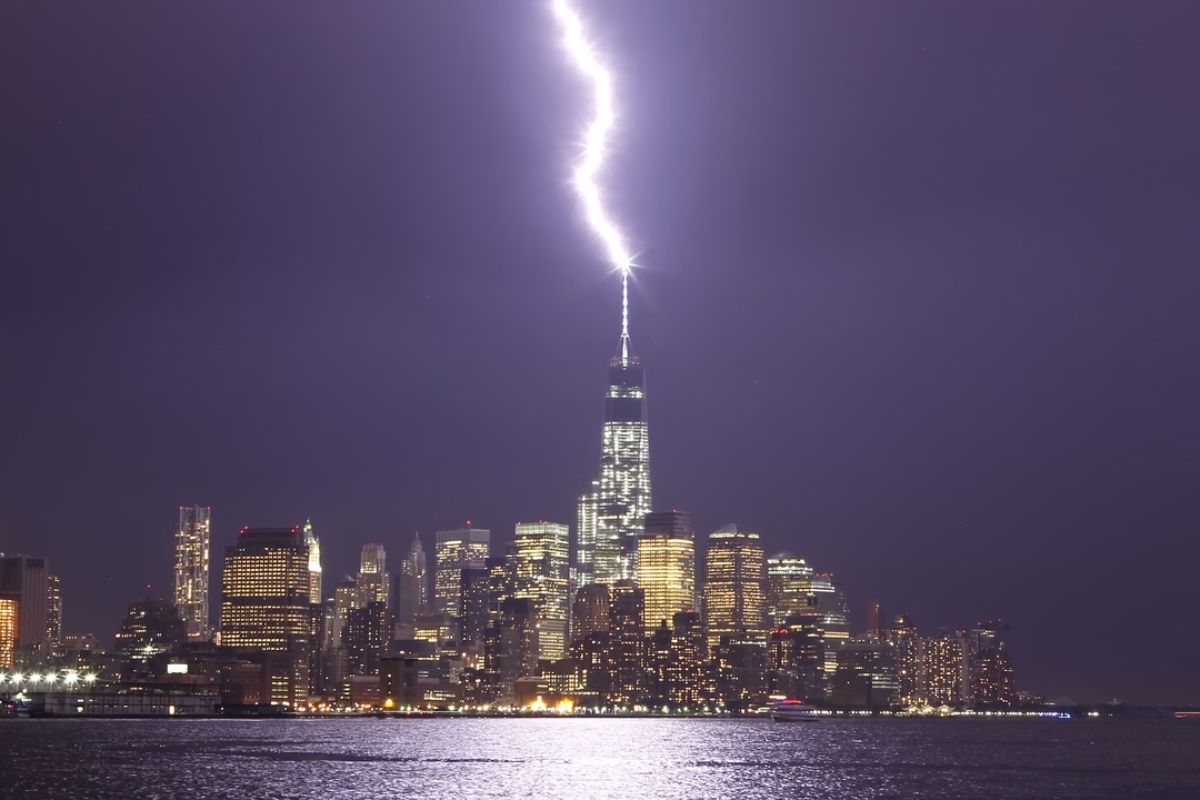
Understand The Technology Created By Benjamin Franklin That Attracts And Safely Conducts The Energy Of A Lightning Strike, Protecting The Tallest Buildings In The World.
The image of a lightning strike hitting the top of a building is impressive. This electrical discharge can exceed 300 million volts, a colossal energy that needs to be controlled. For this, there is one of the most important inventions in engineering: the lightning rod at the top of a skyscraper.
Contrary to what many think, it is not just a simple metal rod. The protection of a modern building is a complex and integrated system, designed to provide a safe path for this natural force, dissipating its energy into the ground and protecting the structure and the people inside.
How The Discharge Of 300 Million Volts Is Formed Between The Cloud And The Ground
The origin of a lightning bolt lies in the static electricity generated within storm clouds. Collisions between ice and water particles separate electric charges, with the base of the cloud becoming negatively charged and the top positively charged. This separation induces a positive charge on the surface of the Earth just below, creating an electric potential difference that can exceed 300 million volts.
-
Neither Brazil nor the USA: China produces over 60% of the world’s farmed fish and accounts for about 40% of all global seafood, using industrial-scale aquaculture megafarms to influence the international market and supply billions of people.

-
Archaeologists opened the only Etruscan chamber never looted in 2,600 years and found four individuals lying on stone beds with 110 intact objects around them, and the inscriptions found in the tomb have not yet been deciphered because the Etruscan language is a mystery that science has not yet solved.

-
Health issues urgent alert for flu and calls for the vaccination of the elderly, children, and pregnant women this Saturday with Day D and drive-thru in Curitiba.

-
What seemed like waste has turned into a barrier, and now human hair collected from salons helps retain debris in the water of ancestral channels in Latin America.

The air, which is normally an insulator, cannot contain this tension. An ionized air channel, called a “leader,” begins to propagate from the cloud downward. As it approaches, the intense electric field pulls positive charges from tall objects on the ground, which emit their own ascending channels, the “connectors.” The lightning rod at the top of a skyscraper is designed to be extremely efficient in launching these connectors. When a leader and a connector meet, the circuit closes, and the main discharge, which we see as lightning, occurs.
The Invention Of Benjamin Franklin: The Creation Of A Safe Path For Lightning
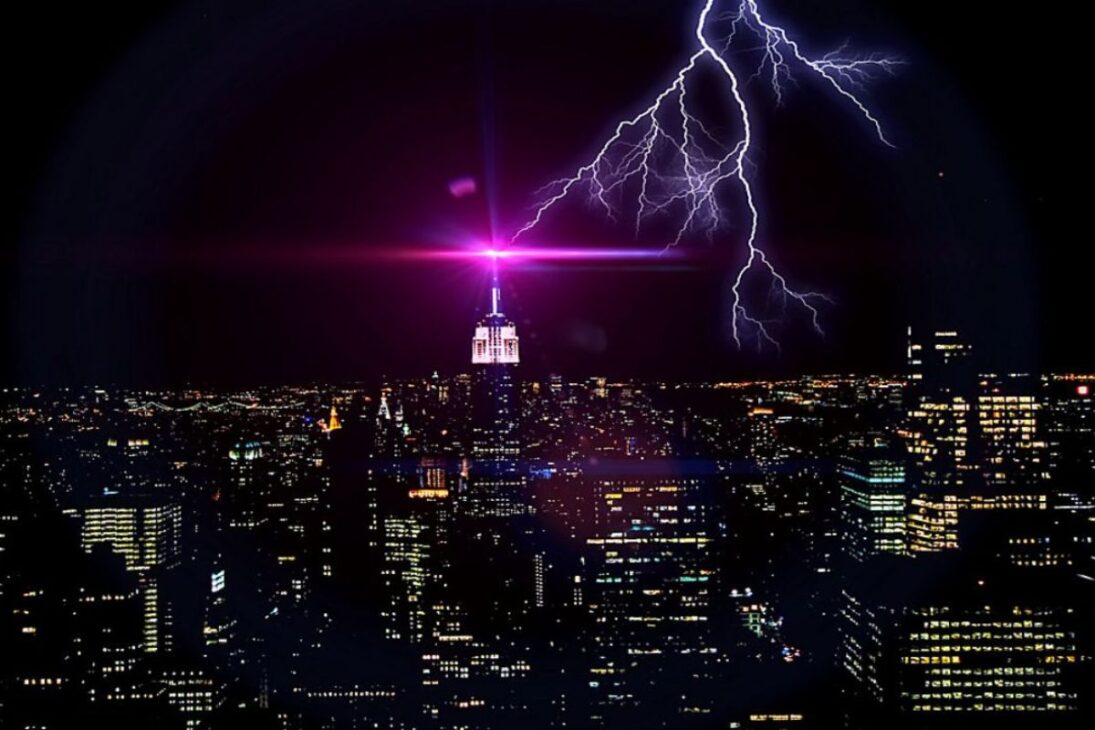
Before science, lightning was seen as a divine act. It was the scientist and inventor Benjamin Franklin who, around 1752, proved that lightning was an electrical phenomenon. With his famous kite experiment, he demonstrated that the electricity from clouds was of the same nature as static electricity.
Based on this discovery, he designed the lightning rod: a pointed metal rod mounted at the highest point of a structure and connected by a conductive wire to the ground. The idea was simple and genius: to provide a path of lower impedance, easier and safer, for the electrical discharge to follow, protecting the building from damage and fire.
The 5 Components Of The Modern Lightning Protection System
A common mistake is to think of the lightning rod at the top of a skyscraper as a single piece. In fact, modern protection is a Lightning Protection System (LPS), composed of five essential components that work together:
Aerial Terminals: are the metal rods (the lightning rods themselves) installed at the top and edges of the roof. Their function is to be the “sacrifice” point that will attract and receive the lightning strike.
Down Conductors: thick copper or aluminum cables that connect the aerial terminals and create a network around the building, conducting the electric current from the top to the ground.
Grounding System: is the most critical part. It consists of copper rods driven deep into the ground around the building. Its function is to safely dissipate the immense electrical charge of the lightning into the earth.
Equipotential Bonding: all large metallic components of the building (steel beams, pipes, air conditioning systems) are connected to the lightning protection system. This prevents the formation of dangerous electric arcs within the building.
Surge Protection Devices (SPDs): while the external system protects the structure, the SPDs protect electronics. Installed in power and data networks, they divert voltage spikes caused by lightning, preventing equipment from being damaged.
The Role Of The Skyscraper As A Faraday Cage
In addition to the installed system, the very structure of a modern skyscraper helps in protection. The skeleton of interconnected steel beams and columns functions as a “Faraday Cage,” a principle discovered by Michael Faraday in 1836.
A Faraday Cage is a conductive mesh that shields its interior from electric fields. When lightning strikes the lightning rod at the top of a skyscraper and its current flows through the conductors, the steel structure of the building acts as a second layer of defense, keeping occupants and equipment inside safe and electrically neutral.
How Many Times Is The Lightning Rod At The Top Of Skyscrapers Of Famous Buildings Hit Per Year?
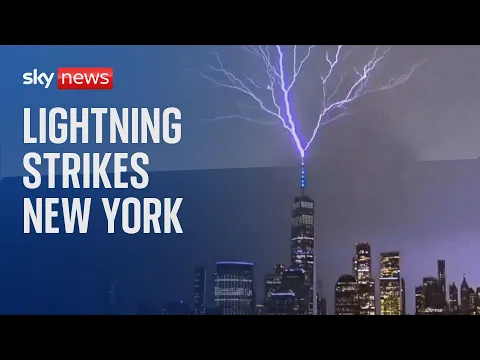

The effectiveness of these systems is proven by data from iconic structures around the world. The frequency with which they are struck demonstrates both the reality of the threat and the success of the protection.
- The Empire State Building in New York is struck an average of 25 times per year.
- The Willis Tower in Chicago was struck 38 times just in 2023.
- The Eiffel Tower in Paris acts as a giant lightning rod, being struck about 10 times per year.
These numbers show that the lightning rod at the top of a skyscraper is not just a theory, but an essential and highly effective technology that allows the largest structures in the world to coexist safely with one of nature’s most powerful forces.







-

Uma pessoa reagiu a isso.