





 Portuguese
  English
  Spanish
  4 min of reading
  5 comments


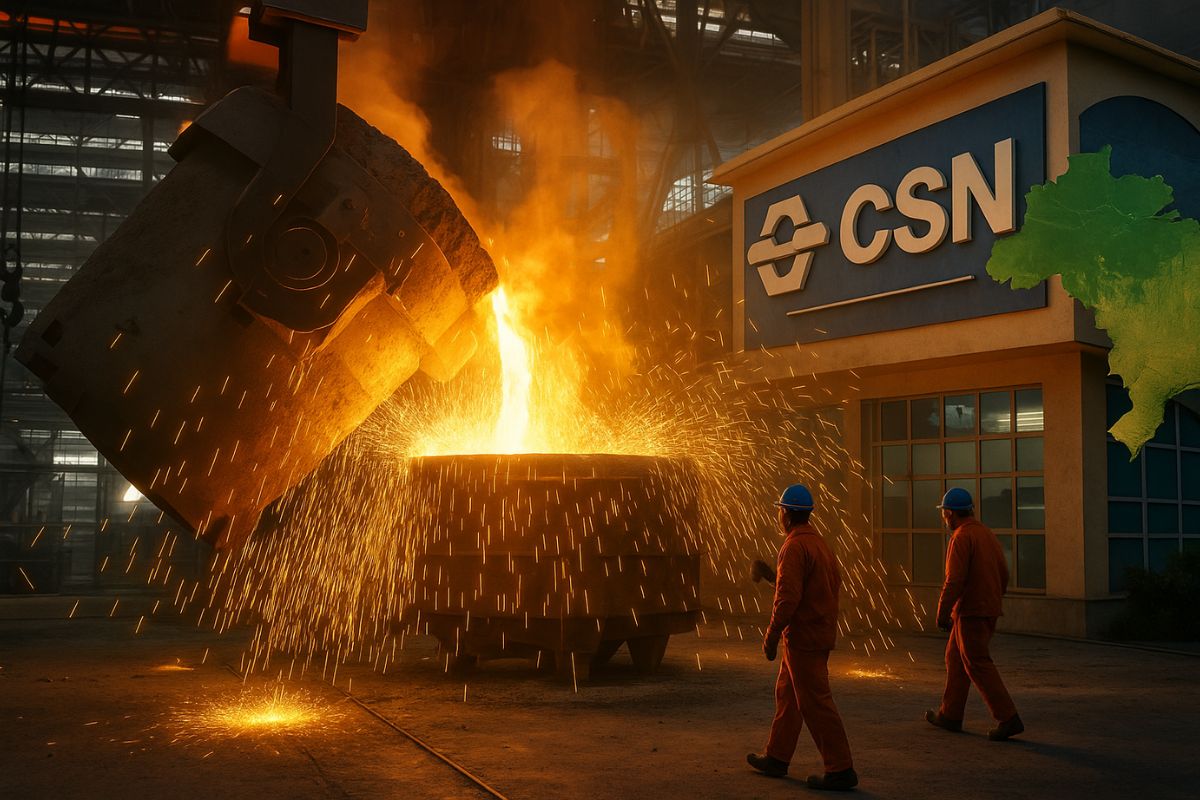


The Transfer Of Control Of The National Steel Company In April 1993, Part Of The National Privatization Program, Was An Event Marked By Legal Disputes, Protests, And A Complex Financial Engineering.
The Privatization Of CSN (National Steel Company), in April 1993, was one of the milestones of the restructuring process of the Brazilian economy in the 1990s. The auction that transferred control of the largest steel company in Latin America to the private sector ended a long and troubled process, which divided public opinion and redefined the base industry and the city of Volta Redonda (RJ).
The sale, completed for over US$ 1 billion, was made possible by the use of government debt securities and resulted in a deep restructuring of the company. The legacy of the process is complex, with distinct results for the company and for the local community that depended on it.
The Scene Of The 90s: Why Did The Government Decide To Privatize CSN?
The decision to carry out the Privatization Of CSN was part of a broader economic policy. In the early 1990s, the government of Fernando Collor de Mello created the National Privatization Program (PND), which aimed to sell state-owned companies to modernize the economy and reduce public debt. CSN was included in the program in 1992.
-
Spain surprises the world by erecting 62 artificial dunes, mixing sand with natural remains of posidonia, and causing the structure to lose only 1.4% of its volume in 1 year.

-
With 16 Bulava missiles, improvements in acoustic stealth, and a design focused on silent patrols, Russia’s nuclear submarine was born to ensure Moscow’s invisible retaliation and has become one of the pillars of its maritime strength.

-
‘Populous’ city in Rio among the worst in Brazil in national ranking and exposes silent development crisis.

-
Couple buys house in the South Zone of São Paulo, opens a hidden door in the garage, and finds a secret wine cellar with dozens of old wines forgotten since the 1970s.

With Collor’s impeachment, his successor, Itamar Franco, continued the program. The sale of CSN was maintained as one of the new government’s priorities, which deepened the privatization policy, including allowing a greater share of foreign capital in the auctions.
Chronicle Of A Troubled Auction: April 2, 1993

The day of the CSN auction at the Rio de Janeiro Stock Exchange was marked by high tension. The session began hours late, amid a heavy police presence to contain protests organized by unions and social movements opposed to the sale.
At the same time, a legal battle was unfolding, with various injunctions being issued to try to suspend the process. The opposition, however, was weakened by a deep division in the labor movement. A new board, aligned with the Labor Force and favorable to privatization negotiations, had won the elections at the Metallurgists’ Union of Volta Redonda, which reduced the strength of the movement against the sale.
The Financial Engineering: The Deal And The “Bad Dollars”
The controlling block of CSN, corresponding to 60.1% of the shares, was auctioned for US$ 1.057 billion. The method of payment, however, was one of the most debated points of the transaction. About 95% of the value was paid with the so-called “bad dollars”.
These “dollars” were old and illiquid government securities. The privatization model allowed buyers to acquire these papers on the market at a deep discount and use them to pay for the state company at their face value. In practice, it was a large operation of exchanging debt for equity, which significantly reduced the real acquisition cost for buyers and the influx of new money into the government’s coffers.
The New Steel Owners: Who Bought CSN?

The control of the “new CSN” was won by a consortium formed by the Vicunha Group, of the Steinbruch family, by the bank Bamerindus, and by Docenave, which at the time was a subsidiary of the state-owned Vale do Rio Doce.
The central figure that emerged from this process was businessman Benjamin Steinbruch, who took command of the Board of Directors. He led the transformation of CSN into an integrated conglomerate, expanding the business into the sectors of mining, logistics, cement, and energy.
The Legacy Of The Privatization Of CSN: The Impacts On The Company And The City
The Privatization Of CSN generated distinct results that are still subject to analysis today. For the company, the change in management led to an increase in efficiency and profitability. Data from IPEA (Institute of Applied Economic Research) showed that after the sale, the company’s sales grew by 81% and productivity per employee increased by 129%.
For the city of Volta Redonda, the social impact was profound. The productivity gains were accompanied by a process of mass layoffs. The workforce, which was 22,000 in 1989, was reduced to about 9,000 in 1997. For the city, which had its economy and identity entirely linked to the steel mill, the restructuring generated a social crisis and the end of the “company-town” model.








A csn dava um prejuizo de 2 bilhoes de reais por ano ao governo.por isso o desespero para venda.
Local onde os si di atos dominavam.
Foi uma privatização com prejuízo economico , social, para o governo, cidade e os funcionários que foram demitidos! A cidade tem vários imóveis abandonados. Um prédio com 16 andares, áreas grandes e terrenos que estão inativos há 32 anos!
Corrupção na privatização das três siderúrgicas do país!
Boa matéria, mas há outras implicações locais. Com a promessa de expansão da CSN privada, não só a planta industrial, mas a maioria dos terrenos vagos da cidade foram no pacote. A CSN não expandiu como prometido e usa esses terrenos sem função social para a especulação imobiliária e moeda de troca de dívidas.O metro quadrado se tornou caríssimo. A dívida nunca foi paga na íntegra apesar dos lucros crescentes e nem os passivos ambientais. Trata-se ainda de uma empresa sucata, que não investe o suficiente em produção sustentável ambientalmente, afetando severamente o território e a população local, com a convivência de órgãos públicos, como o INEA, órgão ambiental estadual.