





 English
  Francês
  Alemão
  Italiano
  Japonês
  Norueguês
  Portuguese
  Spanish
  8 min of reading
  0 comments


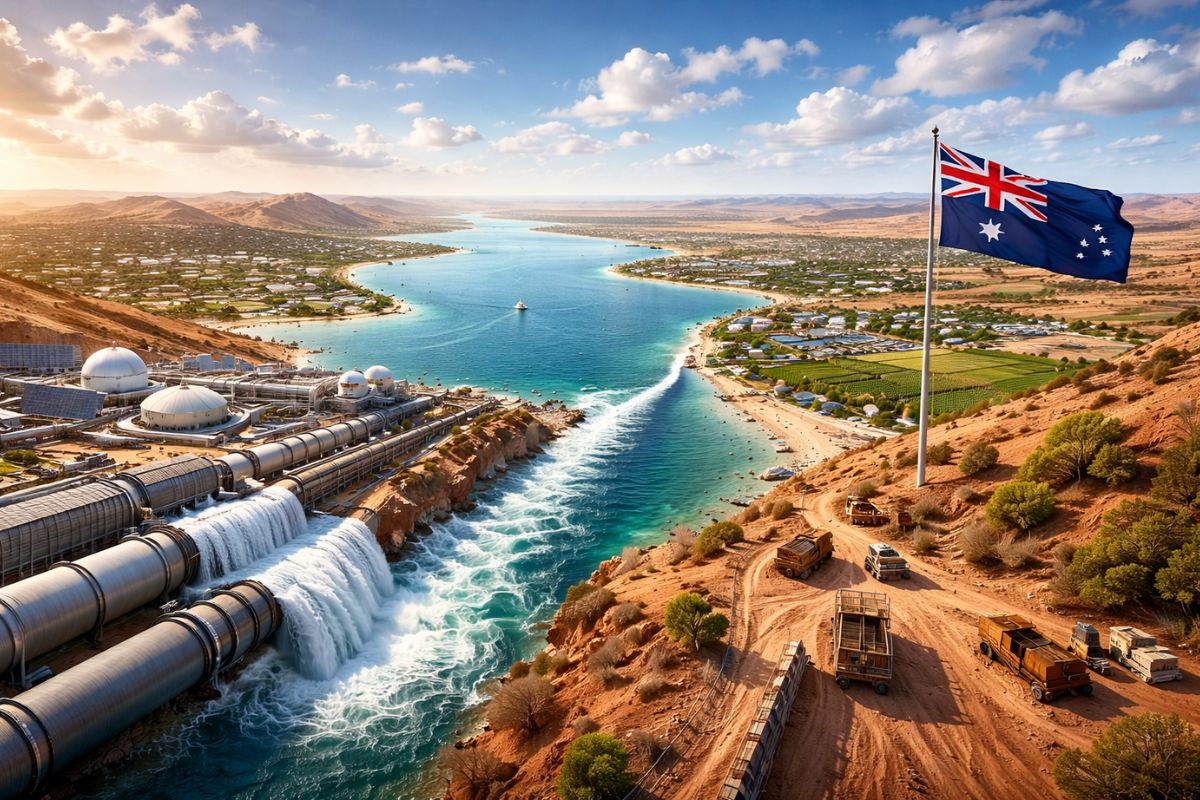
The idea of bringing water to the desert in the interior of Australia has returned to the debate with a proposal that mixes desalination, solar energy, hundreds of kilometers of pipelines, and the creation of an artificial sea in one of the driest and most inhospitable areas of the planet.
More than a plan to fill a natural depression, the water to the desert proposal attempts to address a strategic problem for the country: the population concentration on the coast, water scarcity in the interior, and the increasing pressure from extreme droughts, fires, and loss of productive capacity in a vast territory.
The strength of this idea lies in the contrast that defines Australian geography. Although the country is roughly the size of the continental United States, most of the population remains squeezed along the coastal strip, while the center is marked by extreme heat, poor soil, salinity, and vast infrastructure gaps. It is a country of continental scale with an interior that remains difficult to occupy on a large scale.
It was precisely this imbalance that fueled, for more than a century, the dream of redrawing the map. Instead of accepting the Outback as a permanent void, some engineers began to wonder if it would be possible to bring the sea inland and use this body of water to alter climate, irrigation, energy, and regional development.
-
Explorers find Roman treasure trapped between rocks on the seabed for nearly 1,600 years and reveal a desperate attempt to hide 53 gold coins during the invasions of the Empire.

-
Archaeologists discover Roman vase buried for over 2,000 years with more than 175 intact gold and silver coins, revealing a desperate strategy to protect wealth during the collapse of the Empire.

-
With 241 meters, 48 thousand tons, and a structure designed to accompany aircraft carriers at sea, the Chinese ship that refuels fleets in motion was born to push Beijing away from the coast and has become the hidden gear of its naval projection.
-
“Discreet” city in the interior of SP stands out among the smartest in Brazil thanks to a national ranking.

Australia has a lot of territory but little water where it is most needed
The starting point of the water to the desert proposal is the very geographical distribution of the country. More than 80% of the territory is sparsely or uninhabited, with vast semi-arid or desert areas, while almost the entire population lives squeezed along the coast, where the major cities and best ports are located.
In the heart of the country, the scenario is different. The Outback concentrates severe heat, little rain, salty soil, and enormous distances to basic services.
Living there means facing isolation, high costs, and an environment not conducive to dense occupation, which turns the lack of water into a problem that is not only environmental but also economic and strategic.
The plan began with an engineer who wanted to redesign the country
The idea of bringing water to the desert is not new. In the early 20th century, engineer John Bradfield, known for his role in the Sydney Harbour Bridge, envisioned a monumental project to redirect tropical waters from northern Queensland to the Australian interior.
The plan called for dams, tunnels, and canals extending over 2,000 kilometers to channel these volumes to the Kati Thanda basin, also known as Lake Eyre, a large natural depression that reaches about 15 meters below sea level.
The logic was simple in appearance and gigantic in execution: take water from where it is abundant and bring it to where it is scarce.
The promise was to change climate, irrigation, and occupation
In the original vision, bringing water to the desert could do much more than fill a lake. Bradfield imagined a large inland sea capable of cooling the regional climate, irrigating millions of hectares, attracting more rain, and stimulating new fronts of development in the heart of Australia.
For a country historically marked by recurring droughts, the idea seemed seductive. It offered a grand response to a chronic problem. It would not just be a hydraulic work, but an attempt to alter the logic of occupation of an entire continent.
The project began to crumble when the costs became clearer
As studies progressed, the proposal to bring water to the desert began to show significant weaknesses. Subsequent measurements indicated that Bradfield overestimated the volume of available water and also underestimated the losses due to evaporation in an extremely dry and hot interior.
Moreover, there was no evidence that this inland sea would actually bring a significant increase in rainfall. On the contrary, studies suggested that much of the water could simply evaporate without generating the climatic and agricultural benefits envisioned.
The dream was audacious, but the math began to show that nature might not cooperate as the project hoped.
The trauma of the Aral Sea reinforced the fear of an irreversible project
The idea of large-scale water surgeries lost even more strength when the world saw what happened to the Aral Sea in Central Asia. By diverting rivers for irrigation, the Soviet Union ended up devastating an entire ecosystem, raising salinity, destroying fisheries, and spreading toxic dust over a vast area.
This episode became a global alert about the risks of altering complex water systems without understanding all the consequences. In the Australian case, the lesson was direct. Interfering on a large scale with water, salt, and fragile ecosystems can produce an environmental disaster that is difficult to reverse, even when the initial intention seems rational.
The extreme drought brought the project back to the table

Decades later, the water crisis brought the proposal back into discussion. Starting in 2017, Australia faced a series of severe droughts, reservoirs at critical levels, collapse in inland communities, sacrifice of livestock, and devastating fires during the so-called Black Summer.
In this new context, the old idea of water to the desert gained a more modern guise. Instead of relying on rivers from the north, the new concept began to target the ocean directly, with large desalination plants on the coast, large-scale solar energy, and pumping water over more than 600 kilometers into the interior. The proposal shifted from looking at river transposition to viewing the sea as a permanent source.
The new plan aims to create a lake visible from space
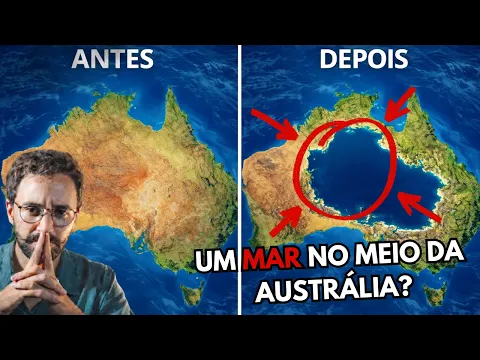
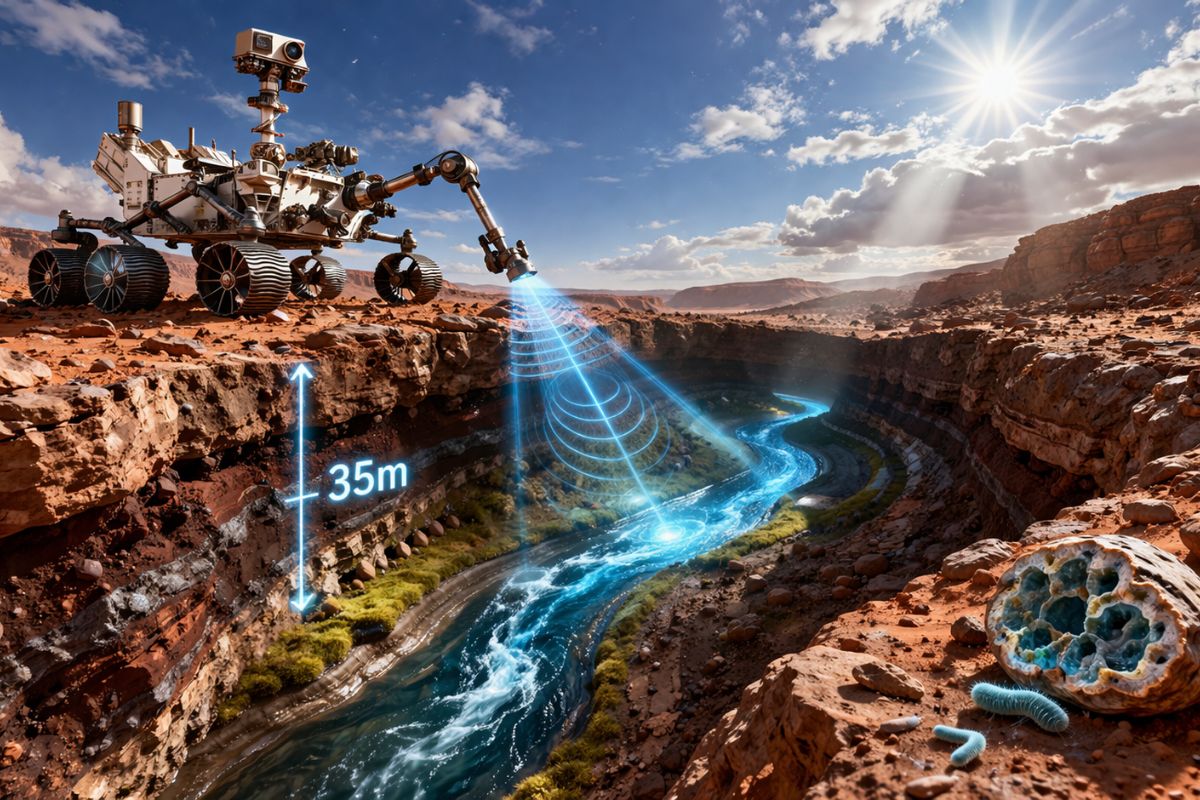
The latest version of the water to the desert proposal imagines pumping water, partly fresh and partly salty, into the Kati Thanda basin, where a large permanent lake would form. In the most optimistic scenarios, this body of water would be visible from space within a few years.
Proponents of the project argue that the new lake could alter the thermal dynamics of the region, increase humidity in the surrounding area, and pave the way for urban, agricultural, and tourism development.
In long-term horizons, they even talk about a semi-coastal ecosystem in an area currently dominated by dust, salt, and mirages. It is a vision of radical transformation, almost like creating a new coastline in the heart of the continent.
The cost could exceed $200 billion
The most evident obstacle to the water to the desert proposal is financial. Just the structure of pipelines, pumping stations, and desalination plants could easily exceed the $200 billion mark, not counting maintenance, energy, and equipment renewal.
This amount alone changes the debate. It is not a common project, but a generational bet that would require decades of execution and political commitments far beyond a single term.
It is the kind of project that tests not only engineering but also a country’s ability to sustain a massive choice for a long time.
The environmental risk remains enormous
Even with more advanced technology, the plan to bring water to the desert remains surrounded by environmental doubts.
The accumulated water would not be a conventional freshwater lake but something much closer to a hypersaline environment, with the risk of becoming a body of water that is difficult to use and even harder to control.
There is also the fear of salinization of the surrounding area, sterilization of soil strips, and the formation of an unstable system that could leave future generations with an almost irreversible problem.
Engineering can bring the water, but no one can safely guarantee the behavior of an artificial ecosystem of this scale over 50 years.
The proposal encounters a cultural and spiritual limit
Another central point is that Kati Thanda is not a void without meaning. For the Arabana people, the region holds sacred value and is linked to creation stories and cultural identity that span tens of thousands of years.
This completely changes the discussion. Permanently flooding the area would not only alter a remote landscape but also interfere with a territory laden with memory, symbolism, and belonging. Not every engineering solution can be measured solely by cost, scale, and economic potential.
The big question is whether it is better to bet on the megaproject or on thousands of smaller solutions
The economic criticisms follow the same logic. With an amount equivalent to that of a single megaproject, it would be possible to spread thousands of smaller solutions across the country, with distributed desalination, water reuse, local water infrastructure, drought-adapted agriculture, and direct support to vulnerable communities.
Proponents of the proposal argue that the time for timid responses is over and that the climate crisis demands boldness on a continental scale. Australia, in this reasoning, needs to think like someone facing a historical challenge, not just a specific problem.
Ultimately, the discussion opposes two visions of the future: one focused on a transformative bet and the other based on many smaller, less risky responses.
The inland sea is still an idea, but it has already become a serious debate
For now, the plan to bring water to the desert remains in the realm of simulations, impact studies, climate projections, and long-term discussions.
There is no ongoing project, but the proposal has returned to the debate because it touches on real and urgent issues about drought, climate, occupation, and national resilience.
That is what makes the idea so powerful and so unsettling at the same time. It seems like science fiction, but it arises from a concrete problem. And precisely for that reason, it continues to provoke fascination, fear, and divergence.
Australia has not yet decided whether it wants to create an artificial sea in the interior, but it has already made it clear that the desert is once again seen as a problem that can be faced radically.
Would you bet on a project to bring water to the desert and try to redesign the interior of Australia, or do you think that money would make more sense in smaller, less risky solutions?




Seja o primeiro a reagir!