





 Portuguese
  English
  Spanish
  4 min of reading
  0 comments


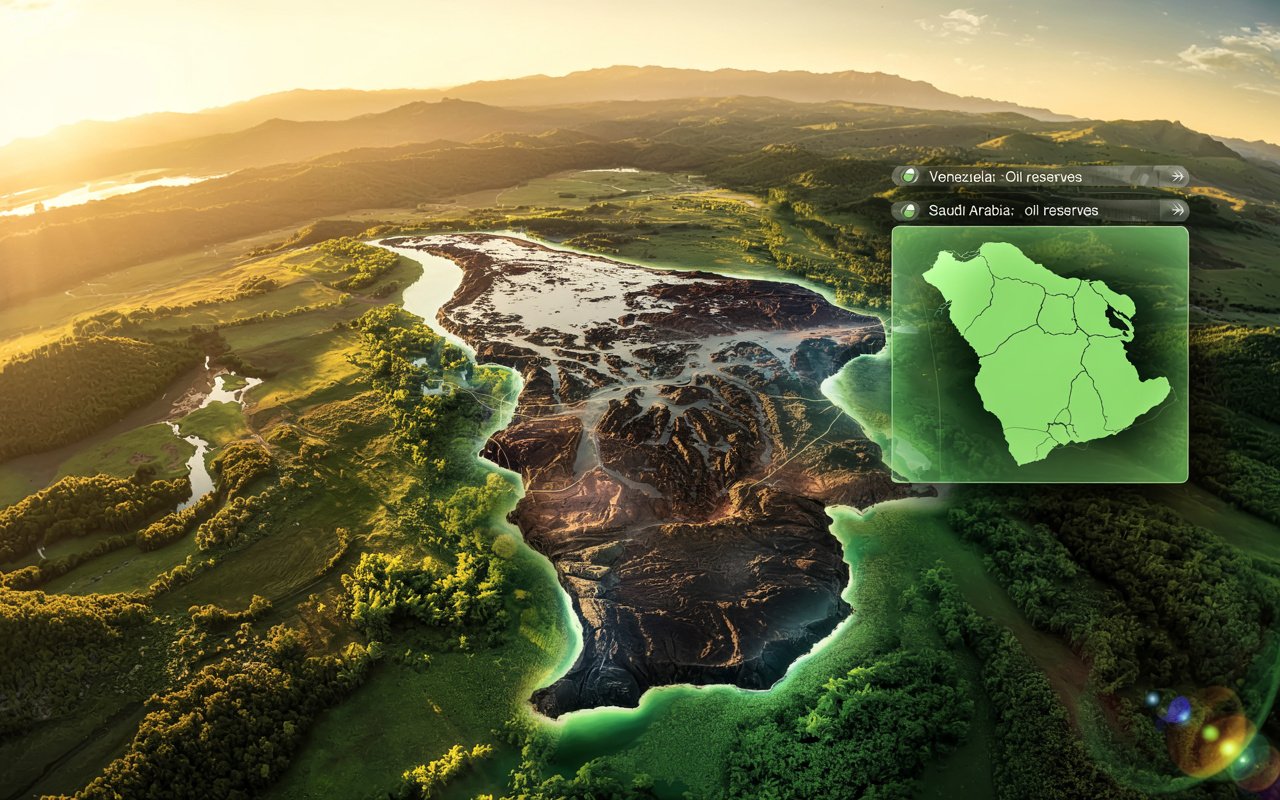
Venezuela Has More Oil Than Saudi Arabia, But Produces 12X Less. Understand Why the Orinoco Belt, the World’s Largest Reserve, Is Stalled — and What This Reveals About the Future of Energy in Latin America.
In the heart of Latin America lies a region with more oil than all of Saudi Arabia. This is the Orinoco Oil Belt, in eastern Venezuela — a land stretch of over 55,000 km², where 300 billion barrels of proven recoverable oil rest. This is more than Saudi Arabia’s 267 billion, according to data from OPEC and the U.S. Energy Information Administration. The Orinoco is, officially, the largest oil reserve on the planet. However, this subterranean wealth coexists with a paradox: Venezuela, even sitting on this energy treasure, currently produces only 770,000 barrels per day. A minuscule figure compared to the 12 million barrels/day from the U.S., 10 million from Saudi Arabia, or even the 3.6 million daily barrels from Brazil.
The Origin of a Slumbering Energy Powerhouse
The history of the Orinoco Oil Belt officially begins in 1936, when the American company Standard Oil of New Jersey drilled the first well in the region: the famous “La Canoa-1”, in Anzoátegui state. Since then, it became clear that the reddish soil of eastern Venezuela concealed something the entire world desired: oil — in unprecedented quantities.


But this is not just any oil. What is extracted from the Orinoco is extra-heavy oil, dense, viscous, and difficult to process. This requires complex refining, mixing with diluents, special transportation, and expensive infrastructure.
-
The rise in oil prices could ensure an extra revenue of R$ 100 billion for the Federal Government, indicates a recent economic study.

-
Naturgy begins an investment of R$ 1.6 million to expand the gas network in Niterói and benefit thousands of new residences and businesses.

-
A major turn in the Justice system suspends tax increases and directly impacts oil and gas companies in Brazil by affecting costs, contracts, and financial planning, leaving uncertain what could happen to the sector if these costs had increased.

-
Brava Energia begins drilling in Papa-Terra and Atlanta and could change the game by reducing costs in oil while increasing production and strengthening competitiveness in the offshore market.

Still, the country enjoyed decades of prosperity with this wealth. During the 1990s and early 2000s, Venezuela produced over 3 million barrels per day, being one of the leaders of OPEC.
How the Country with the Most Oil in the World Fell to 21st Place in Production?
The decline of Venezuelan production has multiple causes. Firstly, years of technical neglect with the state-owned PDVSA and lack of maintenance in refineries and pipelines created severe logistical bottlenecks.
Secondly, the exodus of qualified engineers and technicians due to the economic crisis and insecurity. Lastly, international sanctions, especially from the United States, isolated the country from the global oil trade.
Even with the largest reserves on the planet, Venezuela today is behind Colombia in production volume. In 2024, according to OPEC data, the South American country ranks as the 21st largest oil producer in the world, a number that starkly contrasts with its standing in reserve rankings.
Is Oil Still a Strategic Asset?
Despite the ongoing energy transition, oil is still fundamental to the global economy. In 2023, the world consumed over 100 million barrels per day — and the expectation is that this demand will only start to drop significantly from the 2030s.
In this scenario, Latin America resurfaces as a hub of global energy interest. Venezuela, with its vast Orinoco Belt, represents a strategic asset — but also a missed opportunity.
Other countries in the region experience very different moments:
- Guyana, Venezuela’s neighbor, saw its GDP grow over 33% in 2023 due to offshore oil exploration begun in 2015, in partnership with ExxonMobil.
- Brazil climbed to the 8th position in the producer rankings, with strong production growth in the pre-salt.
- Mexico maintains a solid presence in the market, holding the 11th global position.
Why Does the Orinoco Still Attract Global Attention?
Despite decades of crisis, the Orinoco Oil Belt is still coveted by multinationals and foreign governments. Its geostrategic importance rests on three pillars:
- Unbeatable Volume of Reserves: more proven oil than any other country.
- Geographical Proximity to the U.S. and Caribbean, reducing logistical costs.
- Rapid Recovery Potential, should the political and regulatory environment stabilize.
In October 2023, the U.S. temporarily lifted sanctions on Venezuelan oil for six months, opening a window for international companies to resume operations in the country. Some returned with modest plans. Others requested individual licenses to bypass the blockade, showing that even amidst chaos, Venezuelan oil remains relevant.
Can Venezuela Reenter the Game?
The answer depends on three factors:
- Foreign Investment: PDVSA alone lacks the capital and technical capacity to modernize its refining facilities, pipelines, and platforms. Partnerships with multinationals are vital.
- Political and Legal Stability: No company invests billions in a country without contractual guarantees, legal security, and regulatory predictability.
- Technological Innovation: Extracting and refining extra-heavy oil requires cutting-edge technology, such as steam injection, advanced cracking, and carbon capture.
The potential is there, beneath the land. What is lacking is unlocking access.
With Brazil, Guyana, Argentina, Mexico, and even Suriname advancing in new discoveries, Latin America seems to be experiencing a new race for black gold. But this race has a deadline: the global energy transition has already begun and promises to reduce dependence on oil in the next 20 to 30 years.
Thus, time is short. If countries like Venezuela do not take advantage of this last wave of rising prices and demand, they risk seeing their reserves become stranded assets — valuable only on paper.
The Orinoco Oil Belt represents a brutal paradox: the largest oil reserve on the planet beneath the soil of a country that can hardly produce it. If well exploited, Venezuelan oil could still be a driving force for national recovery and a new energy engine for Latin America.
But for that, the country will have to face its own ghosts: corruption, inefficiency, isolation, and instability. Time is running out — and oil, while still valuable, may soon cease to be the main player.








Seja o primeiro a reagir!