





 Portuguese
  English
  Spanish
  4 min of reading
  0 comments


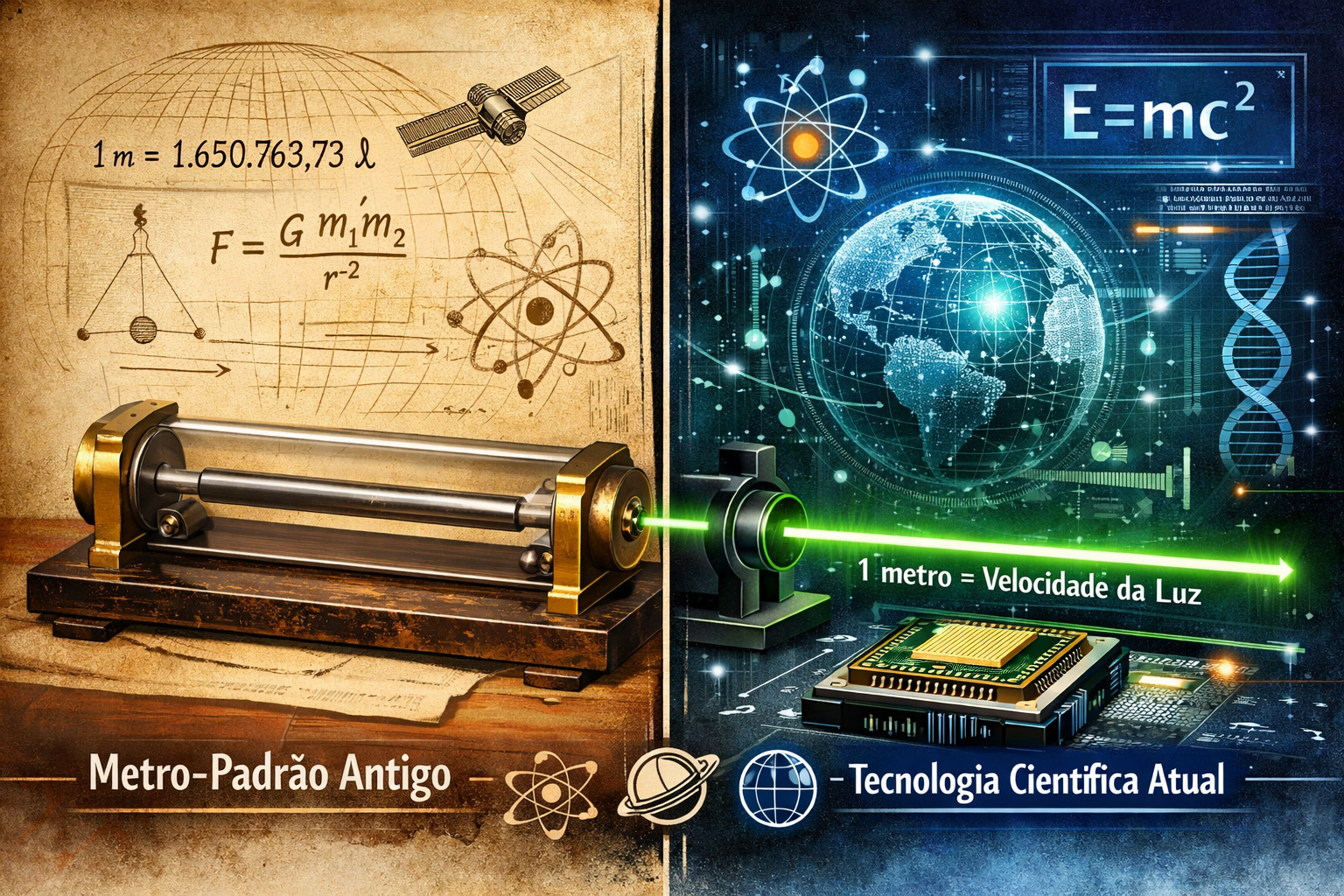
Born in the Chaos of the French Revolution, the Metric System Replaced Thousands of Confusing Measures, Faced Popular Resistance, and Ended Up Shaping Modern Economy, Engineering, and Global Science
The history of the decimal metric system begins discreetly, yet with a profound impact. In Paris, on the facade of the Ministry of Justice, a small marble plaque displays a horizontal line and the word “mètre.” At first glance, it goes unnoticed. However, this detail represents one of the greatest transformations ever made in the history of humanity.
This landmark integrates the ancient “mètre étalons,” standard meter bars scattered around the city for over 200 years. During that time, France attempted to impose a universal way to measure distances, weights, and volumes. In this context, measuring ceased to be a local habit and became a scientific, political, and social project.
Measuring seems like a simple task. However, precisely because it appears banal, it hides complex and controversial stories. This information was published by BBC Travel, in a report signed by Madhvi Ramani, based on historical and scientific research about the origin of the decimal metric system.
-
Spain surprises the world by erecting 62 artificial dunes, mixing sand with natural remains of posidonia, and causing the structure to lose only 1.4% of its volume in 1 year.

-
With 16 Bulava missiles, improvements in acoustic stealth, and a design focused on silent patrols, Russia’s nuclear submarine was born to ensure Moscow’s invisible retaliation and has become one of the pillars of its maritime strength.

-
‘Populous’ city in Rio among the worst in Brazil in national ranking and exposes silent development crisis.

-
Couple buys house in the South Zone of São Paulo, opens a hidden door in the garage, and finds a secret wine cellar with dozens of old wines forgotten since the 1970s.

The Chaos of Measures Before the French Revolution
Before the end of the 18th century, the world was in true chaos regarding measures. Each country adopted its own standards. Furthermore, within the same territory, towns and cities used different units. In France, estimates suggest the existence of thousands of measures circulating simultaneously.
This scenario created confusion, hindered commerce and favored abuses. For this reason, merchants often deceived consumers simply by changing the ruler used. Consequently, standardization became an urgent demand from the population.
With the French Revolution, which began in 1789, the revolutionaries decided to go beyond the overthrow of the monarchy. They sought to rebuild society from the ground up. In this process, they altered customs, laws, calendar, and, naturally, the system of measures.
At the same time, the revolutionary leaders attempted to implement the so-called decimal hour, with days of ten hours. However, this proposal quickly failed. Nevertheless, decimal logic remained alive. Therefore, it served as the basis for the new system of measures.
Science Steps In to Define the Meter

The revolutionaries entrusted the creation of the new system to the leading scientists of the Enlightenment. They rejected standards based on local traditions. Instead, they advocated measures based exclusively on nature.
Thus, they decided that the meter would correspond to one ten-millionth of the distance from the North Pole to the Equator. To achieve this value, it would be necessary to measure an arc of the Earth’s meridian. In this context, they chose the meridian of Paris.
Two astronomers led the mission. Jean-Baptiste-Joseph Delambre headed north, while Pierre Méchain advanced southward, to Barcelona. They used modern triangulation techniques and high-precision instruments for the time.
Initially, the project was supposed to last one year. However, it ended up extending over seven years. During this period, France faced extreme political instability. Nevertheless, the scientists persisted. Frequently, authorities confused them with spies. Still, they continued their work.
In 1799, they finally presented the results. From these results, the scientists created a platinum bar exactly one meter long. This object became the official standard of the decimal metric system.
The Pantheon of Paris played a central role in this process. In addition to serving as a geodetic point, the site stored old weights and measures sent from all over France, awaiting replacement by the new standard.
Popular Resistance and Global Consolidation of the Metric System
Despite the scientific rigor, the population strongly resisted the new system. The old measures were tied to customs, local economies, and daily life. Fabrics, for example, followed the width of regional looms. Agricultural land was measured by the time needed to cultivate it.
In light of this, the government reacted with intense regulation. Still, rejection persisted. For this reason, in 1812, Napoleon allowed the use of traditional measures again, even while maintaining the teaching of the metric system.
However, this decision did not last forever. With the advance of industrialization, the need for precision increased drastically. Moreover, the great World Fairs demanded clear standards to compare inventions and structures.
Consequently, the metric system became indispensable. In 1840, France reinstated it officially. From then on, other countries began to adopt it gradually. The Eiffel Tower, built in 1889, symbolized this new era of precision and standardization.
This movement led to the creation of the International Bureau of Weights and Measures (BIPM), located in Sèvres, near Paris. The institution began to ensure the uniformity of seven fundamental units, including meter, kilogram, and second.
Over time, the system evolved further. The meter ceased to depend on a physical object. Instead, it became defined by the speed of light in a vacuum. The kilogram followed a similar path, being redefined by universal physical constants.
Finally, the metric system achieved its original goal. It became truly universal, precise, and accessible. Today, it sustains the modern economy, enables high-precision science, and connects markets on a global scale.
Have you ever stopped to think about what the world would be like today without a single, universal system of measures?








Seja o primeiro a reagir!