





 Portuguese
  English
  Spanish
  4 min of reading
  0 comments


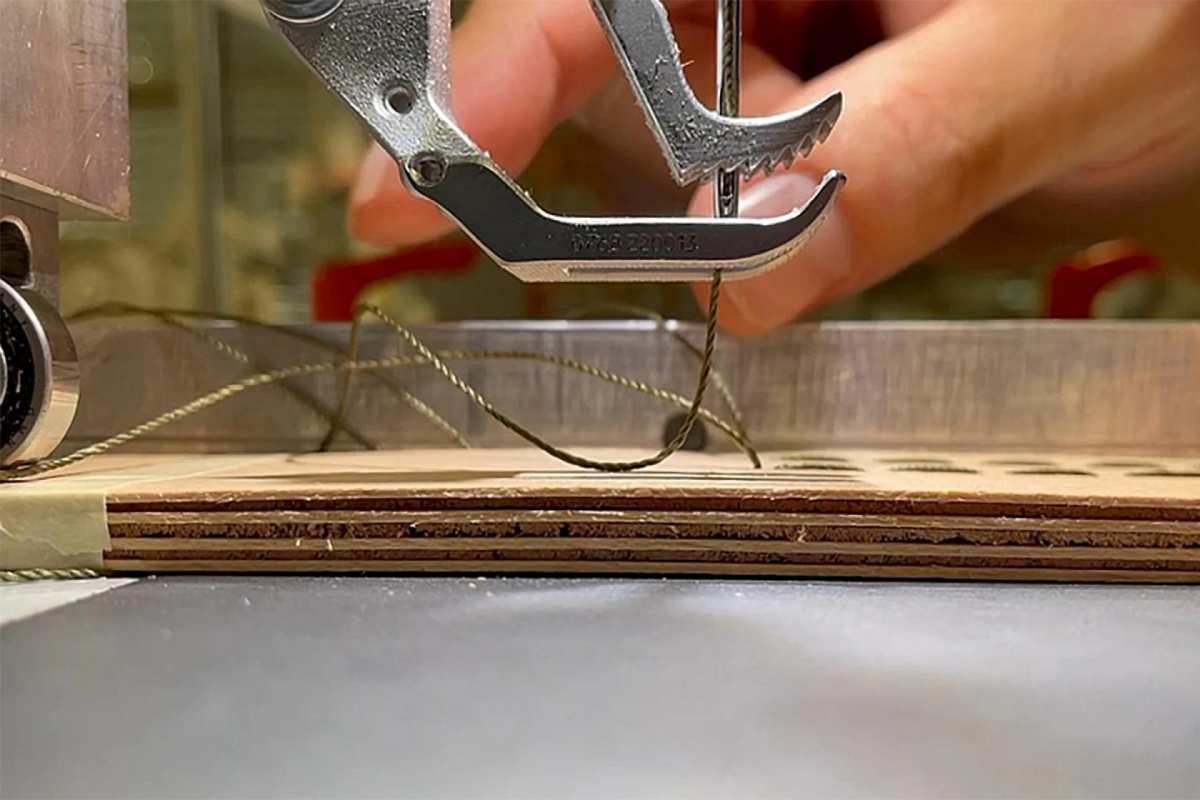
The new technique developed by Austrian scientists reinforces wood with nylon thread in critical areas, increases separation resistance by up to four times, and multiplies the energy required for fracture by 14, with the potential to reduce adhesives and accelerate industrial production.
Engineered wood has gained a new reinforcement developed by Austrian scientists, who began stitching it with nylon thread to make it up to four times more resistant to separation and 14 times more durable against fractures.
The technique was created to address an old limitation of this material in lightweight and structural applications, such as furniture, vehicle interiors, architectural solutions, and sports items.
The innovation was developed by a team from Graz University of Technology in Austria, which used needles, nylon thread, and conventional industrial machines to reinforce precisely the most critical areas of the wood.
-
The gigantic steel shell built to contain Chernobyl for a century has been pierced by a drone, exposing a critical system and creating a hole that could cost over 500 million euros to repair.

-
Brazilian Navy reaches a new level by taking over an airport with a 1,600-meter runway used by 1,800 military personnel and autonomous attack drone testing.

-
The Himalayas continue to grow to this day, with tectonic plates advancing 5 cm per year, mountains rising up to 10 mm annually, and the 2015 earthquake that killed 9,000 people may have increased the risk of an even larger seismic mega-event.

-
At an altitude of 400 km by astronauts from the International Space Station, Paris transforms at night into a golden mesh so precise that it reveals the outline of the Seine River, avenues, and entire neighborhoods like a luminous map drawn over the Earth.


The focus is on points where failures typically begin, especially under tension perpendicular to the fibers, a condition where delamination occurs, leading to the separation of layers.
In mechanical tests conducted by the team, the stitched panels withstood up to four times more load under takeoff conditions.
The energy required for the material’s rupture also increased by 14 times, indicating not only greater resistance but also a higher capacity to absorb impacts before breaking.
Stitched wood enhances resistance in the most critical areas
Laminated wood already occupies an important space in sectors where weight reduction is crucial, but its fragility in certain directions has always been a significant technical obstacle. The method developed in Graz aims to overcome this limitation by reinforcing edges, joints, and areas subject to concentrated stresses.
In these locations, the stitched reinforcement showed a clear advantage without adding significant weight or excessively increasing the complexity of the component. In segments such as sports and automotive, this gain can represent the transition from a conventional product to a more optimized solution.
The technique was not presented as a universal answer for the entire surface of the piece. Its use is more effective in localized areas with high tension, while other methods continue to be considered viable for large surfaces.
Technique may reduce the use of adhesives and chemicals
One of the most relevant points of the new solution is the possibility of partially or even completely replacing synthetic resins and adhesives used in the laminated wood industry. These materials are widely used in bonding the layers, but many derive from petroleum and are associated with emissions in the production process.
With stitching, the structural logic approaches that of reinforced concrete, where an additional element helps redistribute internal forces.
In this case, the stitched thread takes on this role within the wood, helping to contain stresses and delay failures.
The change also has implications in indoor environments, such as homes, furniture, and vehicles, where the chemical load of materials can influence air quality. Additionally, the process eliminates the typical curing time of adhesives, allowing for faster manufacturing, lower energy consumption, and fewer industrial bottlenecks.
Special needles and nylon thread were decisive
The development of the technique required more than just drilling and stitching the wood. The team needed to carefully study the interaction between the material, the thread, and the needle, especially to avoid cutting the fibers during the process.
To achieve this, needles with triangular tips were created to displace the fibers instead of breaking them. This detail was treated as crucial to preserve the integrity of the material and ensure that the reinforcement actually increased the performance of the wood rather than creating new points of weakness.
The nylon thread also played a central role by offering a balance between rigidity and deformation capacity. This combination allows for tension absorption without abrupt rupture, favoring the structural behavior of the piece in stress situations.
Process uses existing machines and expands design possibilities
Another highlighted aspect is the compatibility of the method with already available industrial machines. Production can be carried out at speeds between 1 and 2.5 meters per minute, with thicknesses of up to 20 millimeters, which expands the possibility of adoption without requiring a complete transformation of the manufacturing infrastructure.
The technique also allows for the joining of wood to other materials, such as metal sheets, and opens new possibilities in structural design. Among them are flexible joints, incorporation of fabrics as hinges, and creation of foldable structures, which expands the field of wood use in more complex projects.
Prototypes such as transportable bridges and foldable benches have already been tested, combining strength and mobility.
The expectation is that wood reinforced in this way can contribute to lighter and more efficient constructions, modular structures with lower logistical impact, lighter vehicle interiors, and more durable and repairable products, although the technology still depends on adjustments, additional testing, and industrial adaptation.
More information at TU Graz.








Seja o primeiro a reagir!