





 English
  Francês
  Alemão
  Italiano
  Japonês
  Norueguês
  Portuguese
  Spanish
  3 min of reading
  0 comments


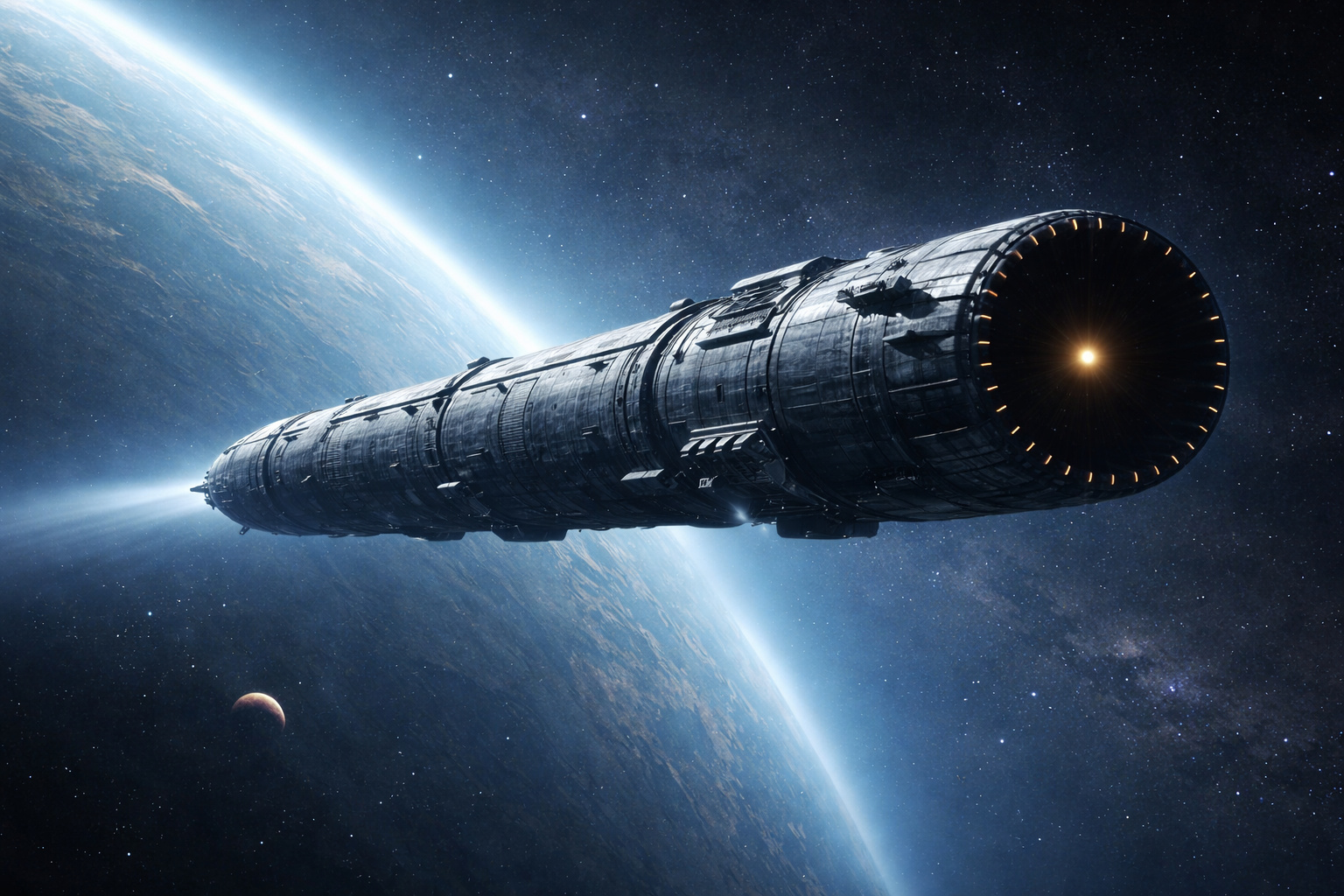
Project developed by the Initiative for Interstellar Studies describes a self-sustaining space city heading towards the Alpha Centauri system
An advanced proposal for space exploration was presented throughout the 2010s, drawing attention in the scientific field. Furthermore, the Chrysalis spacecraft was designed to carry up to 2,400 people on a journey estimated to take 400 years to the Alpha Centauri system.
The project was developed from the Project Hyperion, led by the Initiative for Interstellar Studies, which proposes a self-sustaining society in space. At the same time, the mission’s destination would be the exoplanet Proxima Centauri b, considered promising for future colonization possibilities.
Thus, the concept combines engineering, biology, and social organization, forming a structure capable of sustaining human life for several generations during a prolonged interstellar mission.
-
350-year mystery may have been solved: remains of a soldier who inspired the hero of The Three Musketeers found beneath a church in the Netherlands.

-
NASA photographed a nearly perfect square with 3 km sides on Mars, 13 times larger than the Great Pyramid of Giza, but the official explanation is natural erosion; still, no one has explained why the four sides have almost identical lengths.

-
Starlink breaks the barrier of 10,000 satellites in orbit and takes its expansion to an unprecedented level, with a direct impact on global internet, technological competition, and the race for space.

-
Japan finds an alternative to oil amid rising prices by transforming ocean balance into electricity with a new technology that maintains efficiency even when the sea changes.

Chrysalis structure combines advanced engineering and social organization
Initially, the Chrysalis was designed as a megastructure measuring 58 km in length, organized in rotating concentric modules. This way, these modules would allow for the generation of artificial gravity, reducing the physiological impacts of the journey.

Moreover, the modular design would facilitate repairs throughout the mission, being considered essential for long-duration journeys. Thus, the structure would maintain continuous operation even after decades of use.
Internally, the spacecraft would be organized like a functional city, with well-defined sectors to ensure operational efficiency. In this sense, it would include residential, industrial, and agricultural areas.
Chosen destination enhances the viability of the interstellar mission
Firstly, Proxima Centauri b was selected for being located in the so-called habitable zone of its star. Consequently, this condition increases the possibility of the existence of liquid water, an essential factor for life.
Additionally, its relative proximity within the Milky Way makes the mission more viable compared to more distant destinations. Thus, the planet becomes a strategic option within current limitations.
Therefore, the choice of destination considers both scientific and logistical factors, increasing the coherence of the project within a realistic scenario of space exploration.
Technological challenges still limit project execution
Despite this, although the concept is viable on paper, several technological challenges need to be overcome. Among the main critical points is controlled nuclear fusion, necessary for continuous energy generation.
Furthermore, the life support systems require complete recycling of air, water, and food for long periods. At the same time, the mission depends on continuous structural maintenance, using autonomous systems.
Simultaneously, the psychological preparation of the crew is essential to cope with prolonged isolation. Therefore, these factors represent significant barriers to the practical execution of the project.
Protection against space radiation is a priority in the project
At the same time, cosmic radiation is considered one of the greatest threats in long-duration space travel. In this context, prolonged exposure can cause cumulative cellular damage over generations.
To reduce these risks, the project foresees the use of advanced shielding, as well as self-regenerating materials. Technologies aimed at genetic repair of the crew are also being considered.
Thus, these solutions would increase the safety of the occupants throughout the mission, contributing to the viability of an intergenerational journey in deep space.
Concept expands debate on the future of humanity in space
Finally, the Chrysalis spacecraft represents a significant conceptual advance for intergenerational missions. Additionally, the project proposes new forms of social organization and survival outside Earth.
In this way, the proposal broadens the debate on space colonization, bringing new perspectives for the future of humanity. At the same time, it highlights the technical challenges still present.
Thus, when considering possibilities and limitations, the concept reinforces the importance of long-term planning for space exploration.
In light of this, can a 400-year mission really become a reality?







Seja o primeiro a reagir!