






 Portuguese
  Spanish


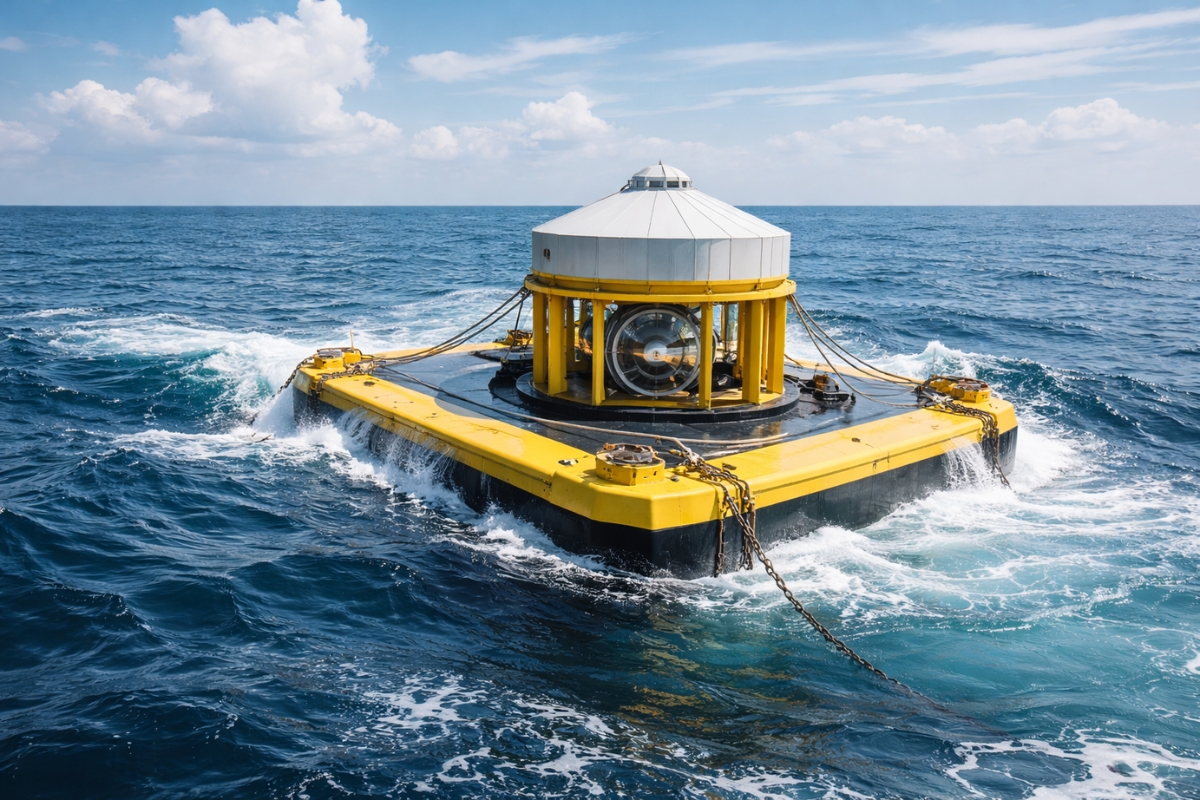


Japanese researchers designed a wave energy converter with a gyroscope and internal flywheel capable of achieving up to 50% theoretical absorption. The model is still experimental, but it points to a promising path to expand the use of this renewable source.
The search for new renewable sources has made significant progress in Japan. A floating system with a gyroscope has been designed to transform wave motion into electricity more efficiently, even when the sea changes in intensity and frequency.
The most important point is the attempt to solve an old limitation in this sector. Many devices perform well only under very specific conditions but lose strength when the behavior of the waves deviates from the norm.
Floating platform uses internal gyroscope to convert sea sway
The proposal starts from a floating body that tilts with the waves while a flywheel spins inside the equipment. This movement generates a controlled reaction capable of powering a generator and transforming the ocean’s sway into clean energy.
-
China Develops Custom 140-Ton Electric Mining Truck with 770 kWh Swappable Battery, Deploys 290 Units in Xinjiang’s Largest Zinc Mine

-
Meta to Launch Arena, a New Prediction App Targeting 3.56 Billion Users, Competing with Polymarket and Kalshi

-
Scientist Challenges Famous Human Evolution Theory, Argues Homo Sapiens Evolved Gradually Over Thousands of Years
-
15-Year-Old American Builds Ocean Generator with PVC Pipe and 3D-Printed Propeller for $12, Wins National Prize, Presents at White House, and Makes Forbes 30 Under 30 List




In practice, the idea is to harness an abundant and constant resource without relying on a single type of wave. This expands the potential use of the technology in maritime areas with variable conditions throughout the day.
Theoretical target of 50% expands the reach of wave energy

The strongest result of the study points to the possibility of reaching the classical theoretical limit of 50% absorption of wave energy. The difference lies in the fact that this yield is not tied to a single adjusted frequency.
This advancement is noteworthy because the biggest challenge of wave energy has always been maintaining high performance when the sea changes. If this adaptation works outside of theory, the sector could scale up significantly.
Takahito Iida aims for real-time control with two central adjustments
According to Takahito Iida, a researcher at Osaka University responsible for the study, the system relies on two main controls: the rotation speed of the flywheel and the generator load. With these adjustments, the equipment can respond to the behavior of the sea in real time.
This mechanism allows for the adaptation of energy conversion to different wave scenarios. Instead of performing well only at an ideal point, the proposal aims to maintain high yield over a broader operational range.
Simulations show gain, but large waves still reduce efficiency
The tests were conducted with simulations in the frequency domain and also in the time domain. The model also underwent scenarios with nonlinear responses to measure how far the proposal can withstand outside ideal conditions.
The result was promising, but with a clear limit. In real wave conditions, efficiency tends to drop, especially when the waves become larger and more difficult to control.
Costs, corrosion, and wear continue as barriers to the project
The system is still theoretical and does not detail the cost of keeping the gyroscope in continuous operation. This includes mechanical losses, auxiliary consumption, and the effort required to maintain active control of the equipment.
Known issues of offshore generation, such as corrosion, structural fatigue, and survival in harsh environments, also remain on the radar. These factors directly affect commercial viability and operational time.
Next step aims for physical tests outside the ideal environment
The next step will be to verify if optimal control continues to function when the behavior of the ocean becomes unpredictable. The intention is to take the proposal for trials with physical models and limits closer to real operation.
There is still an important gap for the future. The ceiling of 50% applies to certain theoretical scenarios, but different architectures and less symmetrical solutions may open up space for new gains.
Japan’s movement reinforces the race for renewable sources that work beyond solar and wind energy. If adaptation to variable seas advances, wave energy could stop being a promise and start competing for real space in the energy matrix.
More than an academic experiment, this proposal puts wave energy back at the center of the debate on energy innovation. By attempting to combine intelligent control and operational stability, the project changes the strategic outlook.






