





 Portuguese
  English
  Spanish
  4 min of reading
  0 comments


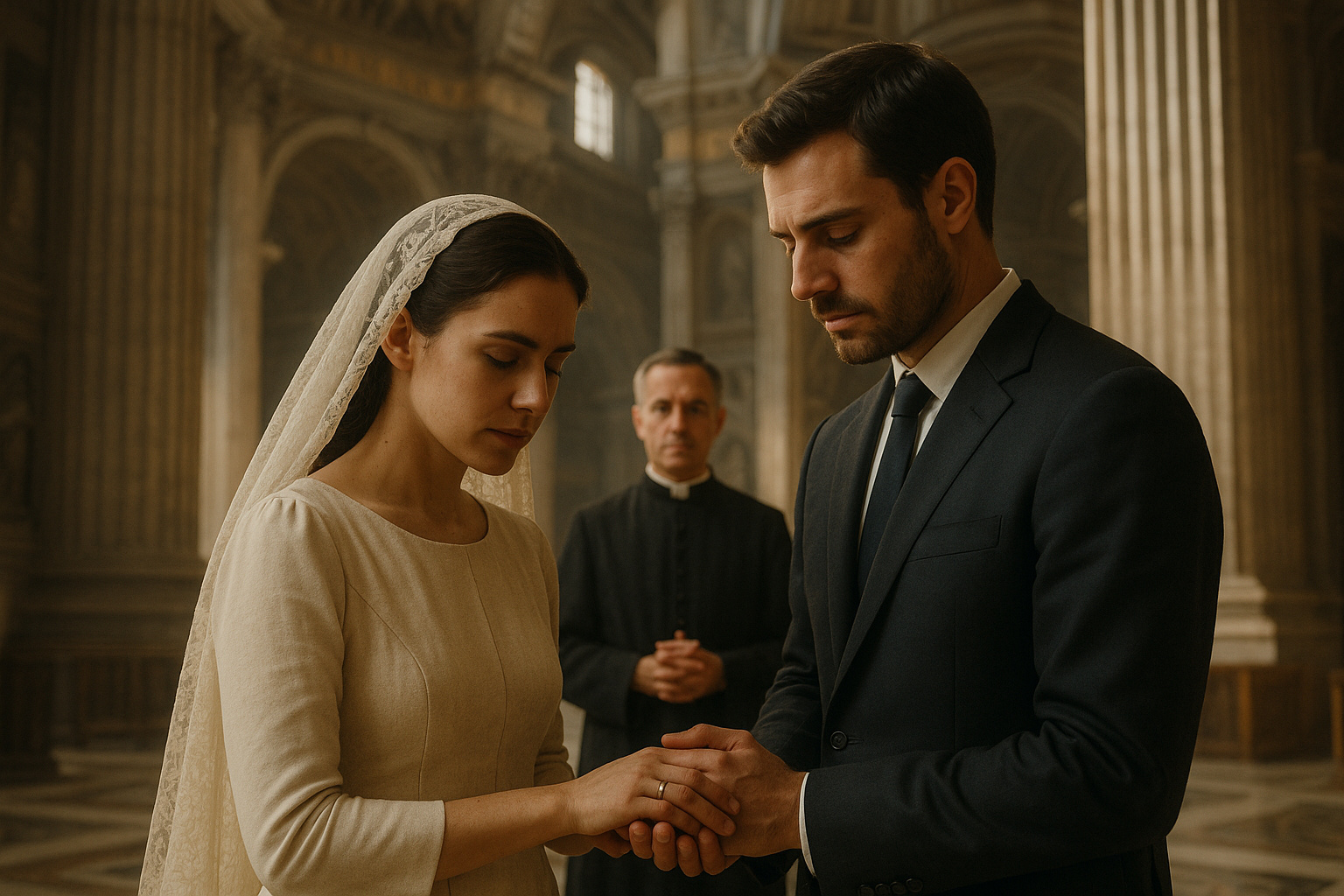
The New Decree Reignites Debates About Marriage, Exclusivity, and Divergent Cultural Practices in Various Regions of the World
The Vatican published a new decree last Tuesday (25) that redefines how the faithful should understand the meaning of marriage in Catholic doctrine. The guidance, approved by Pope Leo XIV, objectively reinforces that “one spouse is sufficient” for a lifetime, reaffirming that marriage must be an exclusive commitment between two people. As highlighted by CNN Brasil, which initially reported the information, the document reignites old discussions about practices of polygamy and multiple affective models that have been gaining traction in different societies.
Although the positioning does not represent a doctrinal break, the text consolidates the traditional view of Catholicism and guides its 1.4 billion followers to reject any form of multiple or simultaneous sexual relationships. Furthermore, the decree emphasizes that Catholic marriage is not merely a religious bond but a definitive pact that accompanies the faithful throughout life, sustained by the dignity, equality, and exclusivity of the couple.
The Vatican’s Position and the Focus on the “Wealth and Fertility” of the Marital Union
According to the document, the Church makes it clear that marriage requires a level of total commitment that cannot be divided with others. The text states that “every authentic marriage is a union composed of two people, requiring a relationship so intimate and all-encompassing that it cannot be shared with others,” reinforcing that exclusivity is part of the spiritual and human structure of the marital bond.
-
Furniture made with aluminum and glass does not warp and has become an alternative to replace MDF in Brazil.

-
Finland, the happiest country in the world, wants to hire 140,000 technology professionals and is eyeing Brazilians: visas are issued in just two weeks and salaries with a 37-hour workweek are surprising.

-
Mr. Mário reveals the technique of the caipira papaya: he cuts the fruit in half, discards the seeds from the tip, and plants the ones from the back to increase the chance of a productive female tree.

-
Few remember, but the submarine that disappeared in 1968 with 52 crew members was found after 51 years at the bottom of the sea at more than 2,000 meters, intriguing the entire world.

The decree also openly criticizes the practice of polygamy in African countries, including among some members of the Church itself, highlighting that such a model contradicts what the Vatican considers to be the essence of Christian marriage. At the same time, while acknowledging cultural changes in the West—such as the rise of polyamorous structures—the text asserts that these models are based on the “illusion that the intensity of the relationship can be found in a succession of faces.”
Moreover, the document highlights the “wealth and fertility” of traditional marriage, encouraging Catholics to seek not just a spouse but a lasting commitment that accompanies family and spiritual building.
Previous Discussions and Global Debates on Marriage, Polygamy, and Polyamory
The publication of the decree did not come out of the blue. The question of how to apply the Church’s guidance to marriage had already been discussed in two summits held in 2023 and 2024, convened by the late Pope Francis. The meetings brought together hundreds of bishops and cardinals to debate the future of the Catholic faith, including sensitive topics such as the rise of polygamy in Africa, where many Catholics still maintain more than one stable relationship, and the growth of polyamory in Western countries.
These discussions, as recalled in records released by CNN Brasil and other international publications, showed that the Church’s challenge is not only theological but also cultural and social. The diversity of affective practices around the world has made the definition of marriage even more complex and required clearer positioning from the Vatican.
Exclusivity, Lifelong Commitment, and Doctrinal Limits Within the Catholic Church
Even with the publication of the new decree, some topics remain untouched. One of them is divorce, which the Church does not recognize because it considers marriage a definitive commitment. However, the document reminds that there is the process of marriage annulment, which assesses whether a marriage was valid from the outset and allows the faithful to regularize their situation in cases of failures in celebration or consent.
The text also emphasizes that doctrine does not require people to remain in abusive relationships, reinforcing that the protection of human dignity is above any formality. The guidance, however, reinforces that the marital bond is only dissolved when the Church legally determines that it never existed legitimately.
This combination of preserving the Christian ideal and openness to evaluate exceptional cases represents, according to analysts cited in CNN Brasil’s coverage, an effort by the Vatican to balance tradition and pastoral sensitivity, especially in the face of social and cultural transformations experienced worldwide.
Decision Reinforces the Church’s Role Amid Global Social and Affective Changes
In a scenario where new types of relationships are gaining ground—from polyamory to multiple partnerships—the decree reaffirms the institution’s position on sacramental marriage. For the Vatican, exclusivity remains a fundamental pillar, not merely for moral reasons but because it believes this format sustains more stable, deeper, and respectful relationships.
The information was disclosed by CNN Brasil, which detailed excerpts from the document approved by Pope Leo XIV and echoed globally. Thus, by stating that “one spouse is sufficient,” the Vatican seeks not only to reaffirm its tradition but also to guide its faithful in a constantly changing world characterized by a plurality of affective and family models.
In the end, the decree aims to serve as a guide on what the Church considers an authentic union: an exclusive, equal, and continuous bond, built by two people committed to living a lifetime side by side without sharing that space with other partners.








-

-

5 pessoas reagiram a isso.