





 English
  Francês
  Alemão
  Italiano
  Japonês
  Norueguês
  Portuguese
  Spanish
  4 min of reading
  0 comments


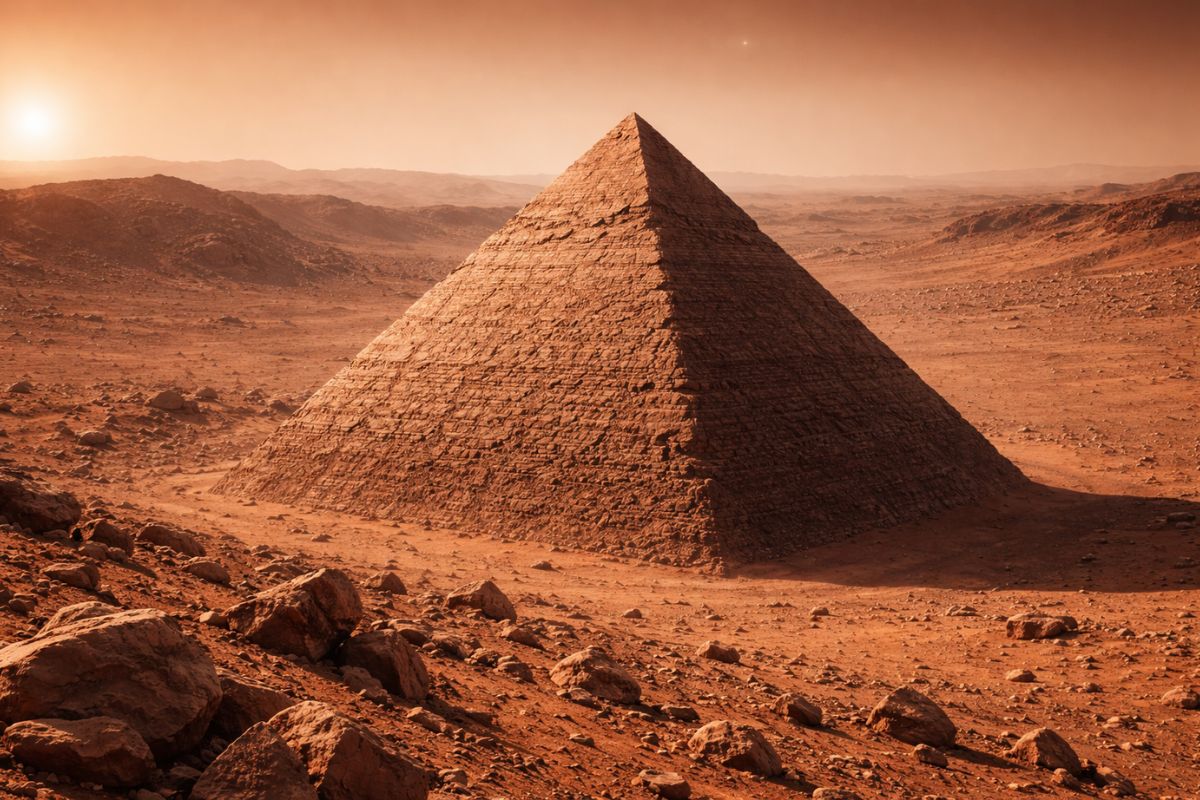
Known as the Candor tetrahedron, the rock formation on Mars is 290 meters in diameter and 145 meters high. Located in the Candor Chasma valley, the pyramid-shaped structure was photographed by satellites in 2002 and fuels debates about natural processes and misinterpretations of the Martian surface.
A geometric structure resembling a pyramid similar to those of Ancient Egypt draws attention not on Earth, but on Mars. The formation, known as the Candor tetrahedron, was identified from images captured by satellites that have been analyzing the Martian surface since the early 2000s. The earliest record of the phenomenon dates back to 2002, when NASA equipment photographed the area where the structure is located. Since then, the images have circulated widely and fueled debates about the possibility of artificial constructions on Mars.
The Candor tetrahedron is located in Candor Chasma, a valley on the red planet characterized by rock formations sculpted over millions of years. The structure is about 290 meters in diameter and reaches approximately 145 meters in height, dimensions that reinforce its grandeur and explain why so many people see similarities with the pyramids of Egypt. Despite its impressive appearance, experts dismiss any artificial origin. Science indicates that natural processes on Mars shaped this formation over geological time.
What is the Candor tetrahedron and where is it located on Mars

The Candor tetrahedron is a rock formation located in Candor Chasma, one of the canyons that make up the Valles Marineris canyon system on Mars. Valles Marineris is the largest known canyon system in the solar system, extending over 4,000 kilometers.
-
Seen from space, a colossal ‘Y’ cuts through the largest desert in China, blending a jade-filled river, red and white mountains, and revealing the absurd scale of the transformation of the Taklamakan surrounded by a green wall with billions of trees.

-
The Pacific Ocean reveals what the cliffs of Big Sur have hidden for millennia: Pfeiffer Beach, in California, features swirling purple sand formed by garnet crystals and displays a stone arch that is illuminated by the sun in winter for just a few days each year.

-
Aursjøvegen in Norway is a 100-kilometer gravel road that crosses chasms and dark tunnels carved into the rock at an altitude of 947 meters in the fjords and is only open for four months a year.

-
With about 4,000 m², the building constructed in a traditional neighborhood in France looks like a rainbow, has a colorful facade, mixes vibrant glass, and creates one of the most unusual visuals in Bordeaux.


Within this colossal valley, Candor Chasma stands out for its complex geological formations, sculpted over billions of years by processes such as water action, landslides, and intense winds.
It is in this geological context that the tetrahedron is situated. With a base diameter of 290 meters and a height of 145 meters, the structure stands out in the Martian landscape for its unusual pyramidal shape. The most detailed images were captured by the HiRISE camera aboard NASA’s Mars Reconnaissance Orbiter.
These records allowed researchers to analyze the formation with sufficient resolution to identify irregularities on the top and faces, details that help determine whether the structure is natural or artificial.
Why does the structure on Mars resemble the pyramids of Egypt so much
The similarity between the Candor tetrahedron and the Egyptian pyramids is not coincidental in the sense that both share simple geometric shapes. The human brain is programmed to recognize familiar patterns, a phenomenon that psychologists call pareidolia.
When we look at a rock formation with triangular sides converging to a high point, our brain automatically associates this shape with a pyramid. This happens regardless of whether the structure is on Earth or Mars.
The pyramids of Ancient Egypt, such as the Great Pyramid of Giza, are about 146 meters high, a dimension remarkably close to the 145 meters of the Martian tetrahedron.
This numerical coincidence has fueled speculation, especially on the internet, where theories about alien civilizations building pyramids have gained popularity. However, for the geologists studying Mars, the similarity is purely geometric and does not indicate any connection between the two structures.
What science says: natural processes that explain the pyramid on Mars
Experts dismiss any artificial origin for the Candor tetrahedron. The Candor Chasma region on Mars has undergone various natural processes over billions of years. The action of water, landslides, intense winds, and possible tectonic activity contributed to shaping the terrain and creating formations that, when viewed from above, may resemble regular geometric structures.
Differential erosion, where layers of rock with distinct resistances wear away at different rates, is one of the most likely mechanisms to explain the pyramidal shape.
Details observed in high-resolution images reinforce the natural explanation. The top of the structure shows irregularities, and the faces are not perfectly smooth or symmetrical. If it were an artificial construction, much greater regularity would be expected on the surfaces and edges.
For researchers studying the geology of Mars, the Candor tetrahedron is a fascinating example of how nature can produce shapes that appear designed, but are the result of millions of years of erosion and deposition.
The circulation of images and the debate between science and speculation about Mars
Since the first images of the Candor tetrahedron were released in 2002, the structure has become one of the most debated topics among space exploration enthusiasts. With the advancement of artificial intelligence and image editing tools, doubts about the authenticity of the material have arisen.
However, the original images are from NASA and are publicly available in the agency’s archives. There is no manipulation: the formation exists and is recorded in legitimate scientific data.
The debate between science and speculation about Mars is not new. The famous “Face on Mars,” photographed by the Viking probe in 1976, generated decades of conspiracy theories before later images revealed it to be a common rock formation.
The Candor tetrahedron follows the same pattern: a natural formation whose shape, viewed from a certain angle, resembles a human construction. For science, Mars remains a fascinating planet not for housing pyramids, but for the evidence that it once had liquid water, a denser atmosphere, and conditions that may have supported microscopic life in the past.
What do you think about this structure on Mars?









Seja o primeiro a reagir!