





 Portuguese
  English
  Spanish
  4 min of reading
  0 comments


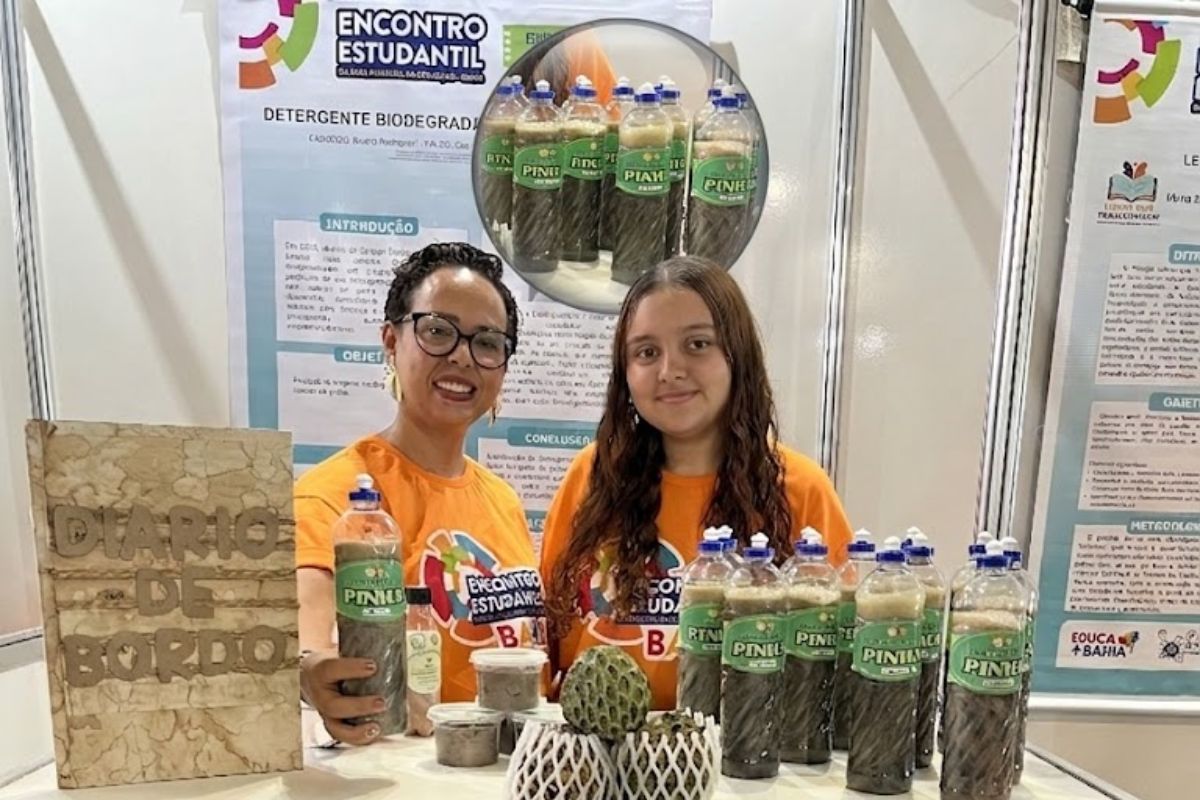
The biodegradable detergent made from soursop peel was developed by a student from Presidente Dutra, a city that produces 20 thousand tons of the fruit per harvest and uses natural saponins found in Annona squamosa as a cleaning agent in liquid and paste versions without aggressive chemicals to the environment.
According to the portal ba.gov.br, a student from the semi-arid region of Bahia discovered that the soursop peel, a waste discarded by the tons in the largest producing region of the fruit in Brazil, contains natural substances with cleaning properties. From this discovery, Beatriz Rodrigues, from the Leila Janaína Brito Gonçalves State School in Presidente Dutra, developed a biodegradable detergent based on soursop peel that works in both liquid and paste versions, without aggressive chemicals to the environment. The project was highlighted at the Student Meeting that gathered about 10 thousand students at Arena Fonte Nova.
The context makes the discovery even more relevant. Presidente Dutra is known as the world capital of soursop and produces about 20 thousand tons of the fruit per annual harvest, according to data from the Department of Agriculture. The soursop production chain is the main source of employment and income for the city, but it generates a huge amount of waste peels that until now had no economic destination. Beatriz’s biodegradable detergent transforms this agricultural waste into raw material for a sustainable product, closing a cycle that benefits both the environment and the local economy.
The scientific discovery behind the biodegradable soursop peel detergent
It all started with a challenge proposed by teacher Mirian Carvalho: to create an innovative product that had soursop as raw material. Beatriz dove into research and discovered that Annona squamosa, the scientific name for soursop, contains saponins, natural substances with cleaning and foaming capabilities.
-
An extratropical cyclone more intense than usual forms this Tuesday and is expected to hit the South of Brazil with winds of up to 125 km/h, rainfall of 100 mm, and a real risk of hail and destruction between Tuesday and Wednesday.

-
It wasn’t China: a European country tests the world’s first train with quantum technology that eliminates the need for GPS and inaugurates a new era in rail transport.

-
Scientists create a filter made from organic materials that transforms even seawater into drinking water using only sunlight, without electricity, without chemicals, and with almost zero production cost.
-
No more worrying about age: scientists discover a way to reprogram your cells to keep your bones as strong as iron for a lifetime.
Saponins are compounds found in various plants and have been used for centuries by different cultures as washing agents; the difference is that no one had specifically applied the saponins from soursop peel to create a biodegradable detergent.
From this scientific basis, Beatriz developed the product formulation. The biodegradable detergent uses soursop peel as the main ingredient, combined with biodegradable neutral soap. “Compared to conventional detergents, this is a completely biodegradable product,” explains the student.
The composition without aggressive chemicals means that the liquid discarded after use does not contaminate rivers, groundwater, or soil—something especially relevant in a semi-arid region where water is a scarce and precious resource.
How the biodegradable detergent works in liquid and paste versions
The first product developed was the biodegradable detergent in a traditional liquid version—the most familiar format for any consumer. The saponins from soursop peel, when in contact with water, produce foam and act as natural surfactants, removing grease and dirt from dishes and surfaces.
In a second phase, Beatriz created a paste version of the biodegradable detergent using basically the same ingredients with changes in proportions, which expanded the possibilities of use without the need to change the raw material.
The next steps of the project include refining the formula through new tests, aiming to improve efficiency, consistency, and durability of the product.
A formal evaluation of the environmental impact is also planned, reinforcing the sustainable nature of the biodegradable detergent. The team assures that the product is exclusive and innovative; there is no record of another biodegradable detergent made specifically from soursop peel in the Brazilian market.
The role of the Presidente Dutra community in the biodegradable detergent project
The biodegradable detergent did not just emerge from the school laboratory; it was born from the collaboration between the school and the community. Soursop producers and warehouse owners in Presidente Dutra donated the raw material that made the tests and production of the detergent possible.
This partnership is significant because it shows that the soursop production chain can incorporate a new link: the transformation of waste into sustainable products, generating value from what was previously discarded.
The guiding teacher, Mirian Carvalho, sees the project as part of something larger.
“These projects are not just about science or business, but about restoring dreams, strengthening self-esteem, and making each young person realize that, even living in the countryside, they can transform their own reality,” she states.
The school principal, Indira Neiva, also supported the development of the product. For a city in the semi-arid region of Bahia that depends on soursop to survive, a biodegradable detergent made from what is left of the fruit represents exactly the type of innovation that connects science, local economy, and sustainability.
Would you buy a biodegradable detergent made from soursop peel? Do you think this type of innovation should receive more support? Let us know in the comments.







Seja o primeiro a reagir!