





 Portuguese
  English
  Spanish
  5 min of reading
  0 comments


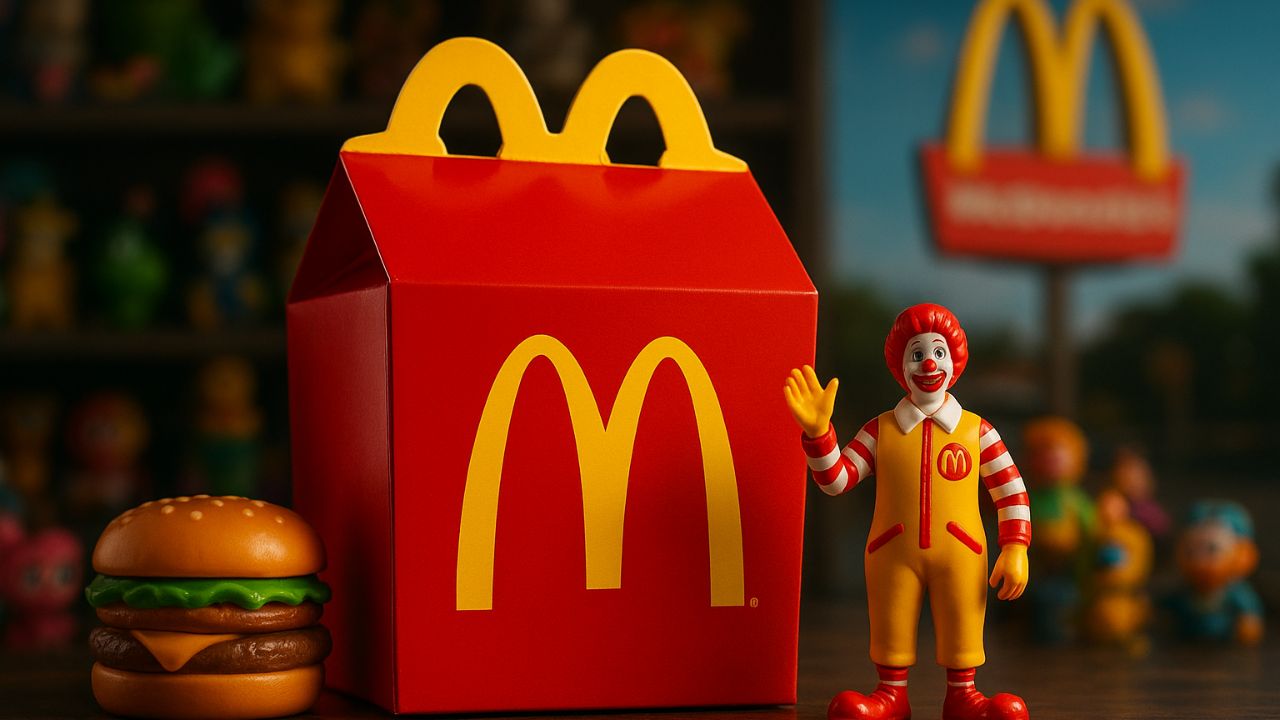
The Fast-Food Chain McDonald’s Has Transformed the Happy Meal Into a Distribution Engine That Exceeds the Physical Production of Industry Giants Annually.
The global toy industry, traditionally dominated by corporations dedicated to playfulness like Mattel and Hasbro, has a new and unexpected leader in unit distribution volume: McDonald’s Corporation. Far from being a traditional manufacturer, the world’s largest fast-food chain has established itself as the hidden king of toys, delivering around 1.5 billion units of Happy Meal (Happy Meal) toys to consumers worldwide each year.
This market anomaly is the result of massive logistics and sales strategy, transforming a promotional item into a ubiquitous cultural currency. The astronomical number is validated by market analysis from People Plus Science, in its report “The Happy Meal Effect”, which details the volume in a daily metric of approximately 4.1 million toys distributed per day. According to the report, this unit volume from McDonald’s is comparable to roughly half of the total toy volume sold in the North American industry, positioning the burger company as a gravitational force in the global supply chain, easily surpassing the combined production of the largest dedicated manufacturers.
Comparative Analysis: Volume vs Market Value
To understand McDonald’s hegemony, it is essential to differentiate distribution volume from financial revenue and see how the “toy” fits into the business model.
-
Tourists were poisoned on Everest in a million-dollar fraud scheme involving helicopters that diverted over $19 million and shocked international authorities.

-
Hidden beneath the dense forest of the Sierra Nevada, Betoma emerges in a neighbor of Brazil as the greatest archaeological discovery of the century, revealing a colossal ancestral city covering over 18 km², with 8,334 stone structures and the potential to rewrite the history of South American civilizations.

-
Goodbye iron: new technology from Xiaomi promises to revolutionize the way we iron clothes with 500 kPa steam, continuous flow of 120 g/min, heating in 65 seconds, and six smart modes for different fabrics.

-
Rio Pardo, the most mysterious city in Rio Grande do Sul: untouched Pampas castle, the missing treasure of the Devil Boy, bride’s saint, invisible tunnels, and a 200-year curse today.


The traditional toy market, represented by Mattel (Barbie, Hot Wheels) and Hasbro (Monopoly, Magic: The Gathering), operates under the logic of maximizing Average Selling Price (ASP), where profitability is derived from the margin on each physical product. Mattel, for example, reported a net revenue of approximately US$ 5.44 billion in 2023. Inferring an average price of US$ 10.85 per unit in the market, Mattel’s total volume would hardly exceed 800 million annual units. Hasbro presents a similar scenario, with a physical volume estimated in the range of 400 to 600 million units, increasingly focusing on digital games with higher margins.
In contrast, McDonald’s does not seek to profit from the toy itself; it uses the Happy Meal as a loss leader, a sales catalyst. The cost of the toy (estimated at around US$ 1.66 to US$ 1.78 per unit for franchisees, according to operational reports) is embedded in the price of the meal for the child, but the real profit comes from adult meals (burgers, fries, drinks) purchased by parents, which have significantly higher margins. This strategy allows the chain to distribute 1.5 billion items for US$ 0.00 to the end consumer, establishing a daily penetration that no toy retailer can replicate.
The Hidden Economy of Licensing and Financing Volume
How does McDonald’s finance the massive production of 1.5 billion items of plastic and paper annually? The answer lies in a financial architecture of shared risk and its influence on pop culture.
Contrary to popular belief, the cost of the toys is absorbed by the franchisees, who operate over 90% of global restaurants. They buy boxes of toys from distribution centers. This cost pressure is accepted because the toy is the chain’s most powerful traffic driver, ensuring frequent family visits and the purchase of high-margin items by adults.
Regarding intellectual properties (IP) from Star Wars to Pokémon, the financial relationship with Hollywood studios varies. For “Tier 1” brands, like Disney/Pixar movies (which led to an exclusivity deal in the 90s), McDonald’s pays significant royalties. However, for many other brands, the global exposure provided by the chain is worth more than money. Having a character in the Happy Meal means having 1.5 billion mini-billboards distributed worldwide. This massive exposure can reduce or even eliminate licensing fees in exchange for marketing commitments, allowing the corporation to finance production at scale.
From the “Ronald Menu” to Monetizing Nostalgia (“Kidult”)

The journey of the Happy Meal from a simple giveaway to global hegemony was not immediate. Its conceptual roots trace back to Guatemala, where franchisee Yolanda Fernández de Cofiño created the “Ronald Menu” in the 1970s to simplify portion choices for kids. The official launch in the U.S. in 1979 solidified the concept that the giveaway transforms biological need (food) into an entertainment event.
More recently, McDonald’s has capitalized on the phenomenon of “kidult” (nostalgic adults) to keep volume high. The launch of the Happy Meal for Adults in 2022, in partnership with the brand Cactus Plant Flea Market, resulted in instant sellouts, with the toys appreciating in the secondary market. In 2024 and 2025, the focus on collectible miniatures, such as the “Lil McDonald’s” series, and strategic partnerships (like the Yu-Gi-Oh x Hello Kitty collaboration in 2024), directs traffic from young adults with disposable income, a segment that Circana reported as one of the only real growth vectors in the toy industry. This strategy demonstrates a masterful manipulation of dopamine and the anticipation of the “blind box,” encouraging repeat purchases to complete the collection.
The Existential Challenge: The Sustainability Goal for 2025
The biggest obstacle to continuing the distribution of 1.5 billion units is not its direct competitors, but the challenge of sustainability. Producing billions of single-use plastic pieces annually has become environmentally unsustainable and subject to regulations.
McDonald’s Corporate has an aggressive and publicly validated goal: to reduce the use of virgin plastic derived from fossil fuels in its toys by 90% by the end of 2025 (compared to 2018). This shift, which confirms the massive scale of operations, as indicated in its Sustainability Reports, is forcing a transition to alternative materials, such as plant-derived polymers, certified fibers, and primarily, 3D cardboard toys and books.
In markets like France, the transition is even further advanced, with the near-total elimination of rigid plastic toys in favor of books (in the campaign “One Book or One Toy”). However, this shift creates a business dilemma: while ecologically responsible, parents and consumers often complain about the inferior durability and low “perceived value” of cardboard toys. If the promotional item loses its appeal, the Happy Meal’s traffic engine may fail.
The Unwitting Titan: The Future of the Hidden King
The analysis confirms: McDonald’s is the largest toy distributor in the world by unit volume. The fast-food chain operates an entertainment supply chain that surpasses the physical production of giants like Mattel and Hasbro. This hegemony is sustained not by large profit margins on the toy, but by the ability to transform pop culture distribution into an efficient vehicle for food sales.
The future of McDonald’s as the Hidden King of Toys will depend on its ability to maintain this volume in the face of challenges like the war on plastic, rising import costs, and the need to balance adult nostalgia with the demand for tactile play from children. Integrating digital elements (“phygital”) is the next logical step to compensate for the reduction of physical materials.
Do you agree with this change? Do you think that the Happy Meal with cardboard toys has the same attraction impact as those with plastic? Leave your opinion in the comments, we want to hear from those who experience this firsthand!




-

Uma pessoa reagiu a isso.