





 Portuguese
  English
  Spanish
  4 min of reading
  0 comments


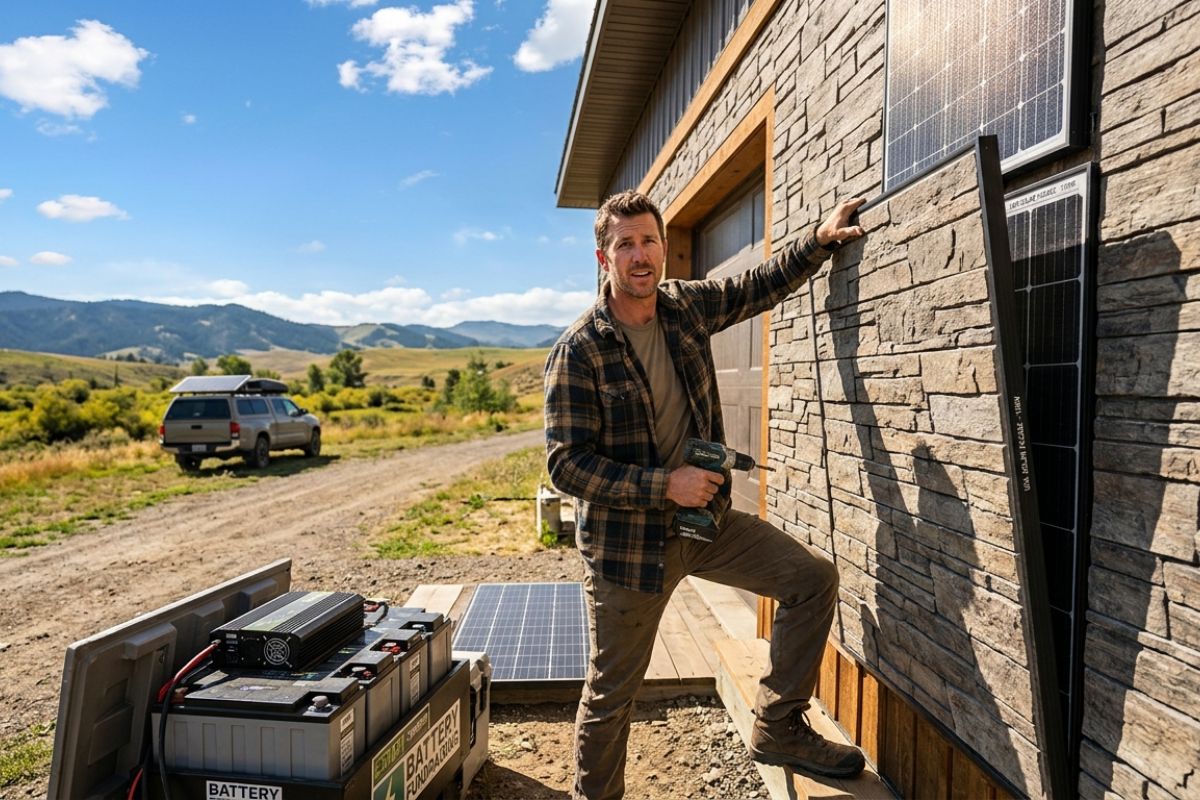
The proposal uses solar facade to hide solar panels, generate solar energy, and bring photovoltaics to the wall with quick installation and MC4 connection
The solar panels may be about to change location and appearance. Instead of roofs full of visible panels, a solution presented in a video shows solar panels integrated into the facade, with finishes that resemble stone, wood, brick, and marble, transforming the wall into an energy-generating surface.
The theme gained traction after a Brazilian off-grid YouTuber showcased the idea while dealing with a real problem in his own system. He reports unbalanced batteries and, at the same time, presents an alternative he calls “solar facade,” in addition to mentioning a crowdfunding campaign to help purchase a new battery for the project.
How solar panels that look like regular facades work

The proposal is simple to understand: solar panels that, on the outside, look like architectural cladding. In the video, the solution is attributed to a North American company called Solit, which describes the product as an intelligent solar facade capable of generating energy without exposing the traditional aspect of a photovoltaic panel.
-
Scientists at the world’s largest particle accelerator accidentally managed to turn lead into gold during a simulation of the Big Bang, but the amount produced is so small that it fits in trillionths of a gram.

-
Intense heat at the beginning of April already has a defined scenario in Rio Grande do Sul, and forecasts indicate temperatures above 30°C, little rain, and a risk of drought in several regions.

-
Friend or villain? See how much it costs to keep the air conditioning on for 8 hours a day in 2026.

-
In 2026, the results of a study involving 140,000 people are expected to be released regarding a blood test capable of detecting 50 types of cancer before any symptoms appear, and this could be the greatest advancement in medicine since penicillin.


The idea is for the facade to behave as part of the building’s “envelope,” maintaining the aesthetic of common materials. In practice, the wall ceases to be just a finish and starts to produce energy.
Textures of stone, wood, brick, and marble without panel appearance

One of the most striking points is the visual. The displayed content shows solar panels with different textures, including options that resemble brick, minerals, wood, and variations of stone. The effect is one of camouflage: to those looking from the outside, it appears to be a regular wall.
This aesthetic appeal appears as a solution for those who do not want the typical appearance of panels on the roof, or for those who prefer discretion. The central argument is to reduce visual pollution without giving up photovoltaic generation.
Power per area and size of the presented modules
The video highlights an example of a module with dimensions of 1140 mm by 570 mm, pointing out that these are not giant pieces.
The mentioned power reaches 130 W per m², with variation depending on the texture and finish of the module, including cases of 120 W.
The comparison made in the content is direct: there are traditional panels with much higher powers per unit, but the proposal of the facade is to scale by the available area vertically. The logic is to use entire walls to add power throughout the day.
MC4 connections and installation described as simple
Another point emphasized is the installation. The video states that the connectors are MC4, the same common in photovoltaic systems, and that the assembly would follow a logic similar to that already known by those who work with solar energy.
The fixation is presented as a structure with profiles and fittings on the wall, where the modules are placed and connected.
The YouTuber highlights that this avoids some typical problems of the roof, such as drilling tiles and concerns about weight, since the solar panels would be on the wall.
Practical advantages mentioned in the video, verticality, and shading
The content also points out some characteristics that stand out in real use. One of them is the vertical installation, with the idea that the same type of tilt adjustment common on roofs would not be necessary.
Partial shading is also mentioned without interrupting the entire generation, indicating that a shaded part would not prevent the others from continuing to produce.
The promise is to maintain distributed generation along the facade, even with shadows in specific sections.
Possible applications in houses, walls, and buildings
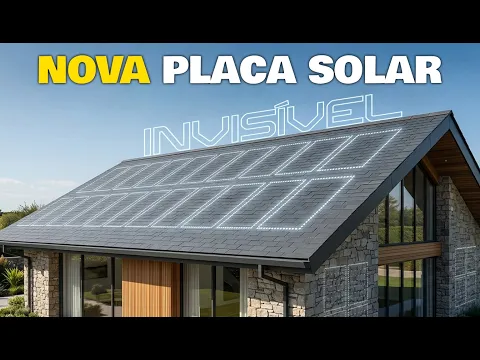

The video suggests use on external walls of houses, on walls, and also in buildings, precisely because the system was presented as a “ventilated facade” that generates energy and maintains architectural appearance.
The bet, in the creator’s view, is that this type of solar panels may interest high-end projects, where the aesthetics of the facade weigh more in the decision.
He also raises the hypothesis that, if this solution gains market, there may be an indirect impact on the prices of traditional panels, but treats this as a personal projection.
The off-grid context, defective battery, and the mentioned crowdfunding
The video presenting the technology starts from a practical scenario: the author reports momentary generation and consumption of the house, and says he is dealing with unbalanced batteries after one battery malfunctioned.
He mentions that he opened a crowdfunding campaign to facilitate the purchase of a new battery and informs an amount raised up to that moment.
This context helps explain why the idea of solar panels in the facade caught so much attention in the content: it is an attempt to look for different solutions while he seeks stability and autonomy in the system.
Would you install invisible solar panels on your house’s facade, or do you prefer traditional solar panels on the roof?






Seja o primeiro a reagir!