





 Portuguese
  English
  Spanish
  6 min of reading
  1 comment


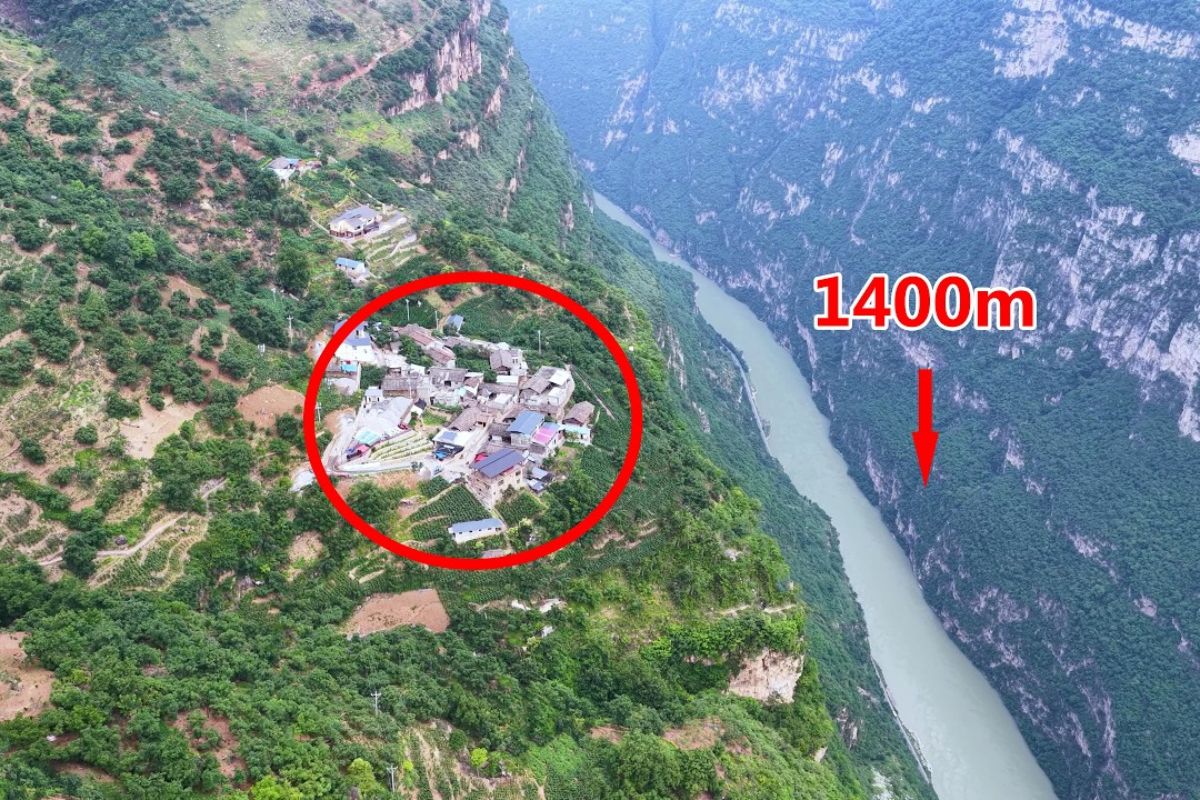


The Chinese Village of Gulu in Sichuan Is Perched on a Cliff with a Drop of Almost a Thousand Meters, Where No Car Can Reach Directly, and Residents Spend Hours Climbing Mule Trails to Connect to the Rest of the World.
The Gulu Village, known as the cliff village or village in the clouds, occupies a mountaintop at over 1,400 meters above sea level, with a vertical difference of about 1 kilometer from the valley floor. It appears suspended in the air, facing the Grand Canyon of the Jinkou River, in a setting so dramatic that even eagles seem to have difficulty flying there. For many visitors, the feeling is of literally walking over an abyss.
Even so, the routine of this Chinese village remains anchored in narrow trails, mules, horses, and a plank road carved into the cliff, which can take six or seven hours of ascent and descent. Among hand-dug tunnels, tool marks on the rocks, and holes in the ground to prevent the animals’ hooves from slipping, access to Gulu is at the same time a physical challenge and a testament to human resilience.
Where Is the Gulu Village and Why Is It Called the Village in the Clouds

The Chinese village of Gulu is located in Hanyuan County, Ya’an City, Sichuan Province. The entire village was built on a cliff with an altitude of over 1,400 meters, with an almost vertical drop of approximately a thousand meters to the valley.
-
He found the largest gold shipwreck in the United States with tons of the precious metal at a depth of 2,400 meters in the Atlantic and recovered a treasure that no one thought possible to reach, but 500 gold coins disappeared without explanation.

-
The United States has a serious problem with its F-35s: China is already producing fighters at a pace that exceeds American capacity and could manufacture up to 300 aircraft per year before the end of the decade, shifting the global military balance.

-
A retired IT professional built a 22-meter boat in his backyard in Oklahoma with a school bus engine, light pole masts, and handmade watertight doors to become the redneck version of Jacques Cousteau.

-
China is building a city in Brazil: a complex with an investment of R$ 5.5 billion comes to light, but allegations involving workers draw attention.

Because of this extreme geography, Gulu has gained nicknames like cliff village and village in the clouds. From the bottom of the valley, the houses seem glued to the mountainside.
Viewed from afar, the buildings give the impression of defying gravity, hanging over the void, linked to the world only by narrow paths and a cable car that crosses canyons.
The Mule and Horse Trail That Still Controls the Rhythm of the Village

To this day, no car can drive directly to this Chinese village. To reach Gulu, residents and visitors still depend on the so-called mule and horse road, a trail carved into the cliff about 6 kilometers long, which winds between precipices and steep walls.
The journey can take six to seven hours round trip, with steep and exposed sections.
Each turn reveals the combination of beauty and risk, with wide views of the Grand Canyon of the Jinkou River and sheer cliffs.
Along the way, small rest stops allow for buying water and resting, and even the elderly and children tackle the climb, often seeking just the challenge that the route offers.
On the ground, several holes mark the trail. They exist so that the hooves of mules and horses have grip, reducing the risk of slips and falls in an environment where any mistake can be fatal.
From Vine Ladders to the Boardwalk Carved Into the Rock

Before the current road, the connection of this Chinese village to the outside world was even more precarious. For a long time, access was made with ladders and vine ropes hanging from the cliff.
Residents literally swung on the mountains’ walls to climb up and down, in a rudimentary system that resembles fiction stories, but was part of the community’s daily life.
In the 1960s, with the construction of the Chengdu-Kunming Railway, work crews saw residents moving “like monkeys” on the vine ladders.
From this, steel stairs were installed, slightly improving the conditions of movement.

Later, in 2002, the government financed, and the residents themselves worked for years to carve a boardwalk into the cliff, known as the mule and horse road.
The project took 16 years, completed in 2018, all done by hand, with tool marks still visible on the rocks.

Today, this hardened road, about a meter wide and with protective rails, is the main path for those who want to experience the extreme routine of this Chinese village – although, even with rails, it is still considered difficult and frightening for many.
Cable Car, Mounted Cars on Top, and the Arrival of Tourism

Over time, tourism became part of the reality of the Chinese village of Gulu.
In addition to the traditional trail, a second route emerged: visitors can take a car up to a higher area of the mountain, take a cable car over the canyons, and then walk about 2 kilometers to the village.
This cable car, with a vertical drop of nearly a thousand meters, links two points of the terrain in a crossing that impresses even those who are not afraid of heights.
For tourists, the ride costs 50 yuan for a one-way trip and 80 yuan for a round trip, but it is free for residents, reinforcing its role as essential infrastructure for the local community.
Interestingly, the cars circulating in the region did not drive up. They were taken apart by the cable car and assembled at the top of the mountain.
Even so, they do not reach the heart of the village. A final stretch still depends on the narrow road and physical effort, both from people and animals.
Life on the Cliff: Simple Houses, Sheep in Impossible Places, and Postcard Views

Upon arriving at the Chinese village of Gulu, visitors find brick houses and a structure that, at first glance, resembles other rural communities. The difference is the absolutely radical terrain on which all this was built.
From an observation platform below the village, it is possible to see the boardwalk literally suspended in the air and the valley below, from where many begin their ascent.
On opposite cliffs, white spots move up the slope: they are sheep grazing in places that seem inaccessible even to birds.
According to local reports, there are shepherds who climb cliffs within the cliff itself, leading the animals to grazing areas that would be unreachable for others.
The climate in the heights is described as pleasant and cool, with a landscape “beyond words”, which helps to make the village a tourist destination for those seeking extreme experiences, impactful photos, and direct contact with a way of life very different from urban.
A Chinese Village Shaped by War, Isolation, and Resilience

The history of the Chinese village of Gulu dates back over 400 years. According to the residents, their ancestors climbed the 1,400-meter cliff to escape the war.
From this fleeing movement, they began to live and multiply in the mountain, forming a community that learned to deal with isolation, scarce access, and daily physical effort.
Before the current road, some residents spent their entire lives without descending the mountain, given the degree of difficulty in moving around.
Even with the cable car and the arrival of tourism, daily life continues to be marked by challenging climbs and descents, transporting goods by mules and horses, and constant use of the boardwalk.
With the advancement of tourism, income has improved, but the scenery remains the same: a Chinese village that lives on the edge of a precipice, balancing tradition, extreme landscape, and an increasing flow of curious visitors.
A Place That Defies Logic and Continues to Attract Visitors
Gulu Village is an example of how a Chinese village can become a symbol of resistance, adaptation, and coexistence with a radical environment.
Among hand-dug trails, cable cars crossing canyons, mules carrying goods, and sheep grazing on stone walls, Gulu combines a history of flight, improvised engineering, and adventure tourism.
In practice, this community shows that, for many people, the idea of an “uninhabitable place” is much more relative than it seems, especially when necessity and history push families into mountains, cliffs, and clouds.
And you, would you dare to climb for hours on mule trails to get to know this Chinese village hanging on a cliff up close, or do you think just seeing the images would have already pushed you past your courage limit?







Se fosse uma vez por semana, quem sabe kkkk