






 Portuguese
  Spanish


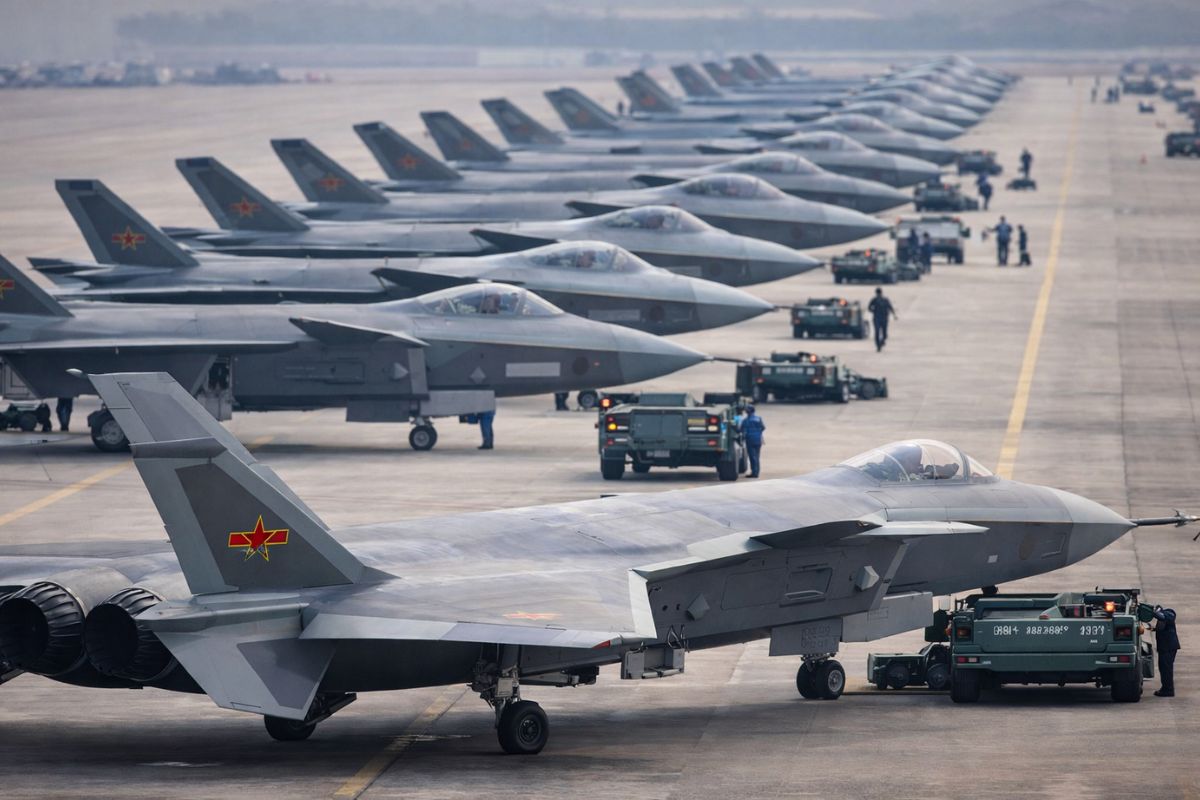


The US fighter fleet has shrunk by more than 60% since the end of the Cold War while China expands its industrial production with projections of up to 300 aircraft per year, and American dependence on the F-35 as the central piece of air strategy exposes a problem that is not technological but rather industrial scale and capacity to produce sufficient fighters to maintain superiority
The United States faces a problem that cannot be solved with technology: they are producing fighters at an insufficient rate to maintain the air superiority they dominated for decades. The American fighter fleet has shrunk by more than 60% since the end of the Cold War, many aircraft have decades of service, and annual acquisitions do not compensate for the retirement of older models. Meanwhile, China is producing fighters at a rate that already exceeds the current capacity of the United States, with projections of up to 300 aircraft per year before the end of the decade.
The F-35, the centerpiece of American air strategy, is technologically superior to any fighter that China operates today. But technological superiority does not solve the problem if there are not enough units to cover multiple operations at the same time. The concern for defense analysts is not whether the F-35 is good enough as a platform, but whether there will be enough fighters to sustain American superiority in the next ten years.
How the US fighter fleet shrank by 60% in three decades

During the Cold War, the United States produced hundreds of fighters per year. The factories operated at a pace capable of sustaining a war economy, and the American air fleet was so large that no country in the world could come close in numbers or quality.
-
Bruno Guimarães, 28, Misses Crucial Penalty Against Norway in World Cup After Replacing Vinicius Jr.

-
Pennsylvania Mine Creates Ice in Summer Heat and Melts in Winter, Turning a Mountain Crevice into a Reverse Natural Refrigerator

-
China Accelerates Global Expansion of Robotics: From Smart Vacuums to Industrial and Humanoid Machines, Millions Exported to Over 150 Markets
-
Inspired by a school lesson on Africa’s water crisis, a young boy raised money through chores to fund a well that transformed a Ugandan community.




With the end of the Soviet Union, production plummeted, contracts decreased, and the American defense industry restructured to produce fewer fighters, but more technologically advanced ones.
The result, three decades later, is a fleet that has shrunk by more than 60%. Many fighters in service have decades of use, expensive maintenance, and operational wear accumulated in conflicts in Iraq, Afghanistan, and global operations.
Acquisitions of new fighters do not compensate for the retirement of old models, which means that the American air force is shrinking every year. The system that worked during the Cold War no longer functions, and the industrial capacity to produce fighters at scale has been lost along the way.
China is not just catching up: it is surpassing in fighter production

The American problem becomes even more serious when looking at what China is doing. Beijing has massively expanded its defense industrial capacity and is producing fighters at a rate that the United States cannot match with its current structure.
Projections indicate that China could manufacture up to 300 fighters per year before the end of the decade, a volume that not only reduces the historical gap but threatens to reverse it.
China is not just betting on quantity. Next-generation Chinese fighters, such as the J-20, incorporate stealth technologies and electronic combat systems that approach Western standards.
The combination of technological modernization with large-scale production is what makes the situation critical: for the first time in decades, the United States faces a rival that can surpass them in both volume and sophistication of fighters. The global balance of air power is changing.
The F-35 is the best fighter in the world, but that does not solve the problem
The F-35 is not just a fighter. It is a flying information center capable of coordinating complex operations in real time, integrating sensor data, and communicating with other military platforms simultaneously.
In terms of technology, the F-35 is probably the most advanced fighter in operation in the world. But this technological superiority creates a dangerous dependency: the United States has concentrated its air strategy on a single platform that is not being produced in sufficient quantity.
Recent conflicts have demonstrated that air superiority depends not only on having the best fighters but on having enough units to sustain prolonged operations, cover multiple theaters of combat, and absorb losses.
If the United States needs to operate fighters simultaneously in the Pacific, the Middle East, and Europe, the math simply does not add up with current production levels. One F-35 cannot be in two places at the same time, no matter how advanced it is.
The problem is not technology: it is industrial capacity to produce fighters
The root of the American problem is not a lack of engineering or advanced designs. It is the industrial capacity to manufacture fighters at scale. During the Cold War, the American defense industry operated with multiple production lines in various factories.
Today, the production of the F-35 is concentrated in a single main line, and the delivery pace is irregular. Annual acquisitions of fighters do not compensate for the retirement pace of older models, creating a progressive deficit that reduces operational capacity each year.
China, on the other hand, has heavily invested in military production infrastructure over the past twenty years. New factories, verticalized supply chains, and trained labor allow Beijing to produce fighters in volumes that the United States would struggle to match even with urgent investment.
Rebuilding industrial capacity takes years, and the window to act is closing as China accelerates and the United States maintains an insufficient pace.
What is at stake in the next ten years
The global air balance is entering a critical phase. The historical advantage of the United States in combat fighters is no longer guaranteed, and if production is not accelerated in the coming years, the country risks losing its deterrence capability against China.
Deterrence means that the adversary knows that attacking would come at too high a cost. If the United States does not have enough fighters to respond to a crisis in the Pacific, that equation changes.
The decision that the United States faces in the next ten years is simple to formulate and complex to execute: produce more fighters, stabilize the defense industry, and reinforce the fleet with more F-35s and other systems.
If this does not happen, the air superiority that the United States has maintained for decades may become a thing of the past, and China will position itself as the dominant air power of the next generation.
The race that the United States may be losing without realizing it
The United States still has the best fighters in the world. But having the best aircraft is of no use if the adversary has ten while you have three.
China is producing fighters at an industrial scale while the American fleet shrinks, and the math of modern warfare says that quantity and quality need to go hand in hand.
The F-35 is an impressive engineering feat, but there is no escaping a simple reality: if there are not enough fighters to cover all the points where the United States needs to be, technological superiority becomes just a detail in an equation that the adversary has already learned to solve with volume.
Do you think that the technological superiority of the United States is still enough to compensate for the production gap? Or has China already turned the tide in the fighter race? Leave your comments and share this article with those who follow geopolitics and defense.


