





 Portuguese
  English
  Spanish
  5 min of reading
  0 comments


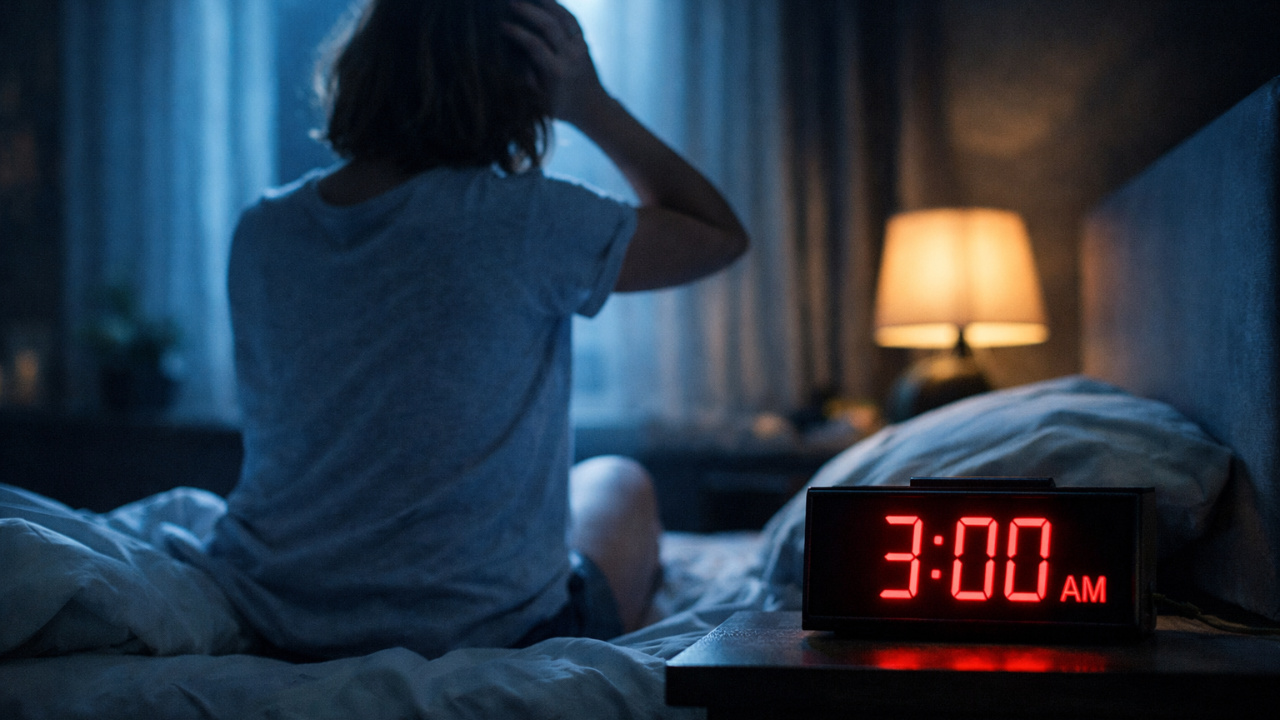
The Nocturnal Awakening May Have Evolutionary Origins. Discover How Biphasic Sleep Works According to Sleep Science.
Waking up in the middle of the night, especially around 3 AM, may seem strange to many people.
However, research from sleep science shows that this nocturnal awakening can be completely natural.
The phenomenon, which occurs with people in different parts of the world, is linked to what is called biphasic sleep, a common resting pattern throughout much of human history.
-
Furniture made with aluminum and glass does not warp and has become an alternative to replace MDF in Brazil.

-
Finland, the happiest country in the world, wants to hire 140,000 technology professionals and is eyeing Brazilians: visas are issued in just two weeks and salaries with a 37-hour workweek are surprising.

-
Mr. Mário reveals the technique of the caipira papaya: he cuts the fruit in half, discards the seeds from the tip, and plants the ones from the back to increase the chance of a productive female tree.

-
Few remember, but the submarine that disappeared in 1968 with 52 crew members was found after 51 years at the bottom of the sea at more than 2,000 meters, intriguing the entire world.


This behavior has been recorded in historical documents, scientific research, and studies on circadian rhythm, the biological clock that regulates the sleep-wake cycle.
Currently, experts point out that the idea of sleeping eight hours straight has only become established in the last two centuries.
Before that, people tended to sleep in two separate phases, with a brief interval of wakefulness during the night.
Thus, understanding this biological characteristic can help many people better cope with occasional insomnia and the anxiety generated by waking during the night.
Biphasic Sleep Was Common Before Modernity
For centuries, the predominant resting pattern was biphasic sleep, that is, divided into two phases throughout the night.
Normally, people would lie down shortly after sunset.
After about four hours of sleep, they would naturally wake up for a short period before going back to sleep until dawn.
This habit was not considered strange.
On the contrary, it was part of the daily routine in various societies.
There are historical records of this behavior in different periods. One example appears in classical literature: Virgil mentioned “the hour when the first sleep begins for weary mortals” in his work Aeneid.
One of the leading researchers on the subject is historian Roger Ekirch, who investigated the topic for 16 years.
Throughout this period, he gathered more than 500 references in historical documents that describe this sleep pattern in various cultures.
Sleep Science Explains Nocturnal Awakening
According to sleep science, the human body has an internal system called circadian rhythm, responsible for regulating biological cycles over approximately 24 hours.
This biological clock controls various functions, including the release of melatonin, the hormone that signals the body that it is time to sleep.
However, external factors can interfere with this process.
The main influence is light. When the brain receives light stimuli, especially at night, melatonin production decreases.
As a result, sleep timing may be altered.
Therefore, the more exposure a person has to artificial light before bedtime, the greater the chance of falling asleep later and maintaining continuous sleep throughout the night.
How Artificial Light Changed Our Sleep Habits
The change in the resting pattern began mainly in the 18th century.
With the popularization of oil lamps, followed by gas and electricity, the night began to be used for social and professional activities.
This gradually modified human habits.
Furthermore, the Industrial Revolution contributed to consolidating a new routine model.
With stricter working hours, it became necessary to concentrate rest into a single period.
Thus, the natural pattern of biphasic sleep began to be replaced by a continuous block of nighttime sleep.
Although this model is now considered normal, it represents a relatively recent adaptation in human history.
Studies Show That the Body Can Return to the Natural Pattern
Recent research supports this idea.
When volunteers are subjected to conditions similar to those of long winter nights—without artificial light, clocks, or electronic devices—the body tends to spontaneously revert to biphasic sleep.
In these situations, people sleep for a few hours, wake up for a calm period, and then go back to sleep.
A study conducted in 2017 in a farming community in Madagascar, where there is no electricity, identified a similar pattern in actual living conditions.
These results suggest that nocturnal awakening may be deeply linked to human biology.
Light Also Influences Time Perception
Another curious factor related to sleep involves how we perceive time during the night.
Research conducted by the Environmental Temporal Cognition Lab at Keele University indicates that dimly lit environments can alter this perception.
In such conditions, the brain tends to interpret time as passing more slowly.
This effect can be even stronger in people with a low mood.
This helps explain why winter nights feel longer and why the clock seems to move slowly when someone wakes up in the middle of the night.
What to Do When Nocturnal Awakening Occurs
If waking up during the night is part of the natural functioning of the body, the way we react to this moment is fundamental.
Experts recommend some simple strategies.
One of the guidelines used in Cognitive-Behavioral Therapy for Insomnia is to avoid staying in bed for long periods without sleeping.
If after about 20 minutes sleep does not return, the recommendation is to get up and engage in a calming activity, such as reading under soft light.
Additionally, repeatedly looking at the clock can increase anxiety. Therefore, avoiding this practice can help the brain relax and allow sleep to return naturally.
Understanding Sleep May Reduce Nighttime Anxiety
For many people, waking up in the middle of the night is a cause for concern.
However, sleep science suggests that this behavior may simply be an expression of the natural functioning of the human body.
Accepting nocturnal awakening as a possible part of the biological cycle can reduce stress and facilitate the return to rest.
Thus, instead of viewing this moment as a problem, it may be more helpful to understand it as a reflection of an evolutionary legacy that has accompanied humanity for centuries.
See more at: Waking Up at 3 AM Is Normal: Sleeping Straight Through Is a Modern Invention, Not an Evolution









-

-

2 pessoas reagiram a isso.