





 Portuguese
  English
  Spanish
  4 min of reading
  1 comment


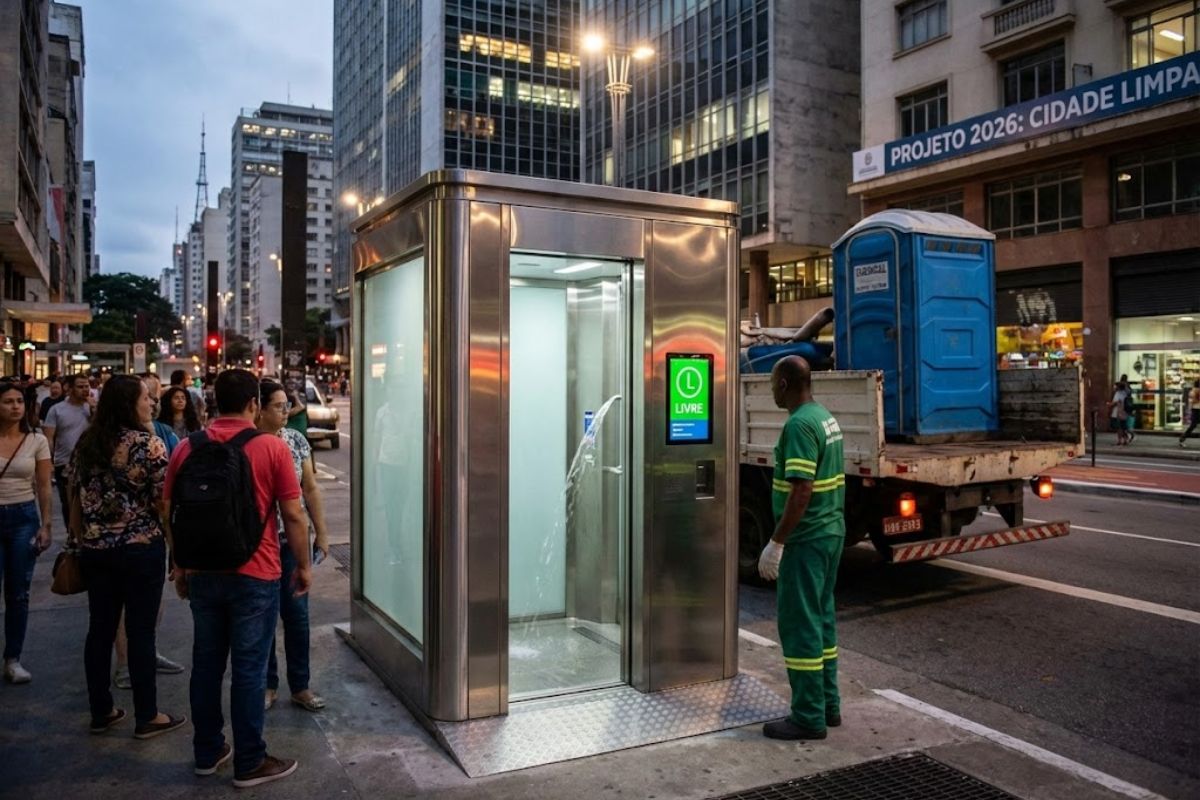


Self-Cleaning Bathrooms Operate From 6 AM to 10 PM, With a Limit of 10 Minutes Per Person, Cleaning Triggered by Sensors and Contactless Control. The Fifth Was Inaugurated in November at Rua Rio de Janeiro, 700, and the City Hall Plans 14 More By 2026
Belo Horizonte took another step in replacing improvised sanitary structures by expanding the network of self-cleaning free bathrooms in the hypercenter. In November, the city inaugurated the fifth module, installed at Rua Rio de Janeiro, 700, near Praça Sete, in a high-traffic area.
The municipal project aims at hygiene and urban infrastructure, with cabins that wash themselves using sensors, operating daily until night and designed for heavy use. The city hall is already working on an official expansion plan to reach 19 units by the end of 2026, distributed across central regions, neighborhoods, and tourist areas.
Where Are the Five Units and What Was the Last Inauguration
The fifth self-cleaning bathroom was inaugurated last November at Rua Rio de Janeiro, 700, near Praça Sete, in the hypercenter of Belo Horizonte. It joins four other operational units at landmark locations in the city.
-
Drought may be creating stronger superbugs in the soil and helping antibiotic resistance reach hospitals, warns a study highlighting a problem that could grow alongside extreme weather.

-
The biggest scam in history: Napoleon’s France deceived the United States by selling them a territory that was Spanish.

-
Why is the Danakil Desert so dangerous? It has unstable terrain and how extreme temperatures and toxic gases turn the region into one of the most hostile environments on Earth.
-
With a height of 221 meters and a capacity for trillions of liters, Hoover Dam still holds a trick that makes water defy logic.

The reported locations are: Praça da Estação, Praça Rio Branco, Avenida Olegário Maciel at Praça Raul Soares, and Rua dos Tabaiares, at the corner with Rua Sapucaí. With the new unit at Rua Rio de Janeiro, the network reaches five active points, concentrated in areas with high pedestrian and worker traffic.
How Self-Cleaning Bathrooms Work and What Rules Apply to Use

The self-cleaning bathrooms operate every day from 6 AM to 10 PM. The length of stay is limited: each user may stay up to 10 minutes per use, a rule designed to ensure turnover and reduce queues in places with a high volume of people.
Each booth is equipped with sensors that trigger an automatic cleaning system. After use, sprinklers apply water and cleaning products inside, standardizing hygiene even with heavy use by thousands of people daily. The proposal is to maintain a consistent level of hygiene without depending on manual intervention for each cycle.
Sensors, Automatic Cleaning, and Contactless Control to Reduce Contamination

The design of the equipment prioritizes automation and reduced contact. The sensors trigger the cleaning process and also allow resource control without touch, decreasing the risks of contamination on high-contact surfaces.
The booths include light signaling to indicate occupancy status, which prevents attempts to open during use and organizes the flow. The combination of automated cleaning, signaling, and contactless control forms the operational core of the hygiene proposal in the city center.
Accessibility and Signage: What Changes for People with Reduced Mobility


The installations include accessibility features aimed at people with reduced mobility. This aspect is treated as part of the objective of modernizing the infrastructure, allowing the bathroom to be usable by a broader audience in high-traffic areas.
In addition to accessibility, the light signaling for occupancy contributes to quick orientation, especially in urban environments with noise, haste, and high pedestrian movement.
Why Belo Horizonte Is Investing and Who Is Most Impacted in the Center
The initiative is presented as a response to a growing demand for efficient sanitary infrastructure in high-traffic areas. Street vendors, app drivers, and pedestrians passing through the center are identified as directly benefiting groups due to the ongoing need for a reliable public bathroom during long journeys.
The described impact goes beyond comfort. The expansion of modern public bathrooms is associated with gains in public health and urban dignity, as it reduces reliance on precarious alternatives and improves the sanitary conditions of public space.
Expansion Plan Until 2026: 14 New Bathrooms and the Goal to Reach 19
The city hall plans to expand the network beyond the five bathrooms already installed. By 2026, an increase with the installation of 14 new bathrooms is planned, raising the total expectation to 19 units by the end of 2026.
The intention is to position the new points in strategic areas, cited as the center of Venda Nova, the commercial center of Barreiro, the Pampulha region, and tourist areas. The expansion seeks to distribute access to different communities, beyond the hypercenter.
Next Immediate Step: Praça do Papa Enters the Schedule
The most immediate step already indicated is the installation of a bathroom at Praça do Papa. This location is part of the ongoing planning to complete this unit and 14 other bathrooms by the end of 2026, consolidating the promised network.
With the new network, Belo Horizonte aims to create a routine of use in public spaces that combines free access, cleaning automation, and operation until night, reducing reliance on temporary solutions during events and high traffic areas.
Which region of Belo Horizonte needs these self-cleaning bathrooms the most right now: hypercenter, Barreiro, Venda Nova, Pampulha, or tourist areas?








Não informa a destinação dos dejetos. Se é ligado à rede de esgoto ou tem outra destinação, reportagem fraca e carente de informação