





 Portuguese
  English
  Spanish
  4 min of reading
  0 comments


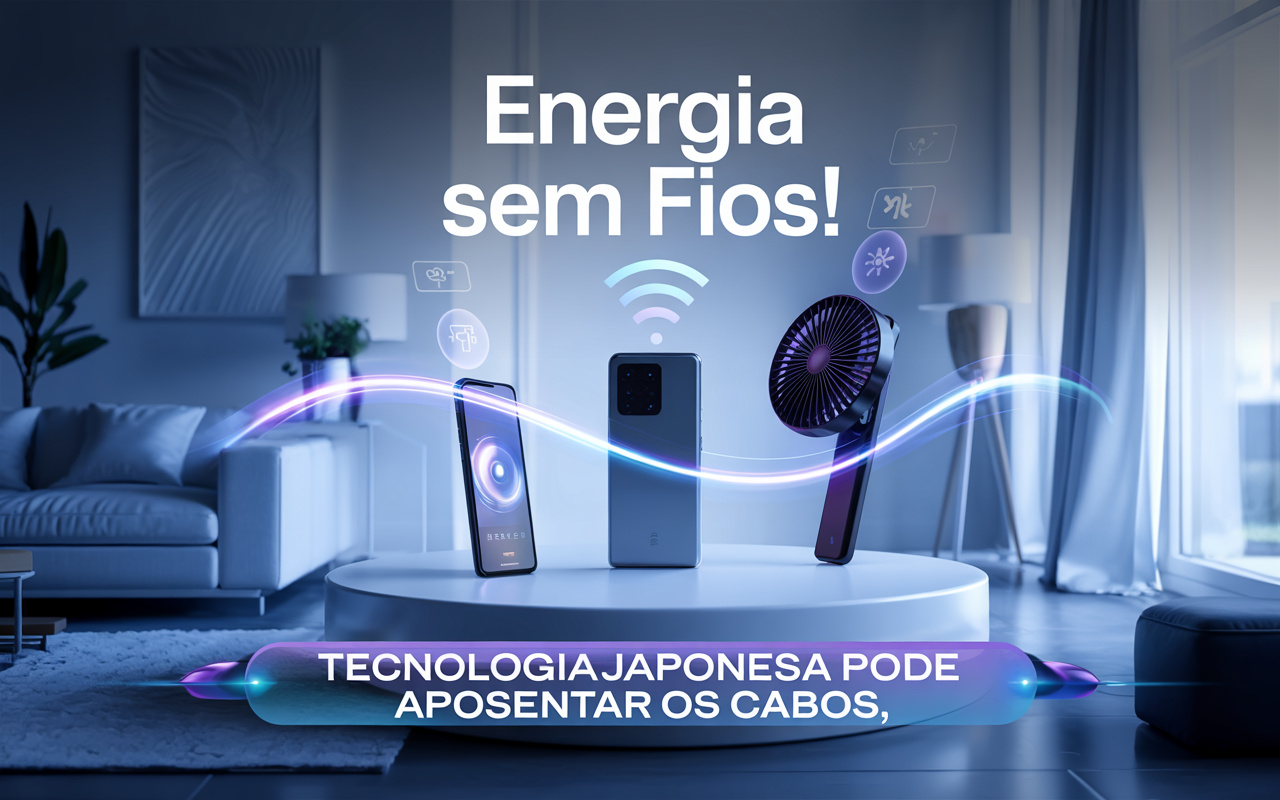
Technology Combines Artificial Intelligence and Machine Learning to Create Stable Energy System Without Physical Connection, Overcoming the Limitations of Traditional Charging.
Japanese scientists may be taking the first step toward a completely wireless world. A team of researchers at Chiba University, led by Professor Hiroo Sekiya, has developed a new wireless power transfer technology that uses artificial intelligence to ensure a stable, efficient, and adaptable supply — even in the face of load variations.
This advancement, still in the experimental phase, addresses one of the biggest challenges in WPT (Wireless Power Transfer) systems: maintaining voltage stability and energy efficiency without relying on ideal conditions. The innovation marks a significant leap toward the end of cables, with potential applications in smartphones, home appliances, electric vehicles, and much more.
What Makes This Wireless Energy System Different from Current Ones?
The idea of transmitting energy wirelessly is not new. Since the experiments of Nikola Tesla in the early 20th century, the dream of powering electronic devices remotely without the use of cables has always been pursued. Today, WPT technology is already present in electric toothbrushes, cell phones with induction charging, and IoT sensors, but all these systems require precise alignment, manually adjusted components, and are highly sensitive to small load variations.
-
With a cost per shot close to zero, the DragonFire laser could change naval warfare in 2027 and provide British ships with nearly unlimited defense against drones.

-
A British startup creates tires that generate electricity in electric vehicles when passing over potholes, speed bumps, and cracks.

-
Scientists have created robots made with living cells that have their own nervous system, swim on their own, explore the environment, and self-organize without any genetic engineering, and now they want to do the same with human cells.

-
Students create a solar-powered ambulance that operates without a plug, without fuel, and still keeps medical equipment running in remote areas.

What changes with the Chiba University project is the ability to maintain stable operation even when the load connected to the system varies — something known as load-independent operation. This feature is considered essential for making the technology viable on a large scale, as it prevents energy loss and instability during everyday use.
AI Takes on the Role of Designer and Solves Complex Equations
To achieve this feat, the Japanese researchers used a method based on machine learning that combines differential equations, genetic algorithms, and physical simulations. The system models the entire circuit, taking into account real factors such as parasitic capacitance, manufacturing tolerances, and environmental effects.
The equations, which describe the evolution of current and voltage over time, are solved step by step until the system reaches a stable point. An evaluation function then analyzes stability, efficiency, and harmonic distortion, and a genetic algorithm — a technique inspired by natural selection — automatically adjusts the parameters to improve performance.
The cycle is repeated multiple times until the system achieves the ideal conditions to operate efficiently, safely, and without relying on manual adjustments.
Stable, Efficient, and Ready to Evolve
Applying the method to an EF class WPT system, the results were encouraging. While traditional systems showed voltage fluctuations of up to 18% with varying loads, the AI-driven system managed to reduce this number to less than 5%. Moreover, it maintained zero voltage switching (ZVS) — a crucial parameter for energy efficiency — even outside ideal conditions.
The prototype was able to deliver 23 watts of power with 86.7% efficiency, operating at 6.78 MHz. The technical analysis also showed that losses in the transmission coils remained constant, another indication of stability in the current supply.
Another highlight was the system’s performance with light loads, which is challenging for current technologies. This was made possible thanks to the precise modeling of parasitic capacitance of the diodes, one of the major achievements of the project.
Goodbye Wires: A Vision for a 100% Wireless Future
For Professor Hiroo Sekiya, the technological advancement is not just a practical solution to technical problems — it is a step towards a completely wireless society. Load-independent operation opens the door to smaller, cheaper, and easier-to-manufacture WPT systems, making mass usage feasible across a wide range of devices.
“We are confident that the results of this research represent a significant advance toward a wireless society,” said the professor. “Our goal is for this technology to become a reality in five to ten years, not in a distant future.”
In addition to the obvious applications — such as charging laptops, cell phones, and home appliances without needing outlets or connectors — the researchers see potential in sectors like electric mobility, medical equipment, and urban infrastructure, where eliminating physical cables can reduce costs and enhance safety.
Artificial Intelligence Accelerates Hardware Development
A notable aspect of the project is how AI can go beyond software and begin to directly impact hardware design. By automating the optimization process and combining precise physical modeling with evolutionary algorithms, the researchers demonstrate that circuit engineering can also be learned and improved by machines.
This approach reduces human errors, accelerates prototyping, and can make the development of electronic components more agile, cheaper, and accessible, benefiting sectors ranging from industry to the end consumer.










Seja o primeiro a reagir!