





 Portuguese
  English
  Spanish
  4 min of reading
  0 comments


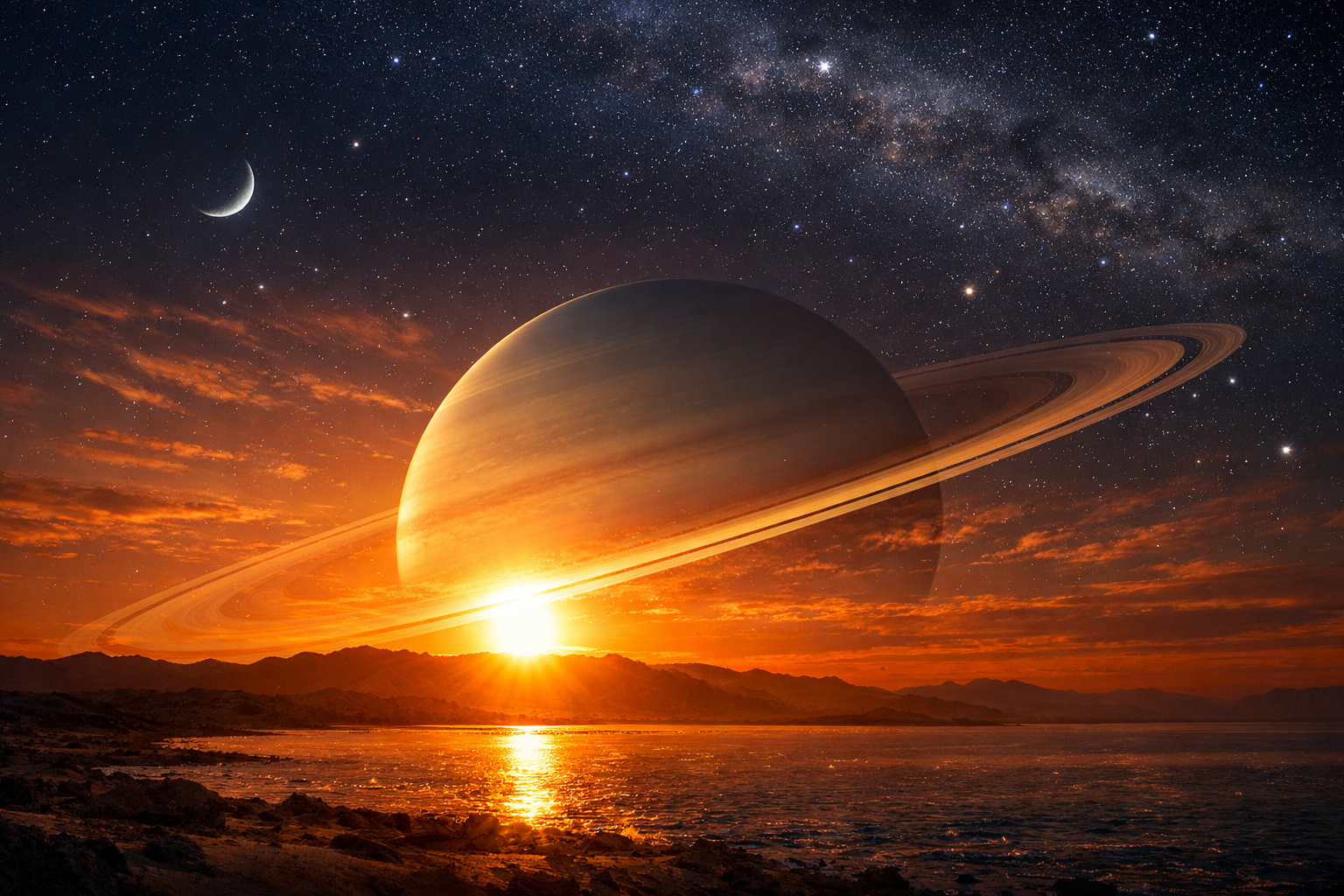
February Closes the Observing Season for Saturn and Changes the Night Sky Scenario, with Eclipses, Celestial Encounters, and Highlighted Planets for Observers in Brazil and the World
February, known for being the shortest month of the year, brings a significant farewell for astronomy lovers. The planet Saturn, famous for its imposing rings and unmistakable appearance, will no longer be visible in the afternoon sky throughout the month, gradually disappearing in the intense brightness of the Sun. This phenomenon marks the end of a viewing window that has been extending since previous months and significantly alters the astronomical landscape visible to the naked eye and with telescopes.
This information was released by Revista Galileu, in a column signed by astrophysicist Gustavo Rojas from NUCLIO in Portugal, as published in the Sky of the Month editorial. According to the expert, Saturn’s disappearance occurs because the planet is angularly approaching the Sun in the sky, becoming invisible due to the excess of solar brightness on the western horizon during sunset.
Furthermore, February is not just about bidding farewell to the “lord of the rings.” On the contrary, the month reserves a series of relevant astronomical events, ranging from encounters of the Moon with bright stars to solar eclipses and great opportunities to observe other planets in the Solar System.
-
Scientists have captured something never seen in space: newly born stars are creating gigantic rings of light a thousand times larger than the distance between the Earth and the Sun, and this changes everything we knew about stellar birth.

-
Geologists find traces of a continent that disappeared 155 million years ago after separating from Australia and reveal that it did not sink, but broke into fragments scattered across Southeast Asia.
-
Samsung launches cordless vertical vacuum cleaner with up to 400W of suction and relies on AI to automatically recognize corners, carpets, and different surfaces.

-
The lost continent beneath Europe: separated from North Africa about 240 million years ago, comparable in size to Greenland, Greater Adria was crushed over 40 million years and left geological marks from the Alps to the Balkans.

Saturn Bids Farewell to the Evening Sky While Jupiter Dominates the Nights
Throughout February, Saturn begins to set earlier and earlier, until it completely disappears from the evening sky by the end of the month. This condition occurs when the planet is in conjunction with the Sun, becoming aligned with our star from the Earth’s perspective. As a result, its observation becomes unfeasible both to the naked eye and with optical instruments.
Meanwhile, on the other hand, Jupiter takes the spotlight in the night sky. The largest planet in the Solar System remains visible for practically the entire night, offering an excellent opportunity for both beginner and experienced observers. With a simple telescope, it is already possible to identify its four main moons — Io, Europa, Ganymede, and Callisto — as well as details of the planet’s atmospheric bands.
This contrast between the farewell of Saturn and the prominence of Jupiter reinforces the constant dynamics of the sky, which changes month by month as planets perform their orbital motions. Thus, even with the exit of one of the most popular celestial bodies, February remains extremely appealing for those who enjoy following astronomical phenomena.
Celestial Encounters, Annular Eclipse, and Mercury in Highlight on the Horizon
The astronomical calendar for February brings notable events that deserve special attention. On the 11th, during the early morning, the waning Moon appears in the constellation Scorpius, very close to Antares, the brightest star in the region. Antares is a red giant easily identifiable to the naked eye, and the visual approach with the Moon creates a celestial spectacle noticeable from 1 a.m..
Then, on the 17th, an annular solar eclipse occurs, a phenomenon that happens when the Moon positions itself in front of the Sun but does not completely cover it. In this case, a so-called “ring of fire” forms in the sky. Although impressive, the eclipse will only be visible from Antarctica, and cannot be observed from Brazil or most of the planet.
Subsequently, on the 19th, one of the best opportunities of the month to observe Mercury arises, considered the most difficult planet to see with the naked eye. Being always very close to the Sun, Mercury only becomes visible during its maximum elongations when it is angularly away from our star. The recommendation is to look closely at the western horizon just before sunset, in areas with an unobstructed view.
Moon, Pleiades, and Final Highlights of the Astronomical Month
Concluding the main events of February, the 23rd reserves a beautiful encounter between the crescent Moon and the star cluster of the Pleiades, one of the best-known and observable star groups in the night sky. The Pleiades can be easily seen with the naked eye and gain even more prominence when accompanied by the Moon, forming a visually appreciated composition for amateur astronomers and sky photographers.
This type of alignment not only visually enchants but also serves as a gateway to astronomical observation, especially for those just starting out. Thus, even with Saturn’s farewell from the afternoon sky, February compensates with a series of phenomena that reinforce the richness and diversity of the firmament.
Throughout the month, therefore, the sky transforms, offering different protagonists and observation experiences. For those following the astronomical calendar, February confirms that, despite being the shortest month of the year, it is far from being poor in relevant celestial events.






-

-

-

-

-

-

294 pessoas reagiram a isso.