





 Portuguese
  English
  Spanish
  4 min of reading
  0 comments


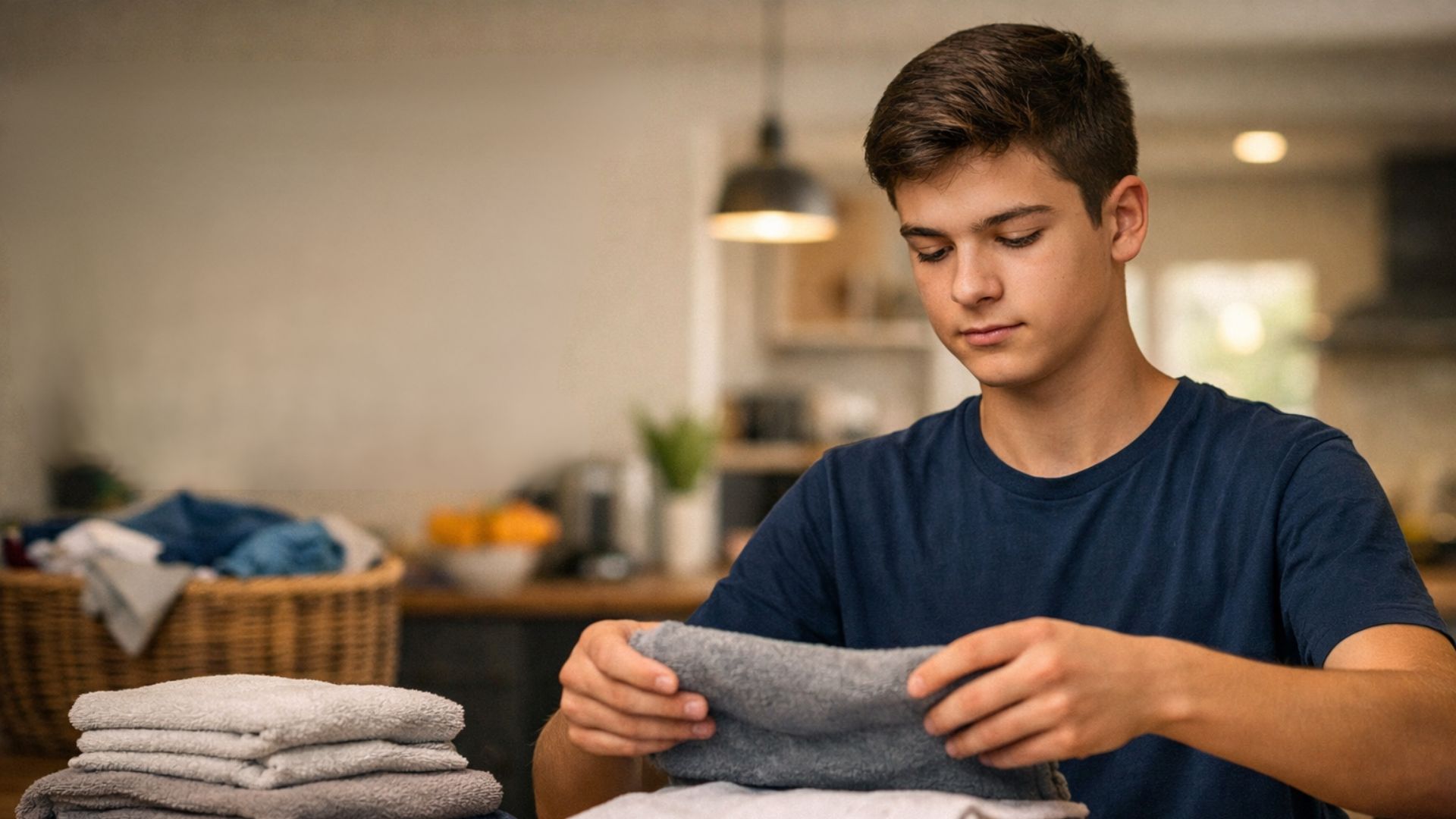
Domestic participation shapes autonomy, responsibility, and perception of capacity among adolescents, with impacts that extend to organization, emotional well-being, and development of cognitive skills over the lifetime.
The frequent participation of adolescents in household tasks is associated, in the scientific literature, with the development of important competencies for everyday life, such as autonomy, persistence, sense of usefulness, and responsibility.
In psychology, this process is close to the concept of self-efficacy, defined as the belief that a person is capable of organizing actions, facing real demands, and producing results from their own effort.
This type of learning does not usually arise only from major achievements, such as passing an exam or winning a sports award.
-
The generation that grew up alone at home in the 80s reveals how an unsupervised childhood shaped adults with high adaptability, resilience, and emotional control, according to scientific studies that indicate a significant increase in tolerance for uncertainty.
-
Children who played in the street without rules developed up to 5 essential emotional skills, such as resilience, self-control, and empathy, according to psychology, and may today have greater mental balance in the face of frustrations and challenges of adult life.
-
Brazil’s neighbor presents a super military aircraft with a digital glass cockpit, +6G/-3G aerobatics, a replacement for a model over 40 years old, testing in 2027, and production expected in 2030 with 100% national technology.

-
The 3rd best city in Brazil is located in the interior of São Paulo and impresses by reaching 12th place among 5,570 cities in the IPS 2025, with highlights in 57 indicators and a strong university hub.

In general, it is formed through repeated and concrete experiences, where the young person perceives that they can start a task, sustain it until the end, and take responsibility for what they have done, even in simple activities of daily life.
Self-efficacy in adolescence and domestic routine
When an adolescent tidies their room, organizes materials, helps with the dishes, sorts clothes, or participates in preparing a meal, the effect is not limited to fulfilling a family rule.
These actions can serve as practical mastery experiences, which play a central role in building self-efficacy throughout development.
The literature also indicates that household responsibilities, when distributed appropriately according to age and with guidance, can promote independence and self-control.
In a longitudinal study published in 2019, researchers observed that performing household tasks in childhood was associated, years later, with indicators such as self-competence and pro-social behavior.
In practice, this helps explain why the home routine can function as a space for emotional and behavioral learning.
Instead of just hearing that they are capable, the adolescent gathers small concrete evidence that they can collaborate, solve problems, remember steps, correct mistakes, and complete what they started, which tends to strengthen their perception of competence.
Cognitive benefits and impact on performance
Recent research has also begun to relate participation in household tasks to important cognitive skills.
A study from La Trobe University in Australia pointed to an association between engagement in self-care and family care tasks and better performance in working memory and inhibition, functions linked to planning, attention, and impulse control.
Although this type of evidence does not allow for asserting cause and effect in all cases, it reinforces the idea that the home is not just a place of demands, but also a training environment.
Routine activities require remembering instructions, organizing steps, alternating actions, and sustaining attention, capacities that also appear in school and social contexts.
Another relevant point is that self-efficacy in adolescence is related to psychological well-being.
In a study with 3,485 adolescents, researchers identified that higher levels of self-efficacy in areas such as academic, social, and emotional were linked to better indicators of health and well-being.
This does not mean that household tasks alone resolve emotional difficulties, but it helps to understand why everyday experiences of competence matter.
Limits between participation and family overload
Healthy participation, however, depends on how this responsibility is organized within the family.
The literature distinguishes experiences that promote learning from those marked by excess, rigidity, or inequality in the distribution of tasks, especially when they disproportionately fall on girls or interfere with study and rest time.
A study with adolescents from public schools showed, for example, that the relationship between household tasks, life projects, and academic performance is not linear and can vary according to gender and social context.
Among the girls in the sample, a greater burden of responsibilities was associated with poorer academic performance in a specific subset, reinforcing the need for caution against simplistic generalizations.
Therefore, experts often differentiate participation from overload.
When there is guidance, recognition, and reasonable division, the task can enhance autonomy and a sense of belonging.
However, when the domestic routine becomes an excessive burden, constant punishment, or a replacement for care that should be provided by adults, the effect can be the opposite and increase tension, wear, and inequality.
How the domestic routine influences behavior and bonds
Understanding this process changes the way we view common behaviors in adolescence.
In many cases, resistance to a task does not merely express disinterest, but also a lack of habit, fear of making mistakes, little clarity about what to do, or absence of gradual participation in age-appropriate responsibilities.
In this scenario, the most consistent gain is not in immediate obedience, but in the repetition of experiences where the young person perceives that they can indeed contribute.
The routine stops functioning merely as a control system and begins to operate as a space for concrete learning, where responsibility, autonomy, and competence are built in everyday life, without grandiose speeches and easy promises.





Seja o primeiro a reagir!