





 Portuguese
  English
  Spanish
  10 min of reading
  0 comments


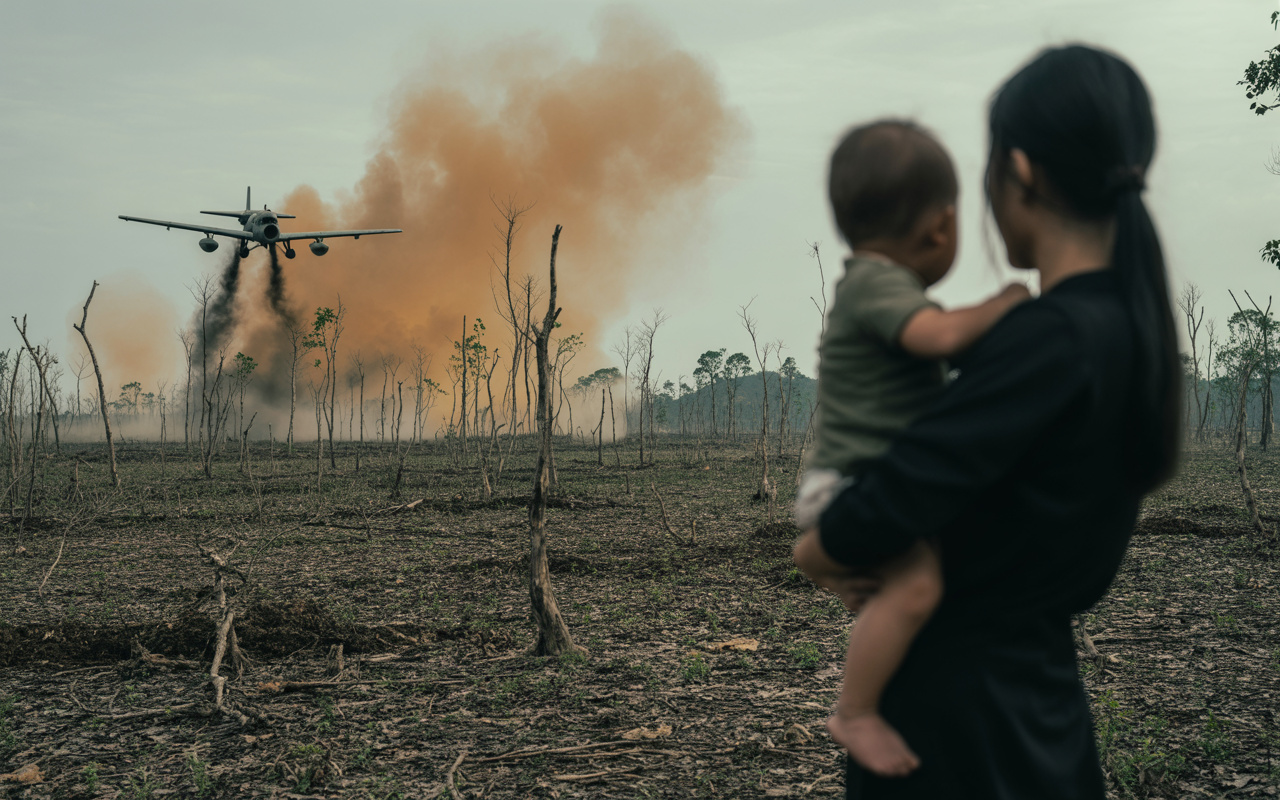
The U.S. Dumped 76 Million Liters of Agent Orange in Vietnam; 50 Years Later, Dioxin Still Causes Birth Defects and Cancer, Revealing a Persistent Environmental Legacy.
In 1968, midwife Nguyen Thi Phuong was on duty at a hospital in Saigon when she delivered a baby that would haunt her forever. The child was born without a brain and spine — just a malformed torso with shrunken limbs.
“I didn’t show the mother because I feared she would go into shock,” Phuong recalled decades later, her voice breaking. “But the father and other relatives insisted on seeing, and it was horrible.”
In the following months, Phuong would deliver dozens of babies with equally severe deformities — three or four a week. Babies born with organs outside their bodies. No arms. No legs. No eyes. It was 1968, two years after the United States had ramped up its use of herbicides in Vietnam to millions of gallons.
-
Friends have been building a small “town” for 30 years to grow old together, with compact houses, a common area, nature surrounding it, and a collective life project designed for friendship, coexistence, and simplicity.

-
This small town in Germany created its own currency 24 years ago, today it circulates millions per year, is accepted in over 300 stores, and the German government allowed all of this to happen under one condition.

-
Curitiba is shrinking and is expected to lose 97,000 residents by 2050, while inland cities in Paraná such as Sarandi, Araucária, and Toledo are experiencing accelerated growth that is changing the entire state’s map.

-
Tourists were poisoned on Everest in a million-dollar fraud scheme involving helicopters that diverted over $19 million and shocked international authorities.


The Name of the Guilty: Agent Orange
Between 1961 and 1971, Operation Ranch Hand dumped approximately 76 million liters (20 million gallons) of herbicides over South Vietnam and border areas of Laos and Cambodia. Of that, around 50 million liters were Agent Orange — containing approximately 170 kilograms of dioxin, one of the most toxic compounds ever created by man.


Today, more than 50 years after the last drop of Agent Orange was sprayed, Vietnamese babies still are born with devastating birth defects. The third generation of children whose grandparents were exposed to the herbicide continue to suffer the consequences of a chemical weapon that has not stopped killing.
What Is Agent Orange and Why Does It Still Kill
Agent Orange was a mixture of two herbicides: 2,4-dichlorophenoxyacetic acid (2,4-D) and 2,4,5-trichlorophenoxyacetic acid (2,4,5-T). The name came from the orange stripes painted on the 208-liter drums used to store it.
But it was not just a herbicide. During the manufacturing process of 2,4,5-T, a deadly byproduct was formed: 2,3,7,8-tetrachlorodibenzo-p-dioxin, simply known as TCDD or dioxin. This substance is so toxic that just 170 kilograms dumped over Vietnam would cause decades of suffering.
Dioxin is one of the most toxic substances known. It is persistent in the environment, bioaccumulative (concentrates in the food chain), and has a half-life of decades in the soil. More than 30 years after spraying, concentrations of TCDD up to 1,000 mg/kg have been found in soil and sediment samples in Vietnam.
American companies like Dow Chemical and Monsanto produced Agent Orange. In the rush of war, manufacturing standards were relaxed. The Agent Orange used in Vietnam contained dioxin levels much higher than in commercial products — up to 13 times the limits considered “safe” at the time.
Operation Ranch Hand: Industrial-Scale Destruction
Operation Ranch Hand was the largest herbicidal warfare campaign the world has ever seen. Between 1962 and 1971, C-123 planes flew low over forests, fields, and villages, dumping their toxic payload.
The official goal was twofold: to defoliate dense forests that provided cover for Viet Cong troops and to destroy crops that fed the enemy. The unofficial goal, according to political scientist Samuel P. Huntington, was part of a “forced urbanization” policy — to destroy the ability of peasants to sustain themselves in the countryside, forcing them to flee to U.S.-held cities.
The numbers are staggering:
- 76 million liters of various herbicides (“rainbow herbicides”)
- 50 million liters of Agent Orange specifically
- 3.6 million hectares sprayed (approximately 10% of South Vietnam)
- 6,500 spraying missions between 1968 and 1971
- 2.1 to 4.8 million Vietnamese civilians exposed directly
To put it in scale: 76 million liters would fill more than 115 Olympic swimming pools. Imagine that entire volume of chemical poison dumped from the sky over forests, crops, and inhabited villages.
The Victims: Numbers That Keep Growing
Vietnamese statistics on Agent Orange are controversial, with the U.S. government questioning their reliability. But even conservative estimates paint a devastating picture.

According to the Vietnamese government:
- 4 million people were exposed to Agent Orange
- 3 million suffered health problems related to exposure
- 400,000 people died or became permanently disabled
- 500,000 babies were born with birth defects
According to the Vietnam Red Cross:
- Up to 1 million people are currently disabled or have health problems due to Agent Orange contamination
According to independent studies:
- A 2003 study by Professor Jeanne Stellman from Columbia University estimated that 2.1 to 4.8 million Vietnamese civilians were exposed to the chemicals during the war
But these are just the direct victims. The horror of Agent Orange is that it does not stop with the first generation.
The Curse of Generations: How Dioxin Passes from Parents to Children
Dioxin has a particularly sinister characteristic: it can cause genetic damage that is passed on to future generations.
In the 1970s, high levels of dioxin were found in the breast milk of southern Vietnamese women and in the blood of American soldiers who had served in Vietnam. Decades later, these concentrations can still be detected.
How Transmission Happens:
- Ongoing Environmental Exposure: Dioxin remains in soil and sediments for decades. It enters the food chain through plants, fish, and livestock. Vietnamese who have never been near the war still consume contaminated food.
- Maternal Transmission: Women exposed to dioxin accumulate the compound in their fatty tissues. During pregnancy and breastfeeding, dioxin is transferred to the baby.
- Epigenetic Damage: Recent studies identify epigenetic links between exposure to toxins and birth defects in subsequent generations. Dioxin can alter how genes are expressed without changing the DNA itself — and these changes may be inherited.
Dr. Nguyen Viet Nhan studied children in areas where Agent Orange was used. The results were devastating: multiple health problems including cleft palate, mental deficiencies, hernias, extra fingers and toes, heart defects, cleft lip, neural tube defects, learning and behavioral problems, immune system disorders, childhood cancers, and endocrine issues.
The Babies That Should Not Exist: Third Generation of Victims
Dao Thi Kieu was 16 years old when she saw planes for the first time. She was working in the rice fields when the aircraft flew over in the morning, leaving a mist that fell over her and the plants.
“It smelled like ripe guava,” Kieu recalled, now 58 years old. “No trees survived. It soaked my clothes.”
Kieu had children. Her children had children. And now, decades after the planes stopped flying, Kieu’s grandchildren — the third generation — are being born with defects that doctors link to Agent Orange.
An eight-year-old boy (name protected as “Danh”) was born with cleft lip, cleft palate, and congenital heart disease. He spent his first month in an incubator struggling to breathe. Today he is as thin as a twig. He cannot speak and is mentally disabled. His mother, Lien, cares for him with exhausted resignation.
“In the first millisecond, it just felt like the skin was heating up,” described a Vietnamese doctor. “Then you realize it’s not normal.”
More than 5 in every 100 Vietnamese children are born with some form of physical or mental abnormality — a fourfold increase since the beginning of the war, according to Vietnamese scientists.
The Controversial Science: Proving the Unlikely
Establishing scientific causation between Agent Orange and birth defects has proven extraordinarily difficult — and politically charged.
Animal Studies: Since the 1970s, numerous animal studies have found that fetuses exposed to dioxin exhibit a wide range of birth defects and developmental issues. This makes a biological impact on human fetuses plausible.
Human Studies: Documenting in humans has proven much more difficult. In 2005, the U.S. National Institute of Environmental Health Sciences (NIEHS) approved a 5-year, US$ 3.5 million study proposed by Dr. David Carpenter of the University of Albany. The study planned to analyze dioxin levels in the blood of 300 Vietnamese mothers of babies with birth defects, using 300 mothers of healthy babies as controls.
The NIEHS canceled the study in 2005 after failing to agree on research protocols with the Vietnamese Ministry of Health. American scientists typically dismiss Vietnamese research, noting that it rarely appears in high-quality Western journals. Vietnamese authorities did not allow American experts to conduct their own studies in Vietnam.
Meta-analyses: In 2006, Dr. Anh Duc Ngo and colleagues from the University of Texas published a meta-analysis that exposed great heterogeneity among studies — consistent with a lack of consensus on the issue. Despite this, the statistical analysis resulted in data showing that the increase in relative risk of birth defects due to exposure to Agent Orange “seems” to be in the order of 3 in Vietnam-funded studies, but 1.29 in the rest of the world.
Official Recognition: In 1996, the U.S. National Academy of Sciences reported “limited/suggestive evidence” of association between exposure to Agent Orange and spina bifida in the children of veterans. The only birth defect recognized for the children of American male veterans is spina bifida, resulting in most affected children not receiving benefits.
American Veterans: Contaminated by Their Own Weapon
The tragedy of Agent Orange did not spare even the American soldiers who sprayed it.
Approximately 2.6 million veterans served in Vietnam. U.S. Armed Forces and Free World Military Assistance soldiers were instructed not to worry about Agent Orange and were led to believe that the chemical was harmless.
After returning home, veterans from all countries who served began to suspect that their poor health or instances of their wives having miscarriages or children being born with birth defects might be related to Agent Orange and the other toxic herbicides they had been exposed to in Vietnam.
U.S. veterans began filing claims in 1977 with the Department of Veterans Affairs for disability payments for health care for conditions they believed were associated with exposure to Agent Orange, but their claims were denied unless they could prove that the condition began while they were on duty or within a year of their discharge.
A 2018 report from the U.S. National Academy of Sciences found “sufficient” or “suggestive” evidence linking 19 conditions to herbicide exposure, including:
- Chronic B cell lymphocytic leukemia
- Hodgkin lymphoma
- Multiple myeloma
- Non-Hodgkin lymphoma
- Prostate cancer
- Respiratory cancer
- Soft tissue sarcomas
- Type 2 diabetes
The U.S. government spent US$ 13.7 billion in 2023 on disability payments for over 1 million Vietnam veterans, many of whom were exposed to herbicides. Millions more were spent compensating families of veterans whose children were born with birth defects.
The Cruel Asymmetry: Justice for Americans, Nothing for Vietnamese
In 1979, American veterans sued the chemical companies that produced Agent Orange. In 1984, they reached a US$ 180 million settlement. American veterans exposed to Agent Orange now receive disability benefits and medical assistance.
In 2004, Vietnamese tried the same. The Vietnam Association of Victims of Agent Orange/Dioxin filed a class action lawsuit against American chemical companies, including Dow and Monsanto.
The case was dismissed in 2005. Judge Jack B. Weinstein ruled that Agent Orange was not a “poison weapon” prohibited by international law and that therefore the manufacturers could not be held liable. The U.S. government filed a statement to the court supporting the chemical companies.
No assistance was given to the children of Vietnamese men or women or Vietnamese Americans related to their exposure, or their parents’ or grandparents’ exposure.
The discrepancy is striking: American veterans exposed to Agent Orange receive lifetime compensation. Vietnamese — whose country was intentionally sprayed with 76 million liters of the herbicide — receive nothing.
The Hotspots That Were Never Cleaned
Today, there are still dozens of environmental hotspots that continue to contaminate food, soil, sediments, livestock, and wildlife with Agent Orange.
Da Nang Airport was one of the main storage and mixing sites for herbicides during the war. In 2011, workers began excavating the soil there and heating it to destroy the dioxin. It was the first large-scale cleanup operation in Vietnam.
But Da Nang is just one site. There are an estimated 28 dioxin hotspots in Vietnam — areas where concentrations remain dangerously high more than 50 years later.
In the most affected areas — the mountainous region along the Truong Son Mountains and the border between Vietnam and Cambodia — affected residents live in dire conditions with many genetic diseases.
The Slow Response of the U.S.
For decades, the U.S. government has resisted fully acknowledging the consequences of Agent Orange in Vietnam.
Since the countries normalized relations in 1995, Congress has allocated at least US$ 125 million to combat HIV/AIDS in Vietnam (whose infection rate ranks 67th in the world). About US$ 46 million has been provided to help Vietnamese who lost limbs to unexploded bombs dropped by the United States.
But until recently, little help has been directed specifically at victims of Agent Orange.
In December 2014, Congress finally passed a five-year, US$ 21 million humanitarian aid package that, for the first time, provides assistance specifically to severely disabled individuals living in areas that were sprayed during the war.
Charles Bailey, former director of the Agent Orange Program in Vietnam for the Aspen Institute, described the aid as a break that “ensures our humanitarian assistance goes to those with the greatest needs.”
But US$ 21 million over five years for millions of victims over three generations? It’s a drop in the ocean compared to the US$ 13.7 billion spent annually just on American veterans.
The Legacy That Never Ends
More than 50 years after the last flight of Operation Ranch Hand, Agent Orange continues to kill.
Vietnamese babies are still being born without limbs. Children still develop rare cancers. Young adults — grandchildren of those who were sprayed in the 1960s — still suffer mental and physical disabilities that their grandparents never had.
The dioxin in the soil of Vietnam has a half-life of decades. It is in the food chain. It is in breast milk. It is in the river fish. It will be there for generations yet unborn.
“The ongoing burden of disease among exposed populations means that the legacy of dioxin in Vietnam remains a significant public health challenge,” says environmental health scientist Tran Thi Tuyet-Hanh from Hanoi Public Health University.
Seventy-six million liters dumped in a decade. Fifty years of suffering. Three generations of victims. And it’s still not over.
Agent Orange is not history. It is present. And it will continue to be future until the last molecule of dioxin finally decomposes in the Vietnamese soil — which may take another century.
As a Vietnamese midwife who delivered hundreds of deformed babies said through tears: “The war ended in 1975. But for these children, the war never ended.”










-

-

-

15 pessoas reagiram a isso.