





 Portuguese
  English
  Spanish
  8 min of reading
  6 comments


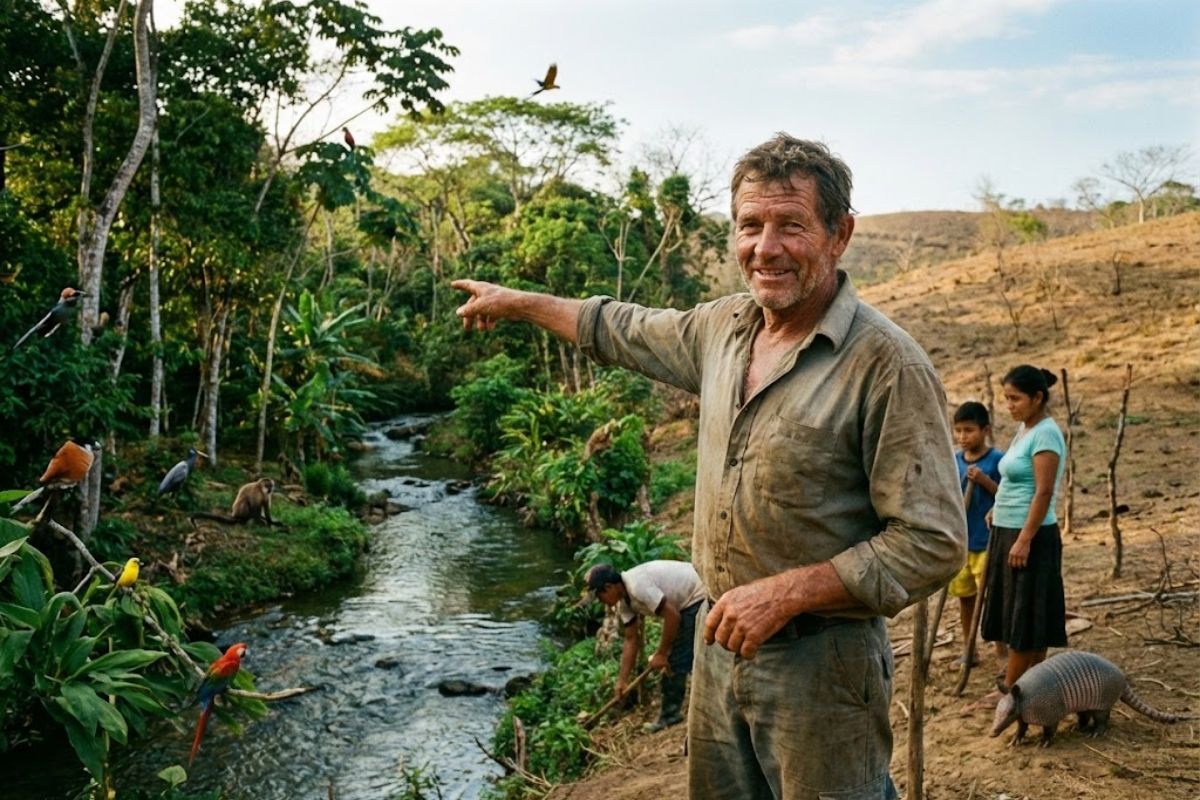


In Piraí do Norte, in the Baiano Semi-Arid, Ernst Gotsch Bought 500 Degraded Hectares and, with Synergistic Agriculture, Rebuilt a Productive Forest that Mixes Crops and Forest. In a Few Years, the Shade Brought Cocoa, Diversity of Species, and Signs of Water: Streams that Were Once Dry Returned, and Wildlife Came Back to the Region.
The forest that today occupies areas once depleted in the interior of Bahia started as a bet against the more common logic of the countryside: simplifying the environment to produce. Instead of “clearing” the land and insisting on a single crop, the proposal was to do the opposite and treat diversity as a tool for recovery.
At the center of this transformation are Swiss Ernst Gotsch, who emigrated to Brazil in the 1980s, and Nelson Araújo Filho, his apprentice. On different scales, 500 hectares in Gotsch’s case and 1.8 hectares in Araújo’s, both applied a system that attempts to imitate the original forest of each location while simultaneously maintaining agricultural production.
The Productive Forest that Exchanges “Monoculture” for Coexistence of Species

When talking about a productive forest, the point is not to “go back to the past” as if the land needed to be untouched to function. The proposal is to create an environment where crops and forest stop competing all the time and start to play complementary roles, with species occupying different heights, different shades, and different growth rhythms.
-
Friends have been building a small “town” for 30 years to grow old together, with compact houses, a common area, nature surrounding it, and a collective life project designed for friendship, coexistence, and simplicity.

-
This small town in Germany created its own currency 24 years ago, today it circulates millions per year, is accepted in over 300 stores, and the German government allowed all of this to happen under one condition.

-
Curitiba is shrinking and is expected to lose 97,000 residents by 2050, while inland cities in Paraná such as Sarandi, Araucária, and Toledo are experiencing accelerated growth that is changing the entire state’s map.

-
Tourists were poisoned on Everest in a million-dollar fraud scheme involving helicopters that diverted over $19 million and shocked international authorities.



Instead of a uniform area, the landscape becomes a living mosaic. Trees, shrubs, food crops, and support plants coexist, and this changes the microclimate of the ground: more coverage, less direct wind, less drying out. The forest, in this sense, is not just a scenery; it is the very “engine” of the system because it organizes light, moisture, and organic matter.
This arrangement also repositions what would normally be seen as a problem. Fungi, insects, and bacteria are no longer automatically treated as enemies but are read as signals. The idea is that the presence of certain organisms indicates the state of the planting and guides management decisions instead of pushing everything into a constant chemical war.
What is Synergistic Agriculture and Why Does it Change the Soil?

The technique associated with this approach became known as synergistic agriculture. The word draws attention, but the principle is quite straightforward: observe how a forest structures itself and try to reproduce its processes, with plantings that follow development phases and management to keep the cycle of organic matter moving.
In practice, this means working with successions of species and with strata, thinking about what grows quickly, what creates shade, what protects the soil, what produces food, and what supports the whole over time. The forest functions as a network of exchanges, and management seeks to keep these exchanges alive. It is not “planting trees” and waiting; it is guiding the system so that it reorganizes itself.
This type of guidance changes the soil because it exchanges exposure for protection. Bare soil tends to lose moisture, suffer erosion, and “disintegrate” its structure over time. A covered soil, with diverse roots and renewing organic matter, tends to improve its infiltration capacity and physical stability. This is where the forest stops being just “green” and becomes a method of recovering degraded soil.
When the Forest Becomes Water: The Return of the Streams

One of the most striking accounts of this process involves water. Upon reaching the purchased land, Gotsch claims that eleven streams had disappeared as a result of deforestation and erosion. From reforestation and redesigning land use, he asserts that the streams have returned to flow, reinforcing the idea that he himself summarizes as “planting water”.

There is a possible ecological logic behind this type of return, without needing to turn the story into a miracle. In degraded environments, rainwater can quickly run off the surface, carrying soil particles and feeding erosion, instead of infiltrating. When the forest returns, the cover reduces the direct impact of rain, roots create paths in the soil, and organic matter helps retain moisture. This can favor recharge and maintenance of moisture for longer periods.
What draws attention is the linkage: the forest alters the microclimate, the soil responds, and the local water cycle may gain momentum. Even so, it’s worth maintaining careful reading: each area has its conditions, and the return of streams depends on many factors. The main point is that the forest was treated as ecological infrastructure, not as decoration.
Animals, Pests, and Indicators: The Return of Life
The reappearance of animals, including those described as rare or considered extinct in the region, emerges as a consequence observed after the environment has been recomposed. When the forest again offers shelter, food, and vegetation corridors, wildlife tends to respond. This is not automatic everywhere, but it makes sense that a more diverse territory invites back species that had lost space.
This return also alters the way of seeing “pests.” In simplified systems, a specific insect finds an abundance of the same food and multiplies rapidly, becoming a crisis. In diverse systems, predators, competitors, and variations of food tend to balance populations. Hence the idea that pests can become allies as thermometers of imbalance, indicating where management needs to adjust shade, density, variety, or coverage.
There’s also an important indirect effect: when the forest structures the environment, the cycles of decomposition and fertility can become more stable. Fungi and bacteria, far from being “villains,” are part of the process of transforming vegetable residues into available nutrients. This is one of the reasons why synergistic agriculture insists on using natural dynamics as allies: biological balance can reduce dependence on aggressive solutions.
Why Did Cocoa Become a Symbol of the Productive Forest?

Among the crops associated with Gotsch’s work, cocoa appears as the main product. This aligns with the logic of the system because cocoa is a plant that develops well in the shade, benefiting from the protection offered by upper strata trees and species. In other words, cocoa helps to “pay the bill” while the forest consolidates.
The highlight of cocoa does not mean that the forest is a disguised monoculture. On the contrary: it enters as a piece within a larger set. Production begins to depend on the arrangement, not on a single dominant species. The shade ceases to be a problem and becomes technology because it regulates temperature, moisture, and plant stress.

This type of strategy also explains why areas once used for cassava, sweet potato, and corn, and later degraded, can change appearance when entering a more diverse model. The reported result is a green landscape, with different strata and densities, quite distant from the “clean” land standard often associated with productivity.
From 500 Hectares to 1.8 Hectares: What Changes When the Scale Changes?
Gotsch’s case draws attention due to the scale: 500 hectares in Piraí do Norte, Bahia. Meanwhile, Nelson Araújo Filho’s case shows that the method does not depend solely on large properties, as he applied the same logic on 1.8 hectares, approximately the size of two soccer fields. This size difference helps answer a common question: “Does this only work for those with a lot of land?”
The scale alters the challenge but does not change the principle. In a larger area, planning the mosaic, access to labor, and the timing of management become even more critical. In a smaller area, the precision of planting and the intensity of management can be greater, and results can be perceived more clearly on a day-to-day basis. In both cases, the forest is treated as an agricultural system, not as landscaping.
Another reported point is the response time: improvements may already be perceptible after three years of system implementation. Three years in the field may seem short to those who imagine reforestation as something that only yields returns in decades. Therefore, the story provokes debate: it suggests that, when the focus is on ecological processes and continuous management, the forest can accelerate signs of soil and environmental recovery.
Why Did Companies Start Seeking the Method?

When multinational companies show interest in learning and reproducing a system, this usually happens for two reasons that do not always coexist harmoniously: expectations of results and the necessity for reputation. In the case described, what attracts them is the possibility of reconciling agricultural production with reforestation, recovering degraded areas and making them productive without relying on the paradigm of extreme simplification.
From a technical standpoint, synergistic forest agriculture attracts attention because it proposes a management pathway: plant, guide, prune, renew, and maintain active cover. This can be especially relevant where the soil has already been depleted, where erosion has advanced, and where water has become the bottleneck. Recovering soil is not just correcting chemistry; it’s about rebuilding structure and life.
At the same time, corporate interest does not automatically transform the model into a universal solution. Agroforestry systems require local knowledge, adaptation of species to the environment, and a real learning curve. The merit of this case is to show a possible path, based on observation and replication of forest processes, without falling into the easy promise of a “magic formula”.
The story of a forest reappearing where there was almost a desert in the interior of Bahia gains strength because it combines three things that rarely walk together in the popular imagination: production, environmental recovery, and water returning to circulate. With synergistic agriculture, the experience of Ernst Gotsch and Nelson Araújo Filho places diversity as a strategy and transforms what was once a sign of soil failure into a sign of environmental recomposition.
Now I want to spark a direct conversation: If you had a degraded area, would you bet on a productive forest or still trust more in the logic of monoculture?
In your region, have you ever seen a spring or stream return after some vegetation recovery, or has the water only diminished over time? Sharing the place and experience completely changes the debate.










Piraí nao é no Semi arido, é Mata atlântica. Quem tá no semiárido e Nelson Araujo
A questão é: será que os governos e as populações estarão interessadas em investir numa agricultura que regenera?! Ou todo trabalho e boa vontade vai ter que ficar nas costas do agricultor solitário que ainda vai ser chamado de **** pelos vizinhos por estar plantando árvores que não são comida humana e sim do solo, mas sem valor econômico?! E treinar e preparar os agricultores a trabalhar com esse método, quem vai fazer?! O Ernst sozinho ou o Nelson?! A sociedade precisa assumir o investimento nessa alternativa
Em 1995 passou essa história no Globo Rural. Ele,na época, tinha duas crianças.