





 Portuguese
  English
  Spanish
  5 min of reading
  0 comments


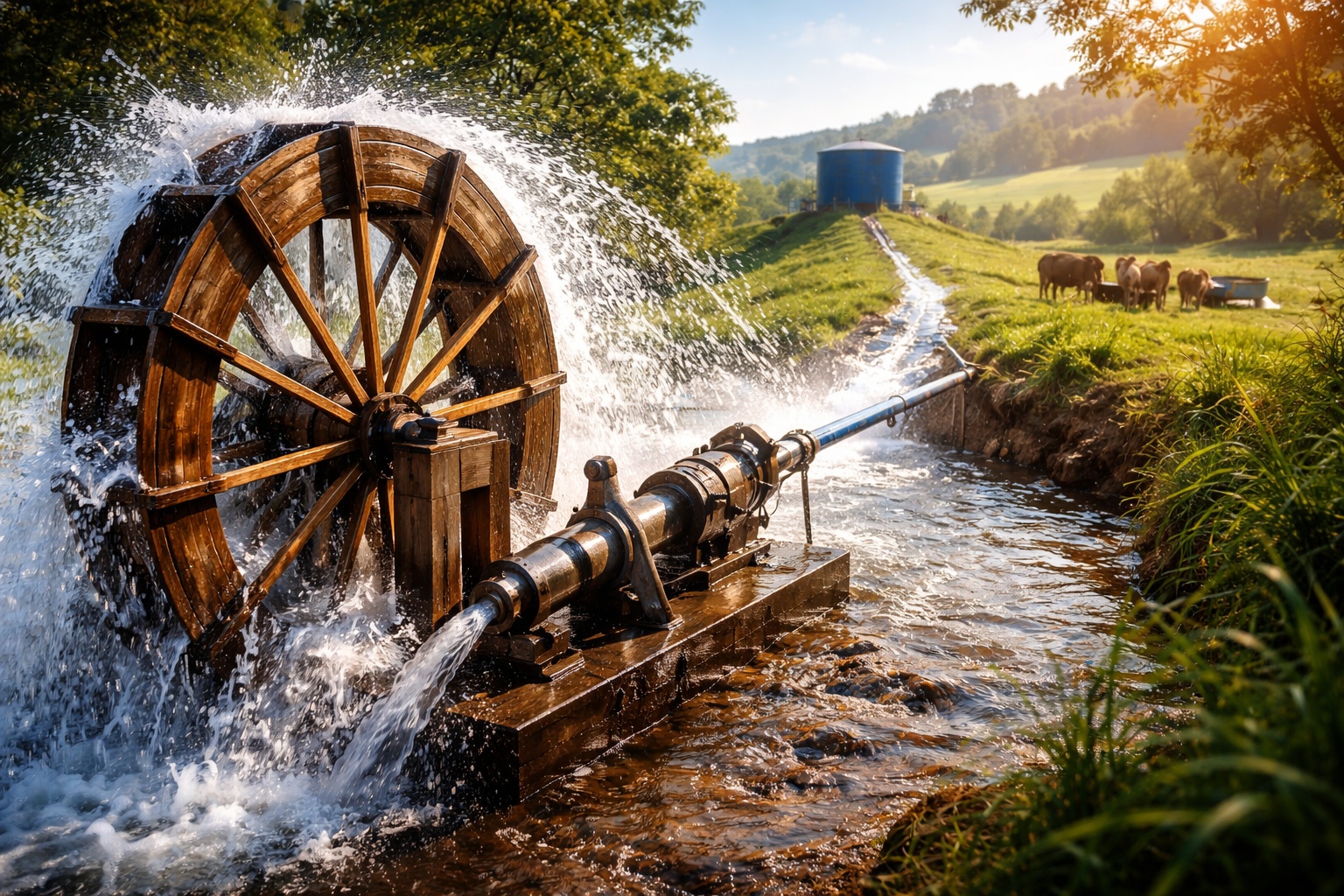
Water Wheel Pumping System Uses Only Current Force to Send Water to Tanks and Rural Irrigation Without Motor, Fuel, or Electric Energy.
In many rural properties where there are small streams, springs, or creeks, an ancient technology has once again attracted the attention of farmers looking to reduce costs with electric energy and fuel: the water wheel attached to a mechanical pump. This system harnesses the natural force of flowing water to generate continuous movement and power equipment capable of raising water to tanks, boxes, or irrigation systems. Although the water wheel has been known since antiquity, it continues to be used in modern agricultural applications, particularly in rural areas without easy access to electricity. The device basically consists of a circular wheel equipped with blades or compartments that rotate when water flows through them, converting hydraulic energy into mechanical motion.
When connected to a piston pump or another mechanism for raising water, this rotation can be used to continuously transport water to higher levels on the property. This system allows for continuous water pumping using only the force of the river or spring current.
How Water Pumping with Water Wheel Works
The principle of operation is relatively simple. The flowing water from the creek or channel is directed toward the wheels’ blades, causing it to start rotating.
-
The water that almost everyone throws away after cooking potatoes carries nutrients released during the preparation and can be reused to help in the development of plants when used correctly at the base of gardens and pots, at no additional cost and without changing the routine.

-
The sea water temperature rose from 28 to 34 degrees in Santa Catarina and killed up to 90% of the oysters: producers who planted over 1 million seeds lost practically everything and say that if it happens again, production is doomed to end.

-
An Indian tree that grows in the Brazilian Northeast produces an oil capable of acting against more than 200 species of pests and interrupting the insect cycle, gaining ground as a natural alternative in soybean, cotton, and vegetable crops.

-
The rise in oil prices in the Middle East is already affecting Brazilian sugar: mills in the Central-South are seeing their margins shrink just as ethanol gains strength.

This rotary motion is transmitted to a central axle that can power various mechanical equipment, including hydraulic pumps. Among the most common applications are:
- piston pump activation
- pumping to elevated tanks
- crop irrigation
- supplying water to animal troughs
The installation process:

Research on agricultural equipment shows that water wheel powered pumps are considered a practical and economical solution for water pumping in rural properties, as they exclusively use the energy from the river current.

This type of system can operate continuously as long as there is sufficient water flow. The great advantage is that the system works without electricity and without fuel.

Minimum Requirements to Install a Water Wheel in Rural Properties
For the system to work correctly, some natural conditions need to exist on the property.
The main requirements are:
- presence of a stream, creek, or water channel
- small waterfall or slope in the terrain
- constant flow throughout the year
- space for installing the wheel and pump


In many rural projects, a relatively small fall of about one meter can already be sufficient to start the wheel’s movement, as long as there is adequate flow. The water that moves the wheel does not necessarily have to be the same as that which will be pumped.
In some systems, the wheel merely provides mechanical energy for a pump that draws water from another source, such as a tank or spring. This characteristic differentiates the water wheel from other hydraulic systems used in the field.
Difference Between Water Wheel and Hydraulic Ram
Many farmers confuse the water wheel with what’s known as a hydraulic ram, but the two systems operate differently. The hydraulic ram uses the phenomenon of water hammer to lift some of the water passing through it, taking advantage of the pressure generated by the flow itself.
On the other hand, the water wheel functions as a mechanical machine driven by the river current. The main difference lies in the mode of operation:
- hydraulic ram uses flow pressure
- water wheel generates rotary motion
- wheel can activate independent pumps
- ram uses the water that enters the equipment itself
Because of this, the water wheel can be used to activate different types of mechanisms, including electric generators and agricultural equipment. This versatility is one of the reasons the system continues to be used in rural properties.
Water Pumping Capacity
The volume of water that can be pumped depends on several technical factors. Among the main ones are:
- wheel diameter
- speed of the river current
- height of water elevation
- type of pump attached
Modern water wheel powered pumps can transport thousands of liters per day to tanks located at higher levels on the property. Some commercial equipment available on the market can pump between approximately 1,300 and 6,500 liters per day, depending on local conditions and system configuration.
This volume may be enough to supply small irrigation areas or animal watering systems. Pumping capacity varies according to wheel size and flow strength.
Continuous Operation 24 Hours a Day
One of the biggest advantages of this type of equipment is continuous operation. As long as there is flowing water in the creek, the wheel will continue to turn and the pump will keep sending water to the reservoir. This means the system can operate:
- during the day
- at night
- for weeks or months in a row
Without relying on electricity or fuel. According to experts in agricultural hydraulic equipment, water wheel powered pumps can operate continuously with minimal maintenance for long periods, using only the hydraulic energy available on the property.
This type of continuous operation allows for slow accumulation of water throughout the day in tanks or reservoirs. Even with moderate flows, the system can fill reservoirs over the course of 24 hours.
Most Common Applications in Rural Properties
The water wheel for pumping is still used in various agricultural regions around the world. Among the most common applications are:
- irrigation of gardens and small crops
- supplying domestic reservoirs
- providing water for animals
- filling water tanks in areas without power
In properties with livestock, for example, the system can keep troughs always filled without the need for electric pumps. In mountainous regions or uneven terrain, it is also possible to use the wheel to transport water to higher points on the property. This technology allows for the utilization of the natural energy available in the rural environment.
Maintenance and Durability of the System
Another factor that stands out in this type of technology is durability. Water wheels can be constructed from various materials, such as:
- wood
- steel
- aluminum
- PVC
When installed correctly and protected against excessive corrosion, they can operate for many years. Maintenance is usually simple and mainly involves:
- checking bearings
- cleaning debris from the water channel
- inspecting the mechanical pump
Since there is no motor or complex electrical system, the risk of failures is usually lower. This mechanical simplicity contributes to the longevity of the system.
An Ancient Technology That Remains Useful in the Field
Despite the advancement of electric pumps and automated irrigation systems, traditional hydraulic technologies continue to be used in certain situations. The water wheel is an example of a solution that combines mechanical simplicity with direct utilization of the natural energy available in the environment.
In addition to reducing costs with electricity and fuel, the system also fits into agricultural production practices that seek greater energy autonomy. Therefore, even though it is a technology known for centuries, the water wheel still finds space in rural properties that have natural watercourses.










-

-

-

-

-

24 pessoas reagiram a isso.