





 Portuguese
  English
  Spanish
  6 min of reading
  0 comments


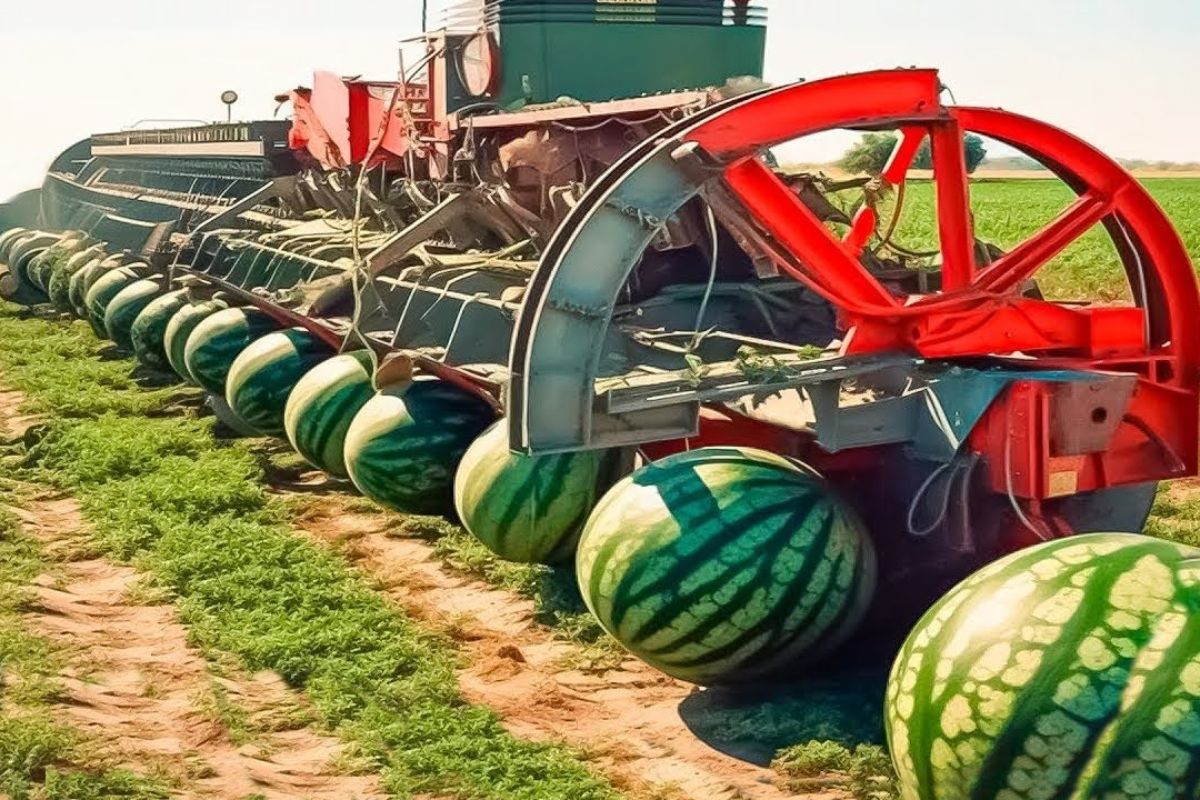
Farmers Are Adopting Equipment That Looks Simple, but Combines Conveyors, Agitators, and Transporters to Harvest Fruits with Care. Pumpkin, Apple, and Watermelon Harvesters Speed Up the Work Without Letting Production Fall to the Ground. Other Machines Prepare the Soil, Bury Stones, and Even Chop Wood, Reducing Effort, Cost, and Losses.
Farmers have always been skeptical when they heard that a machine could harvest pumpkin, apple, and watermelon without damaging the fruit. The doubt made sense: harvesting with care is part of the product’s value, and any bump, fall, or improper handling can compromise quality right in the field.
But the routine began to change when farmers saw equipment that, even though it looked simple, did the job with precision and consistency. Technology and agricultural equipment are constantly evolving, and this translates into savings of time and money, along with a new pace for harvesting, with less improvisation and more continuous flow.
Why So Many People Doubted Before Seeing It Work
The skepticism of farmers arises from a detail that doesn’t show up in catalogs: fruit is not a stiff piece. Pumpkin, apple, and watermelon react differently to pressure, falling, friction, and transport. When harvesting is done without attention, damage can happen in seconds.
-
While Russia dominates the global wheat market, Brazil emerges as an unexpected competitor in the Cerrado, offering grain available in July and August when stocks in the Northern Hemisphere are at their lowest point of the year.

-
China returned almost 20 Brazilian ships with soybeans, but now everything could change: the country that buys 80% of the grain is considering relaxing regulations after impurities held up shipments of thousands of tons and caused million-dollar losses.
-
The drought of the cerrado was considered an enemy of wheat, but Brazilian scientists turned the lack of rain into a competitive advantage by creating a grain with quality that is already attracting the attention of international mills around the world.
-
THE OWNER of Brazil: a farmer who came from laundries, created an ’empire’ and today runs a company valued at R$ 42 billion after tripling its value in less than a year and receiving a billion-dollar investment from the USA.


That’s why the proposal of these machines stands out. It’s not just the speed that changes.
What changes is the control of the fruit’s path, from the moment it leaves the ground or the tree to the point it goes to the tractor, trailer, or internal harvest transport.
Butternut Pumpkin Harvester: Harvesting with Care Becomes a Mechanical Rule

Among farmers, the Butternut pumpkin harvester stands out for working with different types of pumpkins, including acorn, butternut, golden nugget, and hubbard. The logic is simple and straightforward: harvest without damaging.
The machine responds to a well-known risk in the field. Improper harvesting can damage the pumpkin, turning routine work into avoidable losses.
By mechanizing the removal and handling, the equipment tries to standardize care, reducing the chance of cracks, bruises, and marks that appear when the process is rushed.
For many farmers, the practical impact is not in a technological “miracle,” but in repetition.
A machine maintains the same handling standard throughout the day, something difficult to sustain in manual harvesting when the pace increases.
Apple Harvester: Continuous Harvesting, Without Pauses and No Falling to the Ground

The apple harvester catches the attention of farmers for using the continuous harvesting method. The promise of “no pauses” is not just productivity; it’s organization: the trees are harvested continuously, and the workflow doesn’t depend on interruptions to reposition steps.
The center of the system is a continuous agitator. Instead of harvesting fruit by fruit, the equipment keeps the process active, and the collected fruits move along a conveyor belt to an adjacent tractor.
Here’s the detail that changes the perception of many farmers: the apples are transferred without falling to the ground.
This transition is crucial because the ground is often where impacts, dirt, and losses accumulate.
By keeping the fruit on a controlled path, the machine reduces the most sensitive point of the operation.
Watermelon Harvester: Worker Productivity Without Sacrificing the Fruit
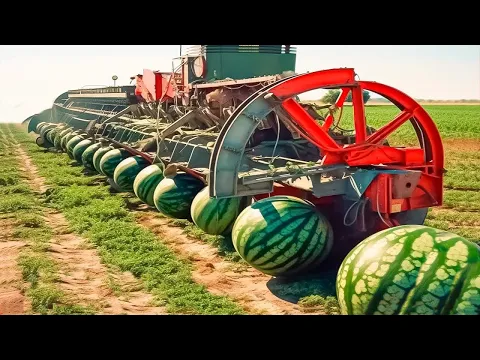

The watermelon harvester is tractor-pulled and designed to significantly speed up harvesting. For farmers, the gain lies in two points that rarely appear separately: speed and preservation.
The equipment is designed to maximize the worker’s productivity while preserving the fruit. The dynamic involves field teams picking watermelons from the ground and placing them on the conveyors.
From there, the conveyors carry the fruits or vegetables to workers on top of the trailer.
In practice, this changes the harvesting rhythm. Farmers stop relying on constant movements with fruit in hand and start organizing work around the flow of the conveyor.
Transport becomes part of the harvest, not an improvised bottleneck.
Soil Improvement: Preparing Before Planting to Avoid Problems Later
Not everything revolves around harvesting. Many farmers also change results when they mess with what comes before, the soil.
The soil improvement machine prepares the area by enhancing the soil up to 90 cm, with or without fertilizer, before planting.
The goal is to tackle soil compaction at the desired depth, removing the resistance that limits roots and water circulation.
When compaction is sufficiently removed across the entire area, the land begins to respond better to management and the subsequent steps of cultivation.
For farmers, this type of equipment is often the “invisible” factor that defines the rest of the harvest. The harvest shows up, but the structure of the soil supports the path to it.
Rock Burier RSE: Transforming Hard Soil Into a Bed Ready for Horticulture
In areas of hard soil, the rock burier RSE with bed former appears as a professional machine mainly used by horticultural companies.
The visual effect is impressive, but the function is objective: create a perfect layer of soil by burying the stones beneath the soil.
The result is a cleaner bed on the surface, with fewer obstacles for the initial development of plants and for future operations.
For farmers and horticulture, this means reducing interruptions and preventing stones from becoming a recurring problem in the routine, whether in planting or in management.
Rotadairon: Reverse Rotation for Multitasking, Screening, and Compacting
The Rotadairon soil cultivator is a reverse rotation rototiller designed for multitasking. It works the soil clockwise and screens, burying rocks and debris and leaving a substantial thin layer of soil behind.
After that, this layer is screened and compacted into what is described as a perfect seedbed. For farmers, the value of this type of solution lies in concentrating functions: working, separating, burying, and finishing the surface in an integrated sequence with fewer trips back and forth.
When soil preparation becomes a continuous process, the planting window tends to be used more efficiently, and the field enters a new operational rhythm.
Wood Chipper: Residue Becomes Useful Input in Daily Life
Among the machines that catch farmers’ attention for their practicality is the wood chipper equipped with a Honda GX390 engine, power transmission belts, and centrifugal clutch at the wheel. The function is straightforward: to quickly and consistently turn wood into chips.
The resulting production can be used for composting, mulching, or in wood stoves fueled with wood chips.
That’s why the equipment appears as a solution for gardeners and lumberjacks, but it also fits into the logic of the field: what was once difficult-to-handle volume can become useful material, depending on the need.
What Is Silently Changing in the Rhythm of Harvests
The common point among these solutions is not sophisticated appearance. Many look simple, and that’s precisely what surprises farmers.
The real impact appears when work starts following a flow, with fewer interruptions, less unnecessary movement, and less risk of damage in handling.
Harvesting with care, preparing soil deeply, burying stones, screening debris, and transforming wood into input are old tasks in the field.
If you were one of the farmers in the field, which of these machines would you test first, the apple harvester, the watermelon harvester, or the pumpkin harvester?









-

-

-

-

-

-

65 pessoas reagiram a isso.