





 Portuguese
  English
  Spanish
  5 min of reading
  0 comments


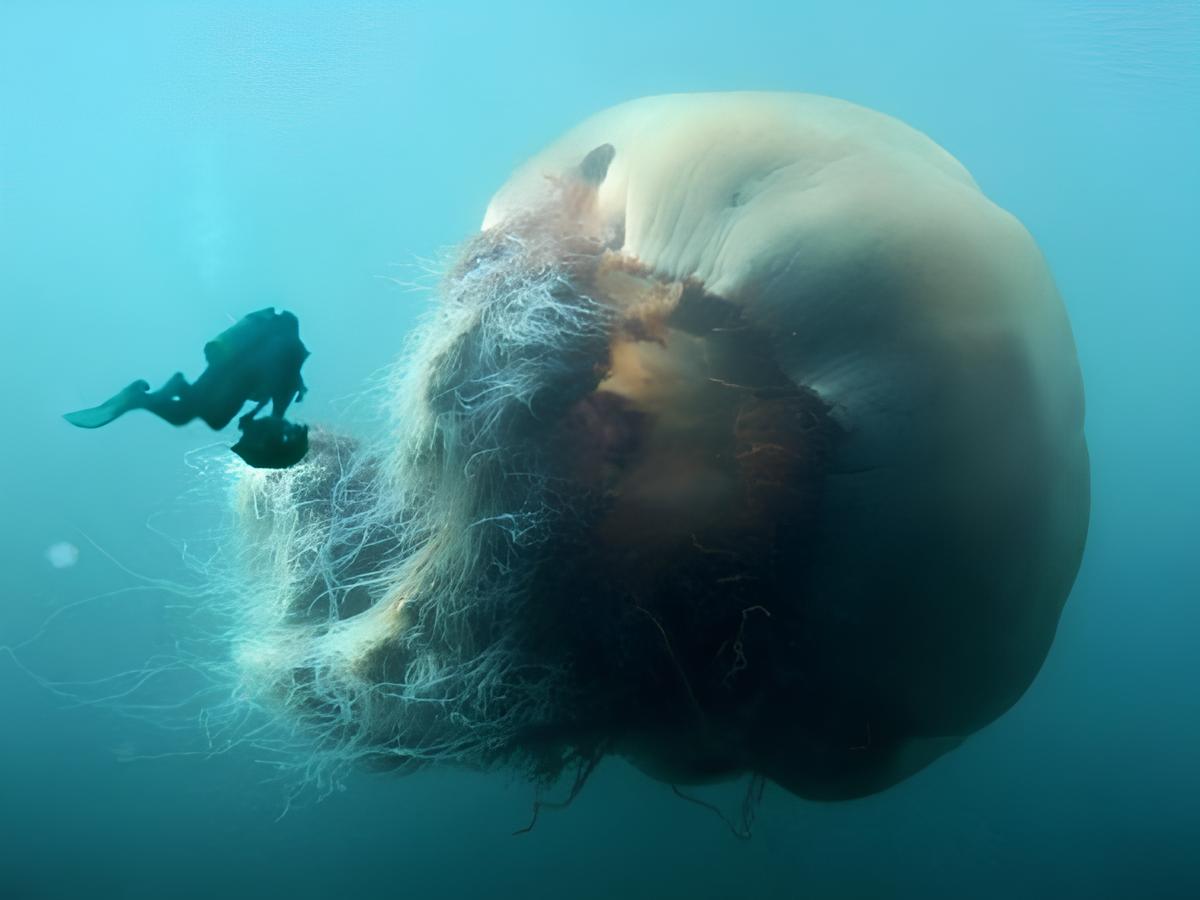
With Tentacles That Can Exceed 36 Meters, The Lion’s Mane Jellyfish Has Outstripped the Blue Whale in Length and Has Become the Longest Animal Ever Recorded in Earth’s History.
When it comes to colossal animals, the image that almost automatically comes to mind is that of the blue whale. Weighing more than 150 tons, it reigns supreme as the largest animal that has ever existed by body mass. But there is a living being that surpasses the blue whale in an even more extreme and visually disturbing criterion: total length. This record belongs to the lion’s mane jellyfish, a marine organism that appears fragile, almost ethereal, but has made its mark in history as the longest animal ever recorded by science, with tentacles that can exceed 36 meters in length—more than the length of a 10-story building lying down.
This achievement turns the lion’s mane jellyfish into a true biological paradox: an invisible colossus, composed predominantly of water, capable of defying everything that was imagined about physical limits in the animal kingdom.
Extreme Dimensions of the Lion’s Mane Jellyfish Surpass Any Other Known Animal in Length
What makes the lion’s mane unique is not the size of its main body, but the brutal sum of its tentacles. The bell, the “dome” of the jellyfish, can reach more than 2 meters in diameter, something impressive in itself.
-
Motorola launched the Signature with a gold seal from DxOMark, tying with the iPhone 17 Pro in camera performance, Snapdragon 8 Gen 5 that surpassed 3 million in benchmarks, and a zoom that impresses even at night.

-
Satellites reveal beneath the Sahara a giant river buried for thousands of kilometers: study shows that the largest hot desert on the planet was once traversed by a river system comparable to the largest on Earth.

-
Scientists have captured something never seen in space: newly born stars are creating gigantic rings of light a thousand times larger than the distance between the Earth and the Sun, and this changes everything we knew about stellar birth.

-
Geologists find traces of a continent that disappeared 155 million years ago after separating from Australia and reveal that it did not sink, but broke into fragments scattered across Southeast Asia.

However, it is from this bell that hundreds to thousands of very thin tentacles extend, forming a true stinging forest in the ocean.


Widely accepted historical records by museums and scientific institutions indicate tentacles measured between 30 and 37 meters, making the lion’s mane:
- longer than an average adult blue whale (25 to 30 meters);
- longer than any known dinosaur;
- longer than buses, train cars, and even many fishing boats.
This record was documented in the early 20th century off the coast of Massachusetts, USA, and remains unbeaten to this day.
Why Has Such a Fragile Animal Managed to Reach Such Absurd Proportions
The lion’s mane jellyfish is composed of over 95% water, drastically reducing the energy cost of growth. Unlike mammals, birds, or reptiles, it does not need to support bones, dense muscles, or highly specialized organs.
Additionally, this species exhibits continuous growth as long as favorable environmental conditions exist. In cold, food-rich seas, this growth can extend for years.
Factors that Favor Gigantism Include:
- low temperatures, which reduce metabolism;
- abundance of zooplankton and small fish;
- absence of large-scale predators;
- currents that keep the tentacles extended without muscle effort.
These conditions are common in the North Atlantic, North Pacific, and subarctic regions—exactly where the lion’s mane thrives.
Where the Longest Animal on Earth Lives and Why It Is Rarely Seen by Humans
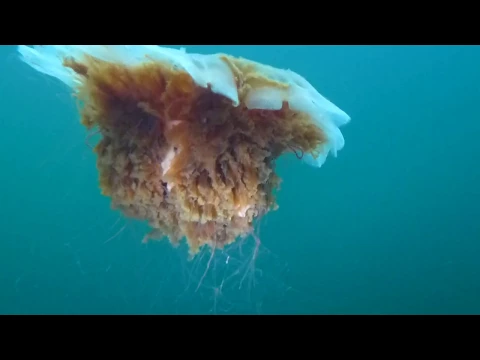
The lion’s mane jellyfish inhabits cold seas of the northern hemisphere, including:
- North Atlantic (Canada’s coast, Greenland, northern Europe);
- North Pacific (Alaska, Russia, Japan);
- regions near the Arctic.
Despite its extreme size, encounters with humans are relatively rare. This happens because:
- a large portion of individuals live in deep waters;
- their tentacles are almost invisible in the water;
- the largest individuals tend to stay far from the shore.
When they appear on beaches, they are usually smaller individuals or fragments brought in by sea currents.
The Venom of the Lion’s Mane Jellyfish and the Real Impact on Humans
Visually frightening, the lion’s mane carries thousands of stinging cells (cnidocytes) distributed along its tentacles. Contact can cause:
- intense pain;
- burning sensation;
- redness and inflammation;
- allergic reactions in sensitive individuals.
Despite this, it is not considered lethal to healthy humans. There are no confirmed records of deaths directly attributed to the species. The venom is designed to capture:
- zooplankton;
- small fish;
- microscopic larvae and crustaceans.
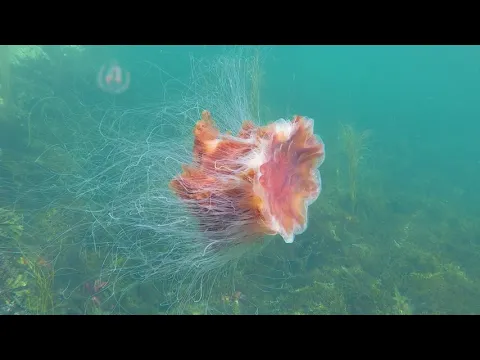
In other words, gigantism is not linked to aggression against large prey, but to efficiency in dominating the marine microecosystem.
How The Lion’s Mane Jellyfish Hunts and Controls Entire Ecosystems with Invisible Tentacles
The hunting strategy of the lion’s mane jellyfish is passive but extremely effective. Its tentacles function as a living floating net, paralyzing any organism that touches them.
A single adult lion’s mane can occupy dozens of cubic meters of water, continuously intercepting zooplankton and juvenile fish. This places it as:
- the dominant predator in cold pelagic ecosystems;
- a regulator of small organism populations;
- an indirect competitor of commercial fishing in some areas.
For this reason, population outbreaks of giant jellyfish are closely monitored by oceanographers.
The Relationship Between The Lion’s Mane Jellyfish and Climate Change
Global warming is altering ocean patterns, and this has direct impacts on jellyfish. In some regions, rising temperatures favor massive blooms. In others, it can limit the growth of species adapted to extreme cold, such as the lion’s mane.
Scientists are investigating whether:
- the frequency of giant individuals may decrease;
- new artificial cold areas may arise;
- the species’ distribution may shift to higher latitudes.
What is certain is that the gigantism of the lion’s mane jellyfish represents a delicate environmental balance, easily altered by global changes.
Predators Capable of Facing the Longest Animal Ever Recorded
Very few animals can feed on the lion’s mane jellyfish without suffering serious effects from its venom. The main one is the leatherback turtle, specialized in consuming jellyfish in large quantities.
This predator-prey relationship is crucial. In areas where leatherback turtles have disappeared, giant jellyfish can multiply uncontrollably, altering entire food chains.
Why the Lion’s Mane Jellyfish Surpasses the Blue Whale in a Fundamental Criterion
Although the blue whale is the largest animal by mass, the total length of the lion’s mane jellyfish is greater. This places the species in a unique category: the longest linear animal in the history of life on Earth. This detail completely changes the popular perception of gigantism. It proves that:
- size is not just weight;
- flexible structures can exceed rigid limits;
- evolution finds extreme paths outside the obvious.
The lion’s mane jellyfish does not roar, does not have bones, does not leave impressive fossils. Yet, it is the longest animal that has ever existed with scientific proof.
It represents an uncomfortable truth for popular science: the largest giants on the planet are not necessarily the loudest or most visible, but those that explore the physical limits of life in unexpected ways.
As long as there are cold, silent, and deep seas, this transparent colossus will continue to float—larger than any creature that has ever walked, swum, or flown on Earth.








-

-

-

-

-

7 pessoas reagiram a isso.