





 Portuguese
  English
  Spanish
  4 min of reading
  0 comments


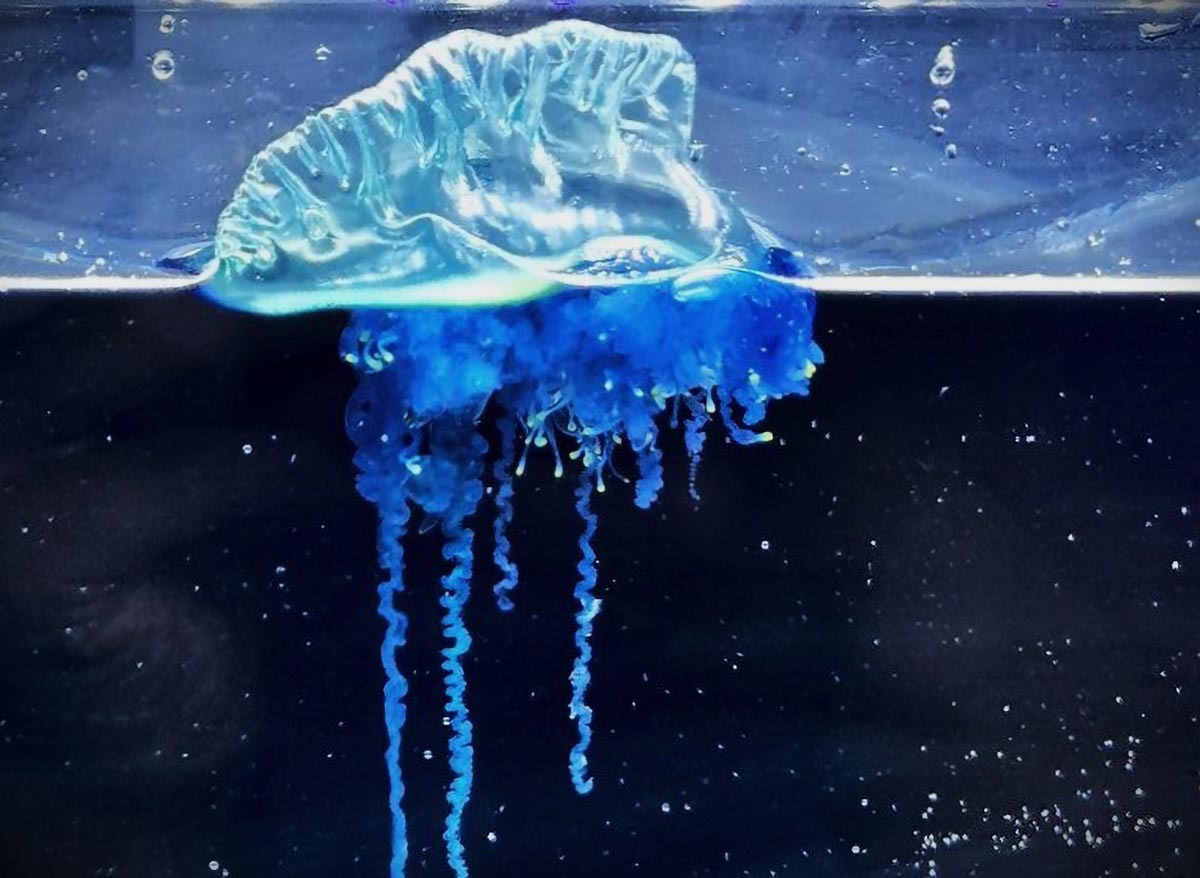
Recent Discovery Off the Coast of Japan Identified a New Species of Venomous Jellyfish of the Genus Physalia, Confirmed by Genetic Analysis and Unprecedented Records in the North of the Country, Indicating Changes in Marine Distribution Associated with the Warming of Ocean Currents
A new species of venomous jellyfish of the genus Physalia was identified in northeastern Japan by researchers from Tohoku University, following genetic and morphological analyses, marking the northernmost record of the group and indicating recent changes in marine environments associated with ocean currents.
The discovery, published on October 30, 2025, in the journal Frontiers in Marine Science, presents the first formal description of a native Portuguese man o’ war species from Japan, named Physalia mikazuki sp. nov., and documents its unprecedented occurrence in the cold waters of the Tohoku region.
Accidental Discovery in Sendai Bay Reveals Unknown Species
The identification of the new species began unexpectedly when a research student from Tohoku University found an unusual jellyfish during fieldwork in Sendai Bay, in the northeastern part of the country.
-
A simple stitch in wood with nylon thread can reduce adhesives, speed up production, and make sheets up to 4 times stronger and 14 times more difficult to break.

-
The gigantic steel shell built to contain Chernobyl for a century has been pierced by a drone, exposing a critical system and creating a hole that could cost over 500 million euros to repair.

-
Brazilian Navy reaches a new level by taking over an airport with a 1,600-meter runway used by 1,800 military personnel and autonomous attack drone testing.

-
The Himalayas continue to grow to this day, with tectonic plates advancing 5 cm per year, mountains rising up to 10 mm annually, and the 2015 earthquake that killed 9,000 people may have increased the risk of an even larger seismic mega-event.


According to researcher Yoshiki Ochiai, the specimen drew attention due to its cobalt-blue color and for not corresponding to any known species in the region, which prompted its immediate transport to the lab for detailed analysis.
The find led to the realization that it was a previously unknown Portuguese man o’ war, representing the first record of this type of organism at that latitude of the North Pacific.
Scientific Publication Formally Describes Physalia mikazuki sp. nov.
The study, published in October 2025, provides a complete taxonomic description of the new species, based on morphological, genetic, and ecological characteristics observed in specimens collected at Gamo Beach in Sendai Bay.
Named Physalia mikazuki, a Japanese term meaning “crescent moon,” the species received this name in reference to Date Masamune, a historical figure from Sendai known for his helmet adorned with a crescent moon.
Other names with local cultural connotation were considered during the naming process, but the chosen term reflects both the regional identity and the distinct morphology of the species’ floating platform.
Detailed Anatomy Differentiates New Species from Tropical Relatives
An anatomical analysis revealed unique body structures that distinguish Physalia mikazuki from the other four known species of the genus Physalia, all of which have previously been associated with tropical and subtropical regions.
According to the study’s first author, Chanikarn Yongstar, the work involved meticulous comparison of each component of the colony with historical records and classical scientific treatises, many of which were manually illustrated by past researchers.
The process required detailed observation of the zooids responsible for feeding, reproduction, and defense, organized under a translucent gas-filled buoy in a crescent shape, highlighting the structural complexity of the colony.
Genetic Evidence Confirms Coexistence of Species in Japan
Before the discovery, it was believed that Physalia utriculus was the only species of the genus present in Japanese waters, with a distribution extending from Okinawa to Sagami Bay.
However, genetic comparisons conducted with public DNA data demonstrated that the distribution of P. utriculus overlaps with that of the newly identified P. mikazuki, indicating that two distinct species coexisted in the region for a long time.
This overlap suggests that the new species went unnoticed until it reached the colder waters in northern Japan, where its presence became more evident to researchers.
Warmed Ocean Currents Explain Northern Displacement
The record of Physalia mikazuki in Tohoku represents the northernmost occurrence of the genus ever documented, raising questions about the mechanisms responsible for its displacement to this latitude.
To investigate this trajectory, the researchers conducted simulations of surface currents in the ocean, assessing how floating organisms may be transported over time.
The models indicated that the extension of the Kuroshio Current to the north, associated with exceptionally high sea surface temperatures, was a decisive factor in the transport of the colonies to Sendai Bay.
Drift Simulations Reinforce Role of Ocean Changes
The particle simulations, described as the virtual launch of floating objects to track their movements, showed consistent trajectories between Sagami Bay and the region where the new species was found.
According to Muhammad Izzat Nugraha, who was responsible for this stage of the study, the results pointed to a continuous trail that coincided exactly with the strandings of the colonies observed in July 2024.
These pieces of evidence reinforce the hypothesis that changes in ocean circulation are reshaping the geographic boundaries where certain marine species can survive and establish themselves, even in traditionally colder waters.
Risks to the Population and Importance of Coastal Monitoring
The presence of Physalia mikazuki also raises concerns related to public safety, as Portuguese man o’ wars have tentacles that can extend several meters and cause painful and debilitating stings.
Researchers emphasize that continuous monitoring of coastal areas is essential to alert beachgoers and local authorities, reducing health risks and preventing accidents.
Additionally, systematic observation contributes to expanding ecological knowledge about the distribution and behavior of these species in changing environments.
Research Reinforces Need for Ongoing Studies on Marine Biodiversity
Despite being dangerous, jellyfish of the genus Physalia are also described by scientists as visually impressive and biologically complex organisms that deserve ongoing research and classification efforts.
The team highlights that discoveries like this evidence existing gaps in knowledge about marine biodiversity, even in relatively well-studied coastal regions.
The study was funded by the Advanced Institute for Changes in Marine Ecosystems and made available in open access in 2025, contributing to the dissemination of data and future investigations into the dynamics of ocean ecosystems in the context of global warming.








-

-

-

10 pessoas reagiram a isso.