





 Portuguese
  English
  Spanish
  7 min of reading
  1 comment


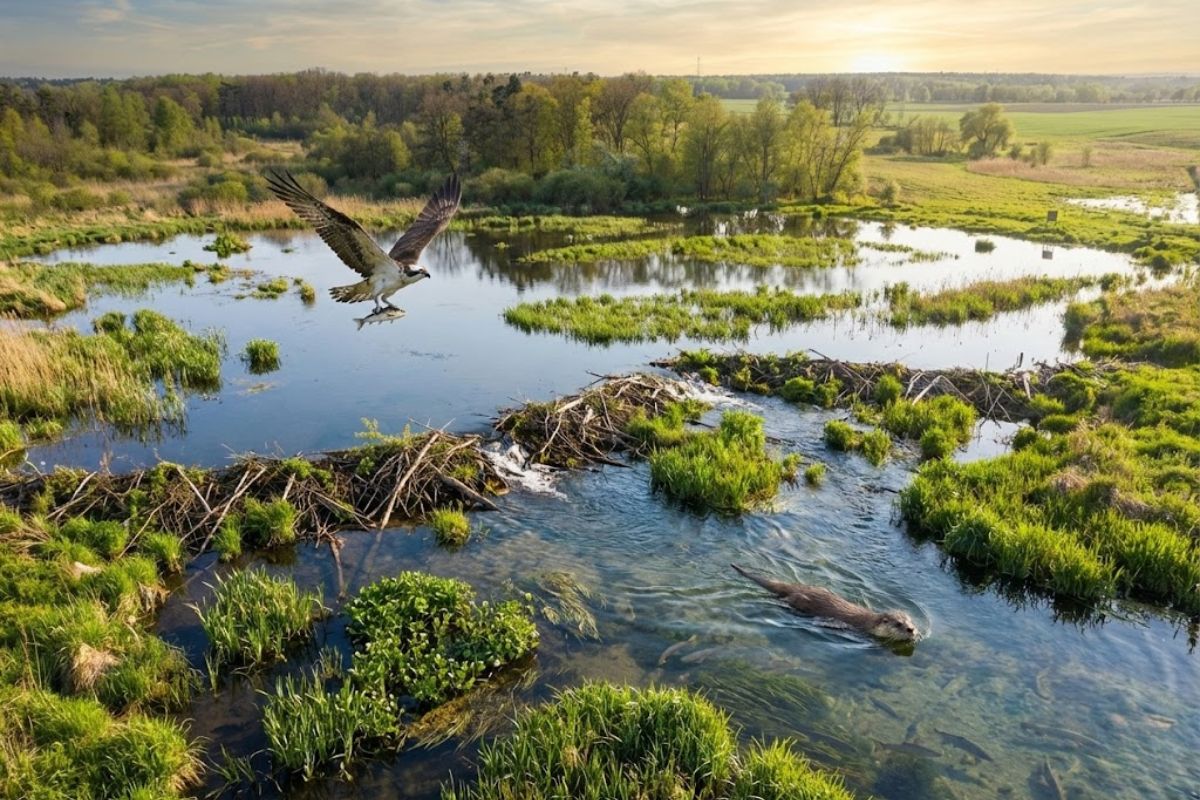


In the Oder Delta, on the German-Polish Border, a Drained Marsh in the Rożnowo Plain Receives Water Back, Protects Peatlands, Reduces Emissions and Improves Soils, with Beavers Rehydrating Up to 80 Hectares and Attracting New Species.
Water is returning to a marsh that for decades suffered from drainage, river straightening, and artificial barriers in the Oder Delta, on the border between Germany and Poland. In the Rożnowo Plain, the marsh and peatlands retain water again over 26 hectares, with a direct impact on biodiversity and climate.
The rewetting happens in the floodplain of the Ina River, within the rewilding landscape of the Oder Delta, and is already beginning to transform previously drained fields into a functional wetland. The marsh is once again retaining water, reactivating natural processes and creating concrete benefits for farmers and local communities, in a region marked by human alterations accumulated over decades.
A Marsh in the Oder Delta That Retains Water Again

The Oder Delta is a large aquatic ecosystem on the German-Polish border, and the Rożnowo Plain lies on the Polish side of this landscape, connected to the Ina River basin.
-
Beet greens that end up in the trash in many kitchens contain a high concentration of antioxidants, and a 2025 study shows that extracts may have even more potent activity when transformed into microparticles.

-
Something was orbiting Earth before any human launched a satellite into space: scientists have found thousands of unexplained flashes in old photos of the sky, and a NASA researcher says the evidence points to non-human intelligence.

-
There is a gap of hundreds of kilometers between weather observation points in the United States, and now drones flying at 6,000 meters altitude in strong winds are filling this gap to predict tornadoes before they kill.

-
The most famous volcano in the world could paralyze one of the largest metropolises on the planet: Japan accelerates emergency plans for the eruption of Mount Fuji, which could bury Tokyo in ash for over two consecutive weeks.


There, the rewetting is returning water to 26 hectares of wetland, in a move that combines land protection, ecological restoration, and monitoring of effects on species and environmental services.
The revitalization does not occur in a vacuum. Over time, interventions in the Oder Delta altered the natural flow of water: drainage for agriculture and forestry, straightening and deepening of riverbeds, damming, and installation of barriers such as dams and weirs.
The result was the loss of connectivity between riverbank sections and flood zones, as well as the degradation of habitats that rely on slow and constant water.
With the rewetting, the goal is to reverse this logic: increase water retention, restore riverbank connectivity, and allow the marsh to function again as a living system, with natural flooding, refuge for amphibians and waterfowl, and protection against droughts.
How Drainage Transformed the Landscape and Why the Marsh Matters

Marta Hapoń-Sobieraj and Maciej Sobieraj, long-time residents of Rożnowo, describe a scenario typical of many European regions: drained wetlands to intensify land use.
According to Maciej, a local farmer intensified drainage without realizing that the water removed affected not only his land but also neighboring land and riverbank habitats that should serve as the foundation for an adjacent protected area.
The local case reflects a much larger process.
More than half of Europe’s wetlands have disappeared over the last 300 years, and Poland has been one of the most affected.
In the last century, large-scale drainage has devastated wetlands once viewed as unproductive, with the loss of more than four million hectares of habitat, along with impacts on water quality and on species that depend on these environments.
In this context, a rewetted marsh is not just a “flooded place.”
It functions as a water regulator, base for food chains, and a key component in land stability, as it retains water, reduces extremes, and sustains wildlife.
The Turning Point in Rożnowo and the Creation of a Local Foundation

In 2023, in response to challenges in the Ina River and its watershed, Marta and Maciej created the Climate and Biodiversity Foundation.
The motivation was direct: Rożnowo is a valuable water source for the Ina River and harbors biodiversity they consider exceptional, but despite the plain being identified as a protection area in 2001 by the Maszewo municipality, no effective actions had been taken.
From there, the couple began to seek ways to promote nature recovery in the area, seen as a crucial refuge for waterfowl and amphibians.
The rewetting of the marsh emerges as a practical response: to stop the continuous loss of water, restore habitat conditions, and create a landscape that works for nature and also for those who live around it.
Beavers as Engineers and the Leap from 26 to 80 Hectares Rehydrated

With the support and collaboration of the Rewilding Oder Delta project team, Marta and Maciej obtained funding to purchase and protect nearly 26 hectares of the Rożnowo Plain, ensuring space for natural processes to occur again.
However, the difference did not stop at the acquired perimeter.
Beavers returned to the area about a decade ago and, in practice, began to operate as environmental engineers.
According to Marta, they reshaped the landscape to reduce water escape, and the positive impact can be observed over a wide area.
Considering the adjacent forest areas, the couple asserts that beavers have rehydrated 80 hectares.
This changes the dynamics of the marsh and its surroundings: dams create ponds, the flow slows down, areas that were once dry become moist again, and new habitats emerge.
Marta also describes the regeneration of alder woodlands and the emergence of environments that did not previously exist there on the same scale.
When the marsh stops “leaking,” it begins to retain life along with water.
Biodiversity Returns and a Marsh Becomes a Meeting Point for Species
The revitalization is associated with the return and recorded presence of many species. Maciej reports that the presence of all species that could potentially live there has been recorded, including the rarest.
In the first year, a pair of black storks found a suitable location and raised chicks.
The following year, a pair of marsh harriers, also known as “frog eaters,” built a nest at the edge of the marsh, attracted by the return of amphibians.
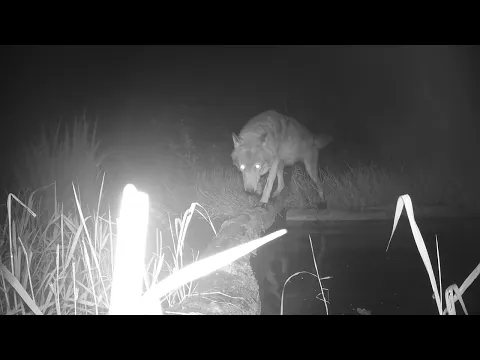
Besides the birds, there is mention of the presence of wolves, badgers, ferrets, and otters, along with a wide variety of bird species in general.
Recently, even a European bison was found, indicating how the rewet landscape can act as a corridor and area for larger fauna use.
The higher water levels also bring hope for the Małka River, a tributary of the Ina River that had been suffering from drought and had recently reduced to a trickle.
Migratory trout and river lampreys used to spawn in the Małka, and the hope is that they will return as the flow is gradually restored.
The Climate Impact of the Marsh and the Brake on Carbon Emissions

Besides biodiversity, the rewetting is treated as climate action.
By slowing water flow in the watershed, the dams built by beavers allow surrounding lands to reabsorb water, something described as especially important in a forested area considered to be at high risk of drought and wildfires.
The marsh, involving peatlands, also plays a direct role in the carbon logic.
Maciej states that healthy peatlands are carbon sinks and that if the peat were drained, it would release on average 14 tons of carbon per hectare each year.
In other words, keeping the peat moist means avoiding undesirable emissions associated with drying out and the accelerated decomposition of organic material.
He also mentions that studies show wetlands created by beavers as a vital source of freshwater during dry periods, capable of reducing flood impacts by slowing down the advance of water and acting as natural barriers against wildfires.
In practice, the marsh begins to function as natural infrastructure, with multiple responses to climate extremes.
Farmers, Local Conflicts, and Solutions to Control Water Without Destroying the Marsh

Not everyone appreciates the changes caused by beavers, and this is reflected in the narrative.
Marta acknowledges that there are conflicts, especially when water rises and may cause localized flooding.
The proposed solution is pragmatic: simple measures, such as flow control pipes in dams, allow for water level management and minimize localized flooding.
The idea is to balance interests.
According to Marta, flow control works well, satisfying both beavers and people: the animals continue to live, the marsh remains moist, and crops and roads stay safe.
Maciej also highlights a point that directly connects conservation to land use: foresters have come to understand that areas near streams and marshes host 90% of local amphibian populations and avoid harvesting in those areas.
For farmers, he points out productive advantages in areas adjacent to wetlands: wetland vegetation accumulates nitrogen and acts as a “biological treatment plant,” filtering wastewater, pollutants, and fertilizers.
The described result is a more favorable microclimate, rehydrated soils, and crops like corn growing better.
The marsh not only becomes a refuge for animals: it becomes a system that improves water, soil, and productivity around it.
A European Model of Rewetting with Lessons for the Future
The rewetting of the Rożnowo Plain is presented as an example of what can be achieved when conservation balances biodiversity and local livelihoods.
The case combines land acquisition and protection, collaboration with partners, monitoring of ecological benefits, and active community participation in river cleaning and tree planting.
In a continent where wetlands have disappeared en masse, the experience of the Oder Delta reinforces the idea that rewetting peatlands and restoring water connectivity can change the landscape, strengthen biodiversity, and create a positive climate impact.
In Rożnowo, the marsh is becoming the center of this transformation, with beavers as agents of change and benefits spreading to rivers, forests, and communities.
What do you think is the biggest gain when a marsh truly comes back to life: more biodiversity, less carbon emissions, or water available year-round?







Love it. When I was a young fellow we used to fish behind a large beaver dam. I estimate it was about 3m high. One day we returned with our fishing poles and found the dam had been dynamited. A sad day for everyone?