





 Portuguese
  English
  Spanish
  4 min of reading
  0 comments


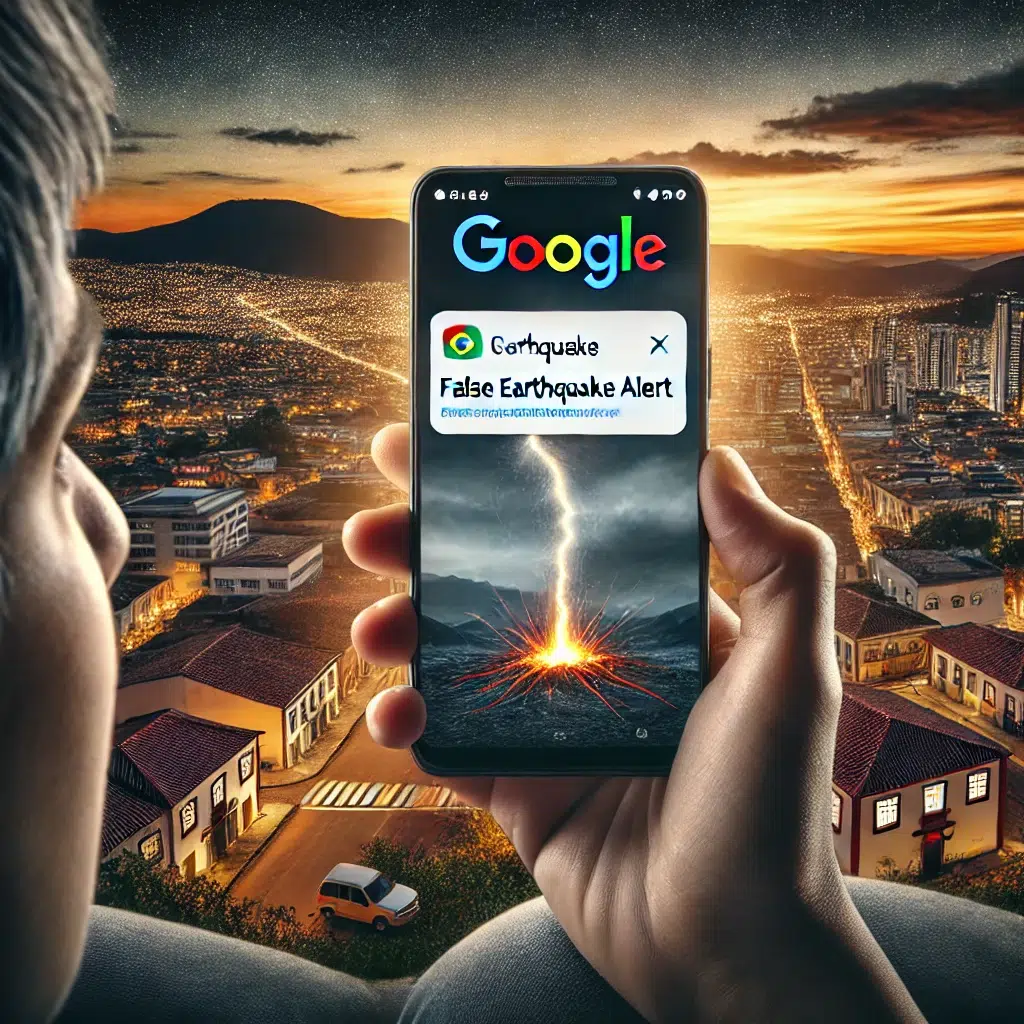
Google Triggers Earthquake Alert, But Tremor Never Happened!
In the early hours of February 14, 2025, thousands of residents in Minas Gerais, São Paulo, and Rio de Janeiro received a false earthquake alert. As expected, the notification caused panic and raised many questions. After all, an earthquake can bring significant consequences.
The emergency notification reported a supposed earthquake of magnitude 4.7 on the Richter scale, located 55 km off the coast of Ubatuba, São Paulo, at around 2:20 AM.
However, experts from the University of São Paulo (USP) and the University of Brasília (UnB) quickly analyzed the situation and ruled out any seismic activity in Brazil.
-
This small town in Germany created its own currency 24 years ago, today it circulates millions per year, is accepted in over 300 stores, and the German government allowed all of this to happen under one condition.

-
Curitiba is shrinking and is expected to lose 97,000 residents by 2050, while inland cities in Paraná such as Sarandi, Araucária, and Toledo are experiencing accelerated growth that is changing the entire state’s map.

-
Tourists were poisoned on Everest in a million-dollar fraud scheme involving helicopters that diverted over $19 million and shocked international authorities.

-
Hidden beneath the dense forest of the Sierra Nevada, Betoma emerges in a neighbor of Brazil as the greatest archaeological discovery of the century, revealing a colossal ancestral city covering over 18 km², with 8,334 stone structures and the potential to rewrite the history of South American civilizations.


For this reason, Google had to acknowledge the error and subsequently temporarily disabled the Android Earthquake Alerts System.
By the end of the morning on the same day, the company issued an official statement, claiming that the detection system had misinterpreted the signals captured by Android phone sensors.
Thus, the Ministry of Integration and Regional Development and the National Civil Defense also confirmed that no seismic event was recorded in Brazilian territory on that date.
Understand the Earthquake Alert That Surprised Brazil
Since the early hours of February 14, 2025, residents of various cities in Minas Gerais, São Paulo, and Rio de Janeiro were surprised by Google’s earthquake alert.
The notification, sent as an emergency alert, indicated an earthquake 55 km off the coast of Ubatuba (SP). As a result, many people were frightened and sought information about the incident.
However, on the morning of the same day, the Seismology Center of the University of São Paulo (USP) and the Seismological Observatory of the University of Brasília (UnB) analyzed the data and confirmed that no earthquake occurred in Brazil.
Thus, it became clear that the alert resulted from a technical error.
Still on February 14, around 3 PM, the Civil Defense of São Paulo and Rio de Janeiro issued an official statement clarifying that no official emergency alert had been generated by Brazilian agencies.
In light of the repercussions, Google immediately released an official statement around 5 PM that same day.
According to the company, the error is under investigation. Additionally, the tech giant apologized for the inconvenience caused.
How Does Google’s Earthquake Alert System Work?
First and foremost, it is important to understand how the Android earthquake alert system operates.
Launched in August 2020, this system detection seismic activity through accelerometers present in smartphones.
When multiple devices register similar movements, the system, by default, issues an emergency alert to users in the affected area.
However, in this specific case, an error in earthquake detection led to the issuance of a false alert.
Thus, thousands of people received the notification without any real tremor.
Since its launch, the system has shown great effectiveness in countries such as Japan, Indonesia, and the United States, where earthquakes occur frequently.
However, in Brazil, where earthquakes are extremely rare, sensors may incorrectly interpret certain vibrations.
In addition to relying on sensors in smartphones, Google also uses data from official seismic networks to validate alerts.
Even so, in this case, the notification reached users before a complete verification of the information.
Therefore, Google opted to temporarily disable the system in Brazil and announced that they would make technical adjustments to prevent new errors.
Reaction of Residents and Brazilian Authorities
From the early hours of February 14, 2025, thousands of residents sought information from the Civil Defense.
Especially in cities in Southern Minas Gerais, such as São Lourenço, Passa Quatro, and Itajubá, many reported being startled by the notification.
At 9:30 AM on the same day, the Ministry of Integration and Regional Development reiterated that no seismic event was recorded in the country.
On social media, the incident went viral in a matter of minutes.
Between 2:30 AM and 4 AM, thousands of users shared screenshots of the alert and questioned the reliability of Google’s system.
As expected, pressure increased, and Google had to publicly respond in the early afternoon.
By around 6 PM on February 14, the University of São Paulo (USP) and the Seismological Observatory of the University of Brasília (UnB) suggested that Google integrate its technology with the data from the National Seismology Center, preventing future errors.
What to Expect in the Future? Will Google Fix the System?
In light of this situation, Google announced that it will review its technology to prevent new incidents.
Among the measures taken, the company plans to improve its earthquake detection algorithm and establish partnerships with Brazilian seismic institutes.
Corrections are expected to be implemented by March 2025.
If the system is reactivated, users will be able to set the option to receive only alerts confirmed by official sources, reducing the risk of false alarms.
Finally, the Civil Defense reinforced that, when faced with any alert, the best course of action is to seek information from reliable sources.
Meteorological and seismological institutions provide updated data and avoid confusion in cases like this.






Seja o primeiro a reagir!