





 Portuguese
  English
  Spanish
  3 min of reading
  2 comments


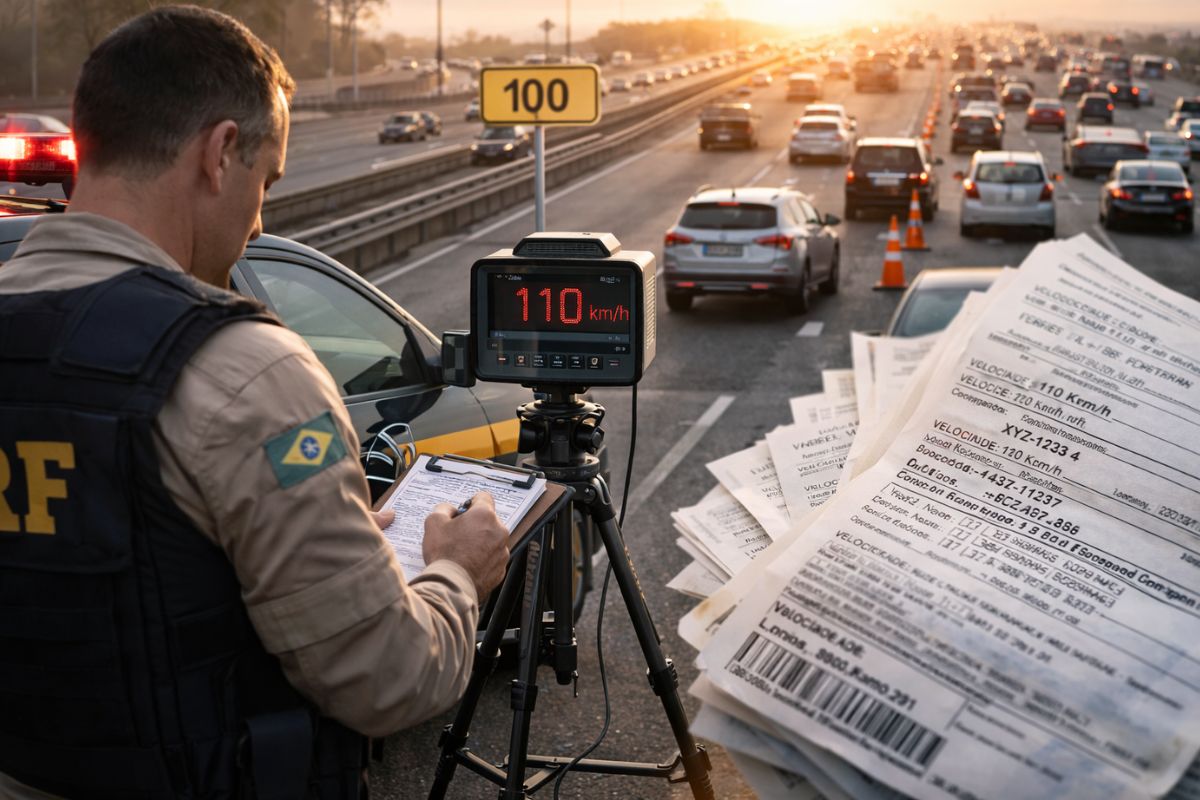


Official Data Shows That Federal Fines Broke a Symbolic Limit in 2025, Revealing a Continuous Pattern of Speeding, Increased Monitoring with More Radars, Concentration on the Country’s Main Highways, and a Scenario That Transforms Driving Routines into a Permanent Structural Alert for Drivers, Managers, States, and Brazilian Cities Today
The increase in federal fines in 2025 is not just a record number. It signals a deep change in road behavior and how monitoring has come to occupy the daily life of highways. Speeding emerges as a recurring practice, normalized in critical stretches and increasingly monitored.
By surpassing the ten million fines mark, the system exposes more than just individual violations. It Reveals Constant Pressure on Drivers, technological expansion of monitoring, and growing risks in essential logistical corridors, where human error meets high speed and heavy traffic.
Federal Fines Reach Historic Levels and Change Traffic Interpretation

The volume of federal fines recorded in 2025 represents a turning point. For the first time, the fines on federal highways exceed eight digits, indicating that monitoring has shifted from being episodic to becoming permanent.
-
The government requests the Federal Revenue Service for a new system to automate the income tax declaration, reducing errors, time, and bureaucracy for millions of Brazilians.

-
Pix in installments, international Pix, and contactless payment without internet: the Central Bank revealed the new features coming to the tool that is already used by almost every adult in Brazil.

-
Mercado Livre has just started selling medications with delivery in up to three hours to your door, and this move could completely change the way Brazilians buy medicines on a daily basis.

-
In Dubai, rising tensions from the war in the Middle East are causing super-rich individuals to leave the Gulf and direct their fortunes to a new financial refuge in Asia.


The 8% increase compared to the previous year reinforces this trend of continuous intensification.
This leap does not occur uniformly. It Concentrates on Strategic Axes, especially along the BRs connecting major urban centers and supporting heavy daily traffic.
The data suggests that intense circulation, combined with everyday haste, increases the risk and frequency of violations.
Speeding Consolidates as the Dominant Violation
Seven out of ten federal fines issued in 2025 stemmed from speeding.
The pattern is repeated across different states, times, and types of vehicles, indicating that the violation has ceased to be an exception and has become a recurring behavior in road traffic.
Driving over the limit drastically reduces reaction time and increases the severity of accidents. When errors happen, the impact is greater, both for drivers and for others involved.
The data helps explain why monitoring focuses efforts precisely on speed control.
BRs 101 and 116 Concentrate Violations and Traffic Risks
BRs 101 and 116 lead the ranking of federal fines.
Not by coincidence, these highways traverse densely populated areas, connect capitals, industrial zones, and logistical hubs, and accumulate a large diversity of vehicles in constant circulation.
In these corridors, the combination of intense flow, irregular overtaking, and speed above the limit creates a permanently tense environment.
Each violation recorded there represents a heightened potential risk, as any failure tends to have amplified consequences due to the volume of traffic.
Tripling of Radars Redefines Monitoring on Highways
The institutional response to the scenario has been clear: the Federal Highway Police intensified monitoring and more than tripled the use of fixed radars in recent years.
The declared goal is to curb recklessness before it leads to serious accidents.
This increase in control also changes drivers’ perceptions.
The sense of constant surveillance pressures behaviors, but exposes a dilemma: Does the high number of federal fines reflect only increased monitoring or a persistent pattern of risk ignored by drivers.
Pressure on Drivers Reveals Structural Problem
For those at the wheel, the scenario is one of continuous tension.
Even in permitted stretches, climate changes, unexpected flow, or simple distraction can turn a quick decision into a serious violation. Speed amplifies all these factors.
The increase in federal fines highlights that the problem goes beyond punishment.
It Points to a Fragile Road Culture, where limits are seen as obstacles rather than collective protection, requiring broader responses that go beyond just radar.
The record number of federal fines in 2025 is not just statistical.
It reveals a circulation model based on haste, risk tolerance, and an increasing reliance on punishment to contain dangerous behaviors.
The national response involves monitoring, but also a change in posture at the wheel.
In your routine, what weighs most when driving on federal highways: time pressure, the feeling of constant monitoring, or the real perception of risk around you?









Por mais radares e fiscalização, se os que correm feitos loucos morressem sozinhos num acidente por imprudência e alta velocidade tudo bem, mas esses mentecaptos as vezes tiram vida de inocentes. Por mais e cada vez mais fiscalização porque muitos não ligam para limite de velocidade, não ligam para vida própria e pela vida dos demais!!! E tinha TB que aumentar e muito a punição caso um desses infelizes tirassem a vida de alguém pela imprudência!!!
Então em vez da polícia e os detrans multaram por que nao cobra do ministros dos trsportes uma melhoria na infraestrutura das rodovias do país que eé um verdadeiro gargalo na 040 nen se fala nos trechos urbanos piora.