





 Portuguese
  English
  Spanish
  4 min of reading
  0 comments


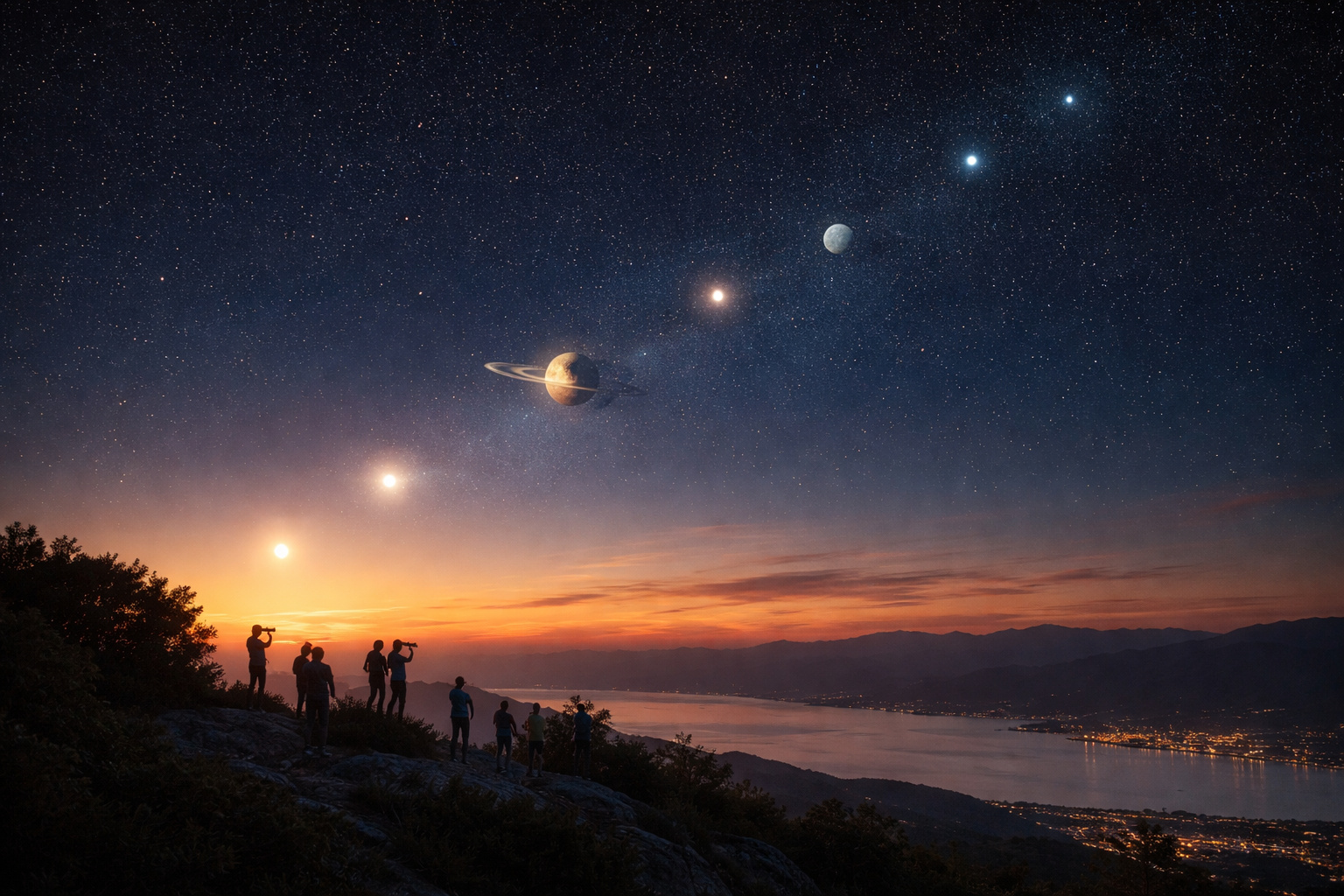
Astronomical Phenomenon Can Be Observed With the Naked Eye and With Optical Aids Over a Short Period of Time
A rare astronomical event is expected in February, when six planets of the Solar System will appear visually close in the sky shortly after sunset.
The phenomenon, known as alignment or planetary parade, generates interest because it does not occur frequently and provides a special opportunity for celestial observation.
Although the planets are not physically aligned in space, the apparent arrangement occurs due to their relative position to Earth and the common orbital plane.
Thus, the phenomenon stands out as a striking visual effect, observed from a specific point on the planet.
Technical Review Reveals Why the Planets Appear Aligned
The alignment occurs because the planets orbit the Sun in a similar plane, called ecliptic, which causes them to appear to form a line in the sky during certain periods.
Thus, when the orbital positions coincide from a terrestrial point of view, the impression of proximity emerges between celestial bodies that are very distant from each other.
This type of configuration poses no risks or physical effects on Earth, as it is merely a visual phenomenon.
Still, the event attracts attention precisely because it allows for the observation of multiple planets in the same section of the sky.
Date and Best Time to Observe the Phenomenon
The alignment can be seen at the end of February, especially on the night when the planets will be above the horizon shortly after sunset.
The best time for observation is approximately 30 minutes after the Sun sets, when the sky is already darker.
In this interval, some planets remain visible for only a short time, which requires the observer’s attention.
Additionally, visibility may vary depending on geographic location and atmospheric conditions.
-
Motorola launched the Signature with a gold seal from DxOMark, tying with the iPhone 17 Pro in camera performance, Snapdragon 8 Gen 5 that surpassed 3 million in benchmarks, and a zoom that impresses even at night.

-
Satellites reveal beneath the Sahara a giant river buried for thousands of kilometers: study shows that the largest hot desert on the planet was once traversed by a river system comparable to the largest on Earth.

-
Scientists have captured something never seen in space: newly born stars are creating gigantic rings of light a thousand times larger than the distance between the Earth and the Sun, and this changes everything we knew about stellar birth.

-
Geologists find traces of a continent that disappeared 155 million years ago after separating from Australia and reveal that it did not sink, but broke into fragments scattered across Southeast Asia.

Planets Involved in the Celestial Parade
During the phenomenon, Mercury, Venus, Mars, Jupiter, Saturn, and Neptune make up the apparent alignment.
Some of them, like Venus and Jupiter, stand out for being brighter and easily identified with the naked eye.
On the other hand, Neptune requires binoculars or a telescope, as its brightness is very low.
Mercury and Saturn appear close to the horizon, which can make visibility difficult in areas with obstacles.
Care and Guidance for Proper Observation
To follow the phenomenon, it is recommended to choose a location with a clear western horizon and low light pollution.
Additionally, starting observation just after sunset increases the chances of seeing all the planets.
The use of simple binoculars already facilitates the identification of the less visible celestial bodies.
Nevertheless, naked-eye observation already allows one to perceive part of the alignment, especially the brighter planets.
Astronomical Importance and Public Interest
Although it has no direct scientific impact, the planetary alignment is significant for the dissemination of astronomy and for popular interest in the sky.
Events of this type help illustrate basic concepts about orbits, planetary movements, and spatial perspective.
Moreover, the phenomenon reinforces the perception of how planets share a common arrangement within the Solar System.
Thus, the February alignment stands out as one of the most talked-about astronomical events of the period.
The Phenomenon in a Broader Context
The alignment is part of a sequence of periodic celestial events that depend on the orbital dynamics of the planets.
These configurations vary over the years, making some rarer than others.
Consequently, the observation becomes an educational opportunity for both beginners and astronomy enthusiasts.
The phenomenon underscores the importance of following the annual astronomical calendar.
What to Expect From Observing the Alignment
For many observers, the alignment represents a striking visual experience, even without advanced equipment.
The possibility of identifying several planets in succession in the sky generates curiosity and scientific interest.
Although the event is brief, it offers a unique moment of connection with space observation.
Given this opportunity, do you intend to simply observe the sky with the naked eye or take advantage of the phenomenon to explore astronomy more deeply?








-

-

-

-

-

-

134 pessoas reagiram a isso.