





 English
  Francês
  Alemão
  Italiano
  Japonês
  Norueguês
  Portuguese
  Spanish
  5 min of reading
  0 comments


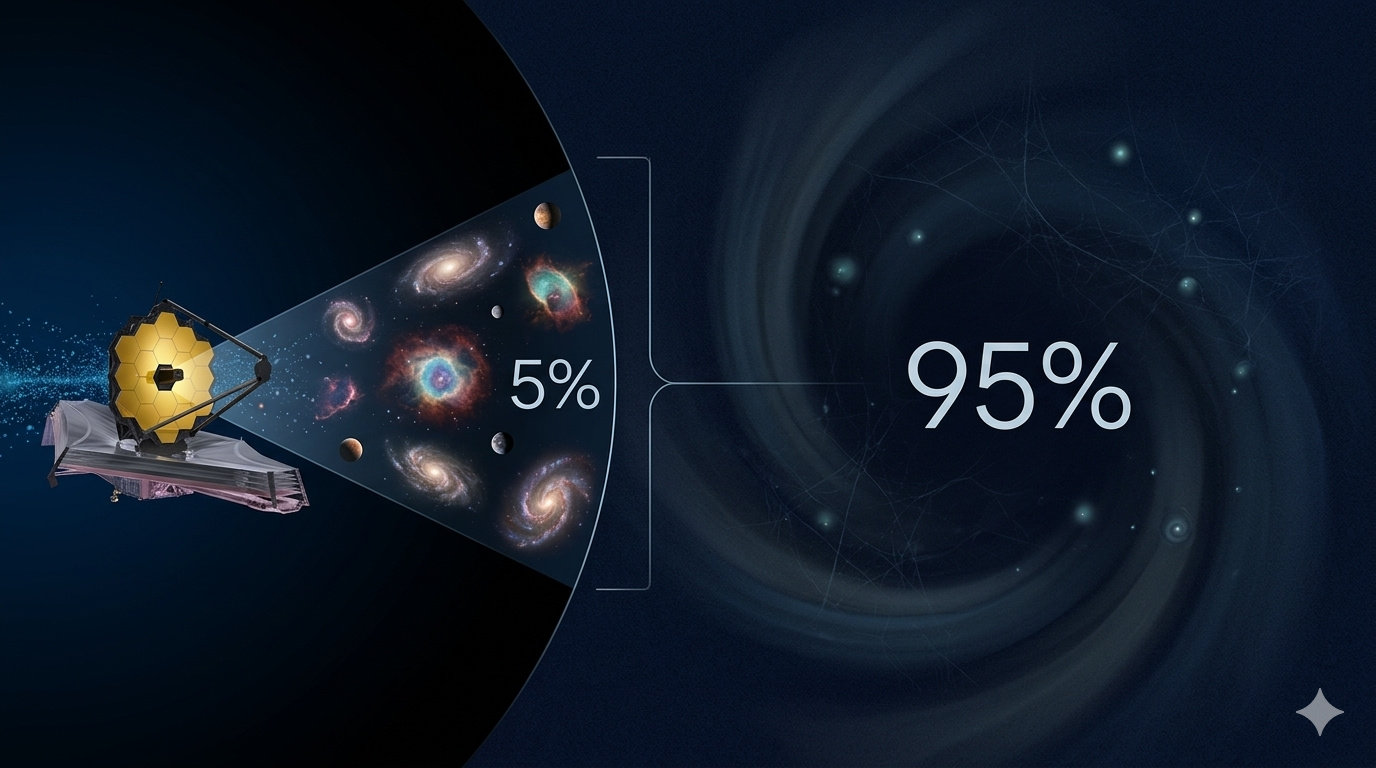
Dark matter and dark energy account for 95% of the universe and remain invisible, challenging modern physics and redefining what we know about the cosmos
In 1933, Swiss astronomer Fritz Zwicky observed the Coma Cluster and noticed something that would change physics forever. When calculating the speed of galaxies and comparing it with the available visible mass, the numbers did not add up. The galaxies were moving too fast to remain bound together solely by the gravity of observable matter. The conclusion was inevitable: there was something invisible dominating the universe. He called it dark matter.
Decades later, this hypothesis would become the center of the greatest unresolved problem in modern physics. Today, we know that dark matter and dark energy together represent 95% of everything that exists — and neither has been observed directly.
Composition of the universe according to the Planck satellite reveals domination of dark matter and dark energy
In 2018, the Planck satellite from the European Space Agency produced the most accurate map of cosmic microwave background radiation ever recorded. This signal, a remnant of the Big Bang, allowed for unprecedented precision in calculating the composition of the universe.
-
350-year mystery may have been solved: remains of a soldier who inspired the hero of The Three Musketeers found beneath a church in the Netherlands.

-
NASA photographed a nearly perfect square with 3 km sides on Mars, 13 times larger than the Great Pyramid of Giza, but the official explanation is natural erosion; still, no one has explained why the four sides have almost identical lengths.

-
Starlink breaks the barrier of 10,000 satellites in orbit and takes its expansion to an unprecedented level, with a direct impact on global internet, technological competition, and the race for space.

-
Japan finds an alternative to oil amid rising prices by transforming ocean balance into electricity with a new technology that maintains efficiency even when the sea changes.


The results completely redefined human perception of the cosmos. Only 4.9% of the universe is composed of ordinary matter — everything that can be directly observed. Dark matter accounts for 26.8%, while dark energy dominates with 68.3%.
This means that everything humanity has ever observed, built, or understood represents a minimal fraction of the actual universe. The rest remains invisible and unknown.
Ordinary matter represents only 5% of the universe known to science
The entire structure of human civilization has been built from this small fraction of ordinary matter. From the first worked metals to modern semiconductors, all technology relies on that 4.9%.
The physical laws that describe this world have been developed over centuries, with contributions from Newton, Maxwell, Einstein, and others. These theories work with extreme precision, but only within this small portion of the universe.
Outside of it, the rules are still unknown.
Dark matter explains why galaxies do not disintegrate in space
The confirmation of dark matter gained momentum in the 1970s when astronomer Vera Rubin analyzed the rotation of spiral galaxies. The observed behavior completely contradicted the predictions of classical physics.

Stars at the edges of galaxies were rotating at the same speed as those in the central regions when they should have been moving more slowly. The only plausible explanation was the presence of an invisible mass distributed throughout the galaxy.
This mass, called dark matter, neither emits nor absorbs light. Its existence can only be inferred from its gravitational effects, which keep cosmic structures cohesive.
Experiments with WIMPs failed to detect dark matter particles
For decades, physicists have sought to identify dark matter as particles called WIMPs. Various experiments have been constructed to detect them, including LUX, XENONnT, and LUX-ZEPLIN.
These detectors operate under extreme conditions, using tons of liquid xenon in underground environments to avoid external interference. Even so, no signal has been found.
After decades of searching and multiple generations of experiments, the result remains the same: no direct detection.
New theories attempt to explain what dark matter might be
With the failure of traditional hypotheses, new possibilities have emerged. Among them are axions, extremely light particles, and sterile neutrinos, which interact only gravitationally.
Another line of research proposes modifying the laws of gravity, as in MOND theory. However, these alternatives cannot explain all observed phenomena.
The absence of a definitive explanation keeps the problem open.
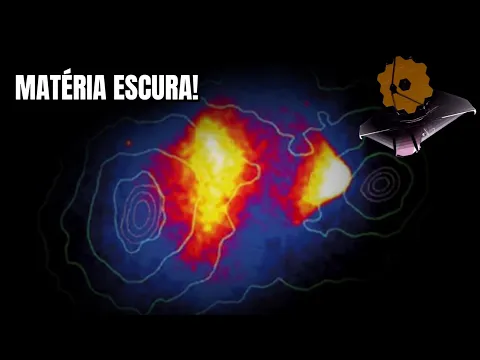
The Bullet Cluster is the strongest evidence for the existence of dark matter
In 2006, the observation of the Bullet Cluster provided one of the most robust proofs of dark matter. During the collision of two galaxies, the visible gas slowed down, while most of the mass continued to move.
This separation can only be explained if most of the mass does not interact with ordinary matter — exactly the behavior expected from dark matter.

In 1998, observations of supernovae revealed that the universe is not only expanding but accelerating its expansion. This phenomenon led to the proposal of dark energy.
It acts as a force opposing gravity, pushing galaxies away from each other. Despite representing the majority of the universe, its nature remains unknown.
Cosmological constant and the vacuum energy problem
The simplest explanation for dark energy is Einstein’s cosmological constant. However, quantum calculations indicate that the expected value should be 10¹²⁰ times greater than what is observed.
This discrepancy is considered the largest divergence between theory and observation in the history of physics. Even without direct detection, the composition of the universe is known through cosmic microwave background radiation. The fluctuations of this signal carry information about the distribution of matter in the early universe.
Theoretical models that reproduce these fluctuations lead precisely to the observed proportions of ordinary matter, dark matter, and dark energy.
The fate of the universe depends on the 95% we still do not understand
The future of the universe is directly linked to the nature of dark energy. If it remains constant, the universe will continue to expand indefinitely. If it varies, it could lead to extreme scenarios like the Big Rip or the Big Crunch.

Everything depends on components we still do not understand. A little-discussed consequence is that dark matter may be more complex than imagined. If it has multiple particles, it could form its own structures.
This opens the theoretical possibility of an invisible universe coexisting with ours, with no direct interaction beyond gravity.
The greatest mystery of modern science remains unanswered
By 2025, experiments will have reached technical limits that make the detection of dark matter even more challenging. Nevertheless, new generations of detectors are being planned.
Meanwhile, telescopes continue to reveal increasingly distant structures. In all of them, most of the mass remains invisible.
What we know for sure is simple: humanity understands only a minimal fraction of the universe. The rest continues to be the greatest mystery ever faced by science.







Seja o primeiro a reagir!