





 Português
  Inglês
  Espanhol
  5 min de leitura
  9 comentários





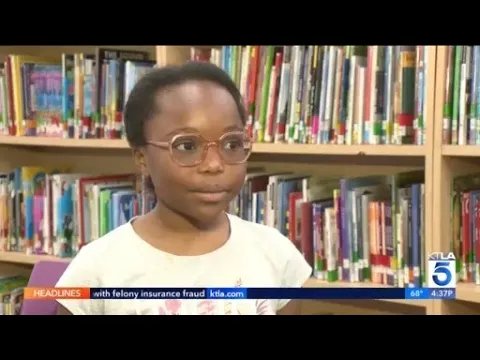
At Kim Park Elementary, student Honey Cooper keeps up with fractions and science, but also attends a college art class at San Bernardino Valley College, a rare experience among elementary students that challenges expectations, requires family support, and careful pedagogical attention in a new classroom.
In a scenario where fourth-grade students typically focus on basic tasks and classroom assessments, Honey Cooper has started to divide her week with something unusual at this stage: a dual enrollment that places her simultaneously in elementary school and in a college class in San Bernardino County.
This experience took shape when she started, this month, a college art course at San Bernardino Valley College. For the school staff, the case stands out not as a “shortcut”, but as a real test of how to support students with non-traditional learning paces without neglecting care for development, routine, and well-being.
Dual Enrollment: How a Child Can Attend College Without Leaving Elementary School

The central idea behind dual enrollment is simple in appearance but complex in practice: allowing students still enrolled in basic education to attend a higher education course when there is authorization and school organization. In Honey’s case, the proposal did not mean “exchanging” elementary school for college, but rather adding experiences, with different expectations, different languages, and different ways of assessment.
-
The world’s first octopus farm wants to open in the Canary Islands and is already provoking an international reaction: the plan aims to produce 3,000 tons per year.

-
Drought may be creating stronger superbugs in the soil and helping antibiotic resistance reach hospitals, warns a study highlighting a problem that could grow alongside extreme weather.

-
The biggest scam in history: Napoleon’s France deceived the United States by selling them a territory that was Spanish.

-
Why is the Danakil Desert so dangerous? It has unstable terrain and how extreme temperatures and toxic gases turn the region into one of the most hostile environments on Earth.


Therefore, the most sensitive point is not the enrollment itself, but the design of the support: who monitors progress, how decisions are made about what is appropriate, how overload is avoided, and how it is ensured that the college content fits without “overwhelming” the fourth-grade curriculum. When the process works, it treats acceleration as pedagogical adaptation, not as a race for performance.
Routine and Differences: From the Full Classroom to the Smaller University Environment
A detail that appears in daily life is the contrast between spaces. Honey describes a clear difference: in the fourth-grade classroom, she interacts with about 33 classmates; while in the college class, the group is close to 12 people.
This change of scale alters everything: participation, speaking pace, autonomy, organizational demands, and even the feeling of being “seen” by the professor.
For many students, a smaller environment can facilitate questions and feedback, but it also increases the need for a more independent posture.
College typically expects students to manage materials, deadlines, and instructions with fewer reminders.
For a child in elementary school, this can be both exciting and exhausting, requiring a well-organized routine between family and school so that the gain doesn’t become a burden.
Early Signs and Learning Trajectory: Autonomous Reading and Constant Curiosity
Honey’s story, according to her family, shows signs very early on. Her mother, Mia Cooper, says that around 18 months something started to change, and over time, she learned to read by herself.
This is not a decorative detail: early reading often transforms how students access the world by expanding vocabulary, accelerating comprehension, and fueling curiosity.
At school, this type of profile appears when the child “pulls” content beyond what is expected, as in the cited case of her also dealing with advanced-level math, reaching the idea of adding a seventh-grade math lesson.
The pedagogical challenge here is to balance: enrich without isolating, progress without “skipping” important foundations, and keep learning connected to the appropriate age in aspects that go beyond content, such as social interaction and self-regulation.
The Role of Family and School: Decisions, Limits, and Support
The initiative does not arise in a vacuum. The very educational management appears as a bridge: assistant superintendent of student services, Rodriguez, mentions having seen a young person in homeschooling taking college courses and brings the question into the context of the public system: why not consider this for students in public schools, when there is interest and conditions?
From the family’s perspective, the decision requires more than “support”: it requires logistics, constant conversation, and clear limits.
The mother reports that Honey has a sensitive point typical of many children: she prefers physical books, but when screen time comes into play, the appeal increases, and social media “pulls” attention.
This type of domestic detail becomes part of the pedagogical plan, because a routine with dual enrollment requires mental energy, focus, and real rest.
What This Experience Reveals About Opportunities for Students: Potential, Equity, and Caution

Cases like this often inspire, and it is natural for the school to see a possibility to pave the way for other students to follow similar steps.
At the same time, the most important lesson may be one of caution: an accelerated trajectory should not become a “one-size-fits-all model,” nor a trophy. What works for one child may not work for another, even if both are curious and dedicated.
There is also the issue of equity, because opportunities depend on information, availability of transportation, time from guardians, and institutional capacity for guidance. Without structure, the idea becomes privilege, not educational policy.
Therefore, if the school considers expanding initiatives, it needs to think about clear criteria, pedagogical support, and accessible paths for different profiles of students, not just for the most exceptional cases.
Emotional and Social Impacts: Belonging, Pressure, and Healthy Development
Attending a college classroom while still in elementary school changes not only the curriculum but also the feeling of belonging.
At college, Honey may be seen as “the youngest,” which brings curiosity and admiration, but can also bring strangeness. In elementary school, she may be viewed as “the one who goes to college,” which sometimes creates distance. The care here is to protect the child from labels.
Moreover, there is the invisible pressure: when adults celebrate the “extraordinary,” they may unintentionally increase the fear of making mistakes.
For students who are very dedicated, this becomes a real risk: transforming genuine interest into obligation. The key is to maintain realistic expectations, allow her to continue being a child, and treat the college class as a formative experience, not as a measure of personal worth.
Honey Cooper’s dual enrollment, combining fourth grade and a college art class at San Bernardino Valley College, draws attention because it breaks a script considered “too early.”
But the most relevant point is another: when the school recognizes the pace of certain students and organizes support, learning can gain new pathways without losing its footing.
What do you think should be mandatory for a school to allow this type of opportunity for such young students: rigorous pedagogical assessment, emotional support, a routine with screen limits, or active family involvement?
Share in the comments which of these factors weighs the most and why.









A participação da família de forma activa é importante. Em relação a Honey, a sua decisão e a prevalência de um comportamento desde tenra idade dá sinais evidentes de necessitar desta rotina para como ser humana completar o se avanço.
Senão tenho permissão por que colocaram no meu celula vocês também não deveriam estar em trando nos celula dos outros pessoas sem permissão
Parabéns para esta jovem é sinal que Ela feiz uma prova é passou com boas
Notas que DEUS continue abençõando à inteligência desta menina é proteja à mente dela continue sempre assim mesmo menina por que assim você vai chegar bem mais cedo onde você quer Parabéns DEUS te abençõe sempre tenha certeza que DEUS vai te honrar com á sua inteligência Amém