





 Portuguese
  English
  Spanish
  4 min of reading
  0 comments


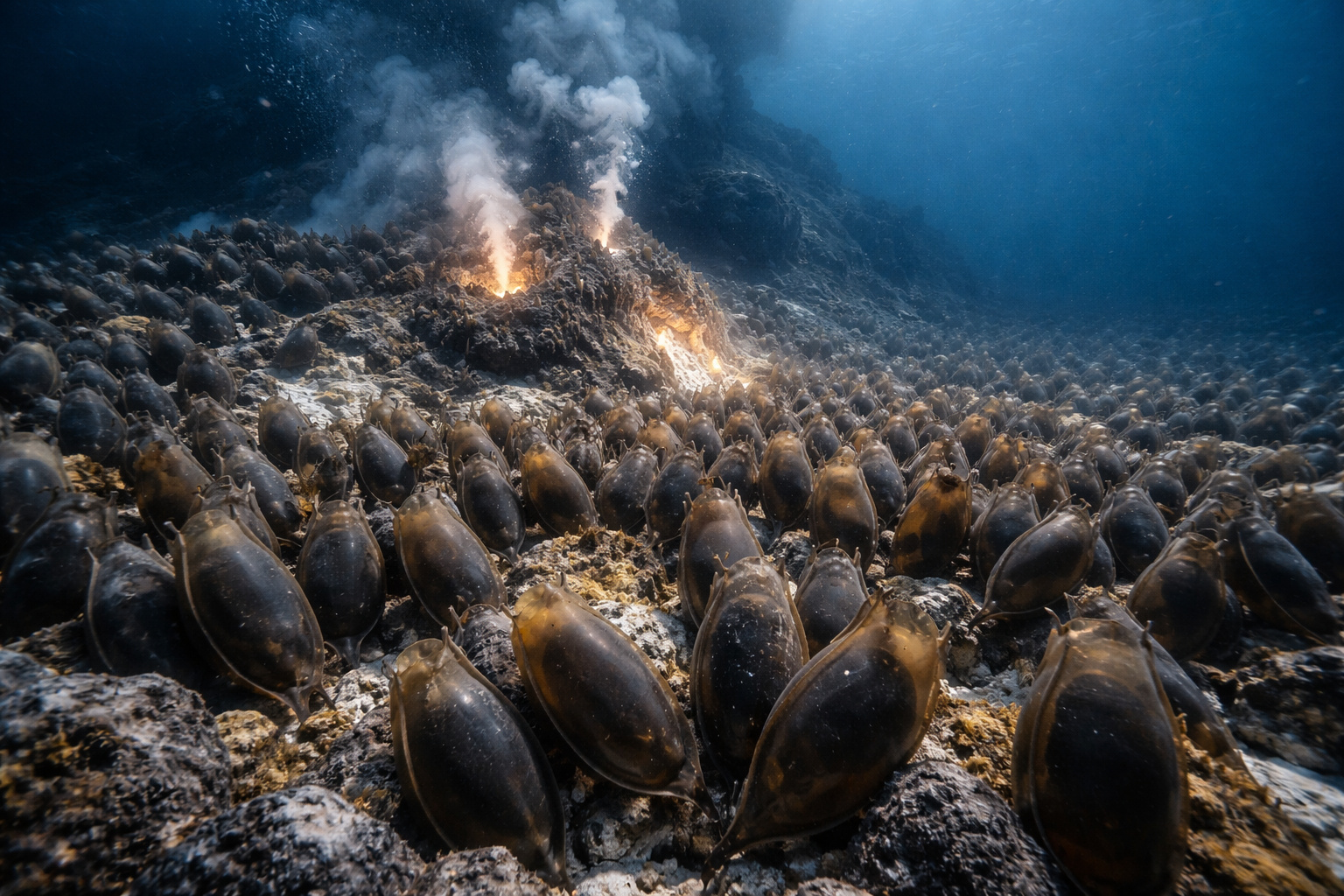
Geothermal heat from active volcano in Canada creates ideal environment for development of rare eggs at extreme depths
A significant scientific discovery for marine biology was recently recorded in the depths of the Pacific Ocean, off the coast of Vancouver Island, Canada. Additionally, around 1,000,000 giant ray eggs were found alive in incubation, in an environment considered extreme and previously poorly understood.
This phenomenon was identified during expeditions conducted by marine biologists, and was later analyzed by specialists in abyssal environments. According to data released in 2025 by scientific teams, the site functions as a natural incubator powered by volcanic activity, reinforcing how extreme ecosystems support highly adapted forms of life.
Investigation reveals natural incubator in underwater volcano
Initially, researchers analyzed an active volcanic seamount located more than 1.5 km deep. This underwater mountain rises about 1.1 km above the ocean floor, creating a unique and highly specific environment.
-
Archaeologists find lost medieval city in Poland with a central square, cemetery, forge, and more than 500 buried artifacts.
-
A massive warm air mass stretched from Brazil to near Antarctica and caused something that almost never happens: lightning and thunderstorms in Ushuaia, in the Falkland Islands, and in the South Georgia Islands.

-
Larger than a football field, with a wingspan of 117 meters, six Boeing 747 engines, and a capacity of 250 tons, the Stratolaunch Roc turns the sky into a gigantic hypersonic launch ramp and accelerates the way the U.S. tests weapons from Mach 5 to Mach 10.

-
Neuralink, the company specialized in brain chips founded by Elon Musk, announced that it intends to implant thousands of brain chips thanks to large-scale production.


During the investigation, a high concentration of Pacific white ray eggs was observed distributed at the top of the volcano, something considered unprecedented on a global scale. According to scientific estimates, more than 1 million eggs were developing simultaneously, which caught the attention of the international scientific community.
Furthermore, each egg can reach approximately 50 cm in length, classified as extraordinarily large. Normally, in cold waters, the development of these embryos takes years; however, in this environment, the heat released by the volcano creates more favorable conditions, functioning as a true “natural oven” for embryonic incubation.
Extreme environment favors species reproduction
Subsequently, scientists sought to understand the reasons for this unusual concentration of eggs in this specific environment. In this regard, the volcanic environment offers clear advantages for reproduction, creating unique conditions for embryonic development.
Among the main factors identified, the following stand out:
- Heated water reduces the development time of embryos, making the reproductive cycle more efficient
- The rocky terrain provides protection against natural predators, increasing survival rates
- The structure of the environment reduces the strength of ocean currents, ensuring greater stability for the eggs
- The presence of minerals may favor embryonic growth, contributing to the species’ development
Consequently, the combination of geothermal heat and marine reproduction becomes highly efficient, although this behavior is still considered rare among deep-sea fish species.
Characteristics of the Pacific white ray
On the other hand, understanding the species involved helps to gauge the importance of the discovery. The Pacific white ray (Bathyraja spinosissima) inhabits deep regions, making its direct records extremely rare and valuable for science.
According to the data presented in the classification image, the species can reach about 2 meters in adulthood and lives at depths between 800 and 2,900 meters. Additionally, its eggs, which reach approximately 50 cm, are among the largest ever recorded in marine environments.
Thus, it is one of the largest representatives of its family in abyssal zones, reinforcing the biological relevance of the observed phenomenon.
Discovery changes concepts of marine biology
In this way, the use of volcanic heat in incubation significantly alters the current scientific understanding of reproduction in extreme environments. Until now, reproduction near geothermal sources was practically nonexistent in marine records.
Thus, the phenomenon challenges traditional concepts of reproduction in extreme environments, opening new possibilities for scientific study. Furthermore, it suggests that other underwater volcanoes around the world may harbor similar natural nurseries.
Therefore, the map of life in the ocean depths can be significantly expanded. According to experts, these environments remain largely unexplored, indicating great potential for new discoveries.
Marine conservation raises alarm
Finally, the discovery also raises relevant environmental concerns, especially given the vulnerability of these ecosystems. Locations like this may require special protection against human impacts.
Among the main identified risks are:
- Bottom trawling, which can destroy sensitive areas and critical habitats
- Deep-sea mining, which threatens ecosystems still unknown to science
Thus, experts emphasize the urgent need to map and protect underwater geothermal regions, recognizing their essential role in the reproduction and survival of rare species.
Consequently, understanding these environments may be decisive for the preservation of deep marine biodiversity.
In light of this, how many other underwater volcanoes still hide unknown natural nurseries in the depths of the ocean?








Seja o primeiro a reagir!