





 English
  Francês
  Alemão
  Italiano
  Japonês
  Norueguês
  Portuguese
  Spanish
  6 min of reading
  0 comments


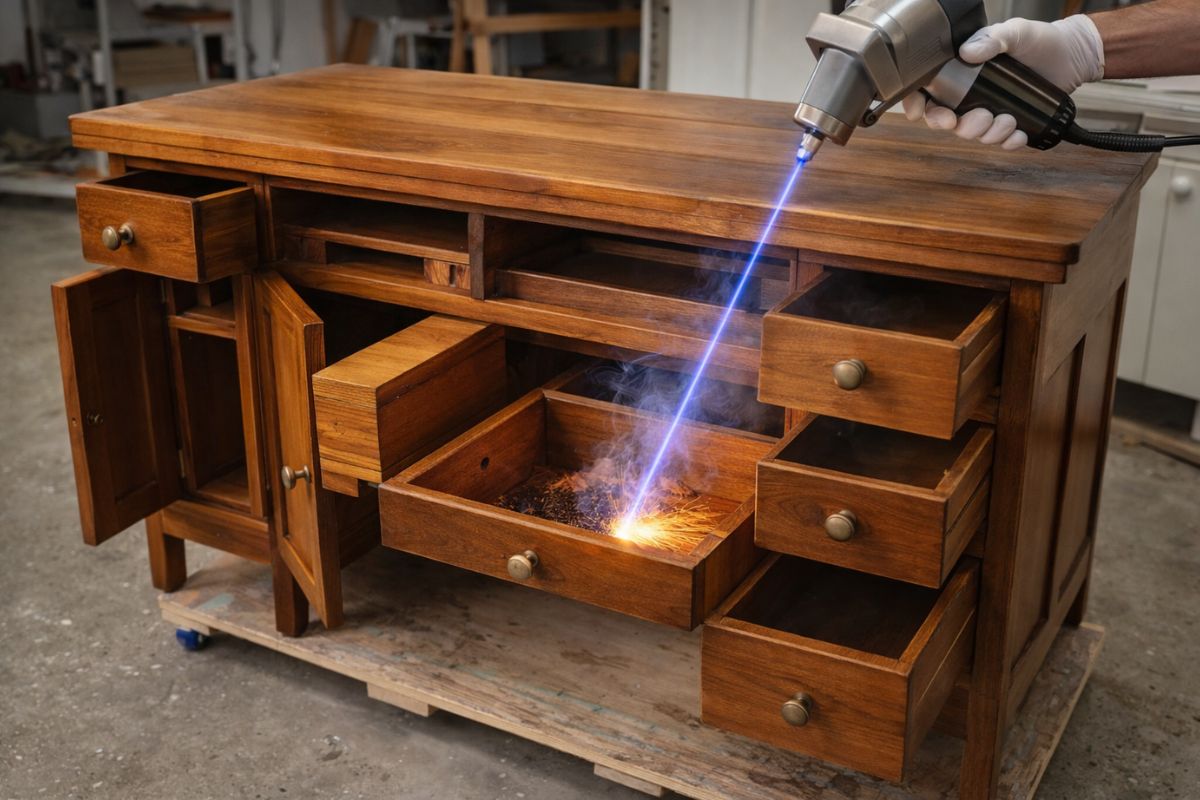
The restored desk surprises by exposing drawers with false bottoms, uncommon internal compartments, hidden solid wood pieces, and an old structure being recovered with manual solutions and laser technology.
The work on the desk mixes investigation, structural repair, and fine finishing. Throughout the restoration, signs emerge that the piece held more than it appeared to on the outside, while modern tools redefine the precision of cuts, engravings, and details of the process.
The restoration begins with clear signs of wear. The bottom shows flaws, some drawers seem glued, and certain fittings raise suspicions right from the first contact. The piece does not behave like a common item, and this completely changes the way to handle each stage of the repair.
From there, the work ceases to be merely aesthetic. Each removal of a board, each nail extracted, and each repurposed piece helps reveal how the desk was assembled, altered, and adapted over time, until reaching a point where the restoration requires both historical sensitivity and technical precision.
-
Seen from space, a colossal ‘Y’ cuts through the largest desert in China, blending a jade-filled river, red and white mountains, and revealing the absurd scale of the transformation of the Taklamakan surrounded by a green wall with billions of trees.

-
The Pacific Ocean reveals what the cliffs of Big Sur have hidden for millennia: Pfeiffer Beach, in California, features swirling purple sand formed by garnet crystals and displays a stone arch that is illuminated by the sun in winter for just a few days each year.

-
Aursjøvegen in Norway is a 100-kilometer gravel road that crosses chasms and dark tunnels carved into the rock at an altitude of 947 meters in the fjords and is only open for four months a year.

-
With about 4,000 m², the building constructed in a traditional neighborhood in France looks like a rainbow, has a colorful facade, mixes vibrant glass, and creates one of the most unusual visuals in Bordeaux.
The desk hid details that did not appear at first glance
Right from the first interventions, it becomes evident that the desk holds elements out of the ordinary. Some thin boards, apparently cut with a band saw, draw attention due to their finish and the way they were fixed with nails. The feeling is that there is something unusual beneath the surface.
This impression grows when the top begins to be removed to reveal what was underneath. The piece starts to be read almost like a riddle, as certain internal solutions do not seem to have been made just for structure or simple reinforcement.
Drawers and false bottom expand the mystery of the piece
In one of the most revealing moments of the process, the restoration shows that an internal compartment of the desk was false. The realization comes when removing the handle and noticing that space could not have been constructed that way from the beginning.
This type of discovery changes the symbolic value of the piece. The desk ceases to be just an antique and begins to carry a component of secrecy, as if part of its history had been hidden behind improvised or intentional solutions.
Solid wood appears where there was once doubt
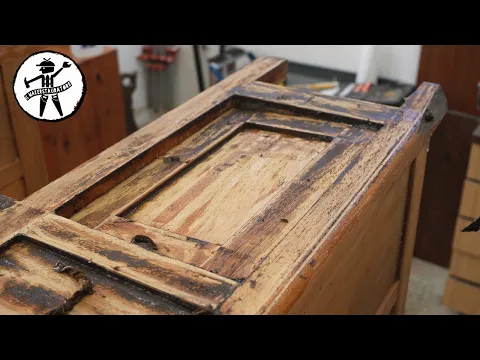

Another point that strengthens the relevance of the restoration is the finding that various parts of the desk are made of solid wood. Instead of a simple piece or one disfigured by later renovations, the item reveals a bottom, sides, and structural elements made of more noble material than expected.
This discovery directly impacts the decision to restore with more care. When solid wood appears in hidden parts, the piece gains another stature, both in construction value and in recovery potential.
Joints made by hand reinforce the age of the piece
When redoing the bottom of a drawer and analyzing internal parts of the desk, hand-made joints emerge that seem very old. This type of detail not only reinforces the impression of age but also suggests a more artisanal manufacturing process.
These marks help tell the story of the piece. These fittings reveal a time when the structure was resolved with hand, technique, and patience, making the restoration even more delicate and important.
Repair requires careful disassembly and correction of spaces
A large part of the work on the desk involves disassembling, un-nailing, and re-gluing boards to eliminate gaps and recover alignment. At one point in the process, the proximity of the tables creates a space of about one centimeter at the back, requiring adjustment of the stop to cover the opening.
This type of correction shows how the restoration depends on millimetric decisions. It is not enough to simply put the pieces back in place, because the goal is to restore visual and structural coherence to the whole, respecting the original behavior of the piece as much as possible.
Old parts are reused in the restoration itself
Instead of replacing everything with new material, the recovery of the desk uses parts of the piece itself to recompose missing areas. A piece of the drawer’s bottom, for example, is considered to fill the missing part in one of the front legs.
This logic values the integrity of the restoration. Whenever the piece itself offers compatible material, the restoration better preserves its identity, reducing contrasts and maintaining the antique character of the item.
Color and finish need to converse with the original base
During the recomposition, the color difference between woods becomes a decisive criterion. At one point, a piece set aside for gluing is discarded precisely because the tone does not match the rest, being replaced by another visually closer.
This care shows that restoring the desk is not just about filling voids. It is about reconstructing without creating obvious visual ruptures, which requires a fine reading of color, texture, and the natural aging of the material.
Laser technology comes in to elevate precision and finish
In the middle of the process, the restoration of the desk intersects with a high-tech tool presented as F2 ULTRA UV, from xTool. The equipment is described as capable of making microscopically perfect cold cuts and even engraving inside glass.
Even appearing in tests with metal, stone, and crystal, this stage changes the horizon of the restoration. The presence of the laser shows how the recovery of an antique piece can dialogue with extremely modern resources, raising the standard of precision and finish possible in meticulous work.
Integrated camera and precise recording expand control of detail
The technology used in the process also features a 48-megapixel integrated camera, a feature that allows for better framing of the work area and accurately tracking the starting point of the recording. The highlighted result is the level of detail reproduced by the equipment.
This gain matters because restoration depends on fine control. The more predictable and precise the intervention, the lower the risk of error on an antique piece, especially when each detail can affect the visual and historical value of the furniture.
Treatment against termites protects the desk for the future
After the structural repairs, the desk also undergoes treatment against termites throughout the body of the piece. This step is decisive because it is pointless to recover fittings, bottoms, and finishes if the base remains vulnerable to biological attack.
The treatment gives another perspective to the restoration. It is not just about recovering the past of the piece, but ensuring that it continues to exist in the future with more security and stability.
Lightening the top seeks visual balance
At another important moment, the piece is moistened and reveals a noticeable difference between the top and the base, with the upper part appearing darker. From this point, an attempt at lightening begins to bring the tones closer and reduce stains.
The result improves the harmony of the whole. When the colors start to converse with each other again, the desk ceases to look like a patched piece and begins to recover aesthetic unity, something essential in any complete restoration.
Restoration transforms the value and perception of the piece
At the end of the process, the desk no longer impresses just for being old. It draws attention for its secret compartments, hidden solid wood, artisanal fittings, structural repairs, and the use of advanced technology to refine the finish.
This set completely changes the reading of the piece. The item moves from the condition of a worn and enigmatic object to that of a restored item with precision, care, and increased value, both from a material and historical perspective.
Would you like to have an antique desk with secret compartments restored this way, or do you prefer new and unremarkable furniture?








Seja o primeiro a reagir!