





 Portuguese
  English
  Spanish
  5 min of reading
  0 comments


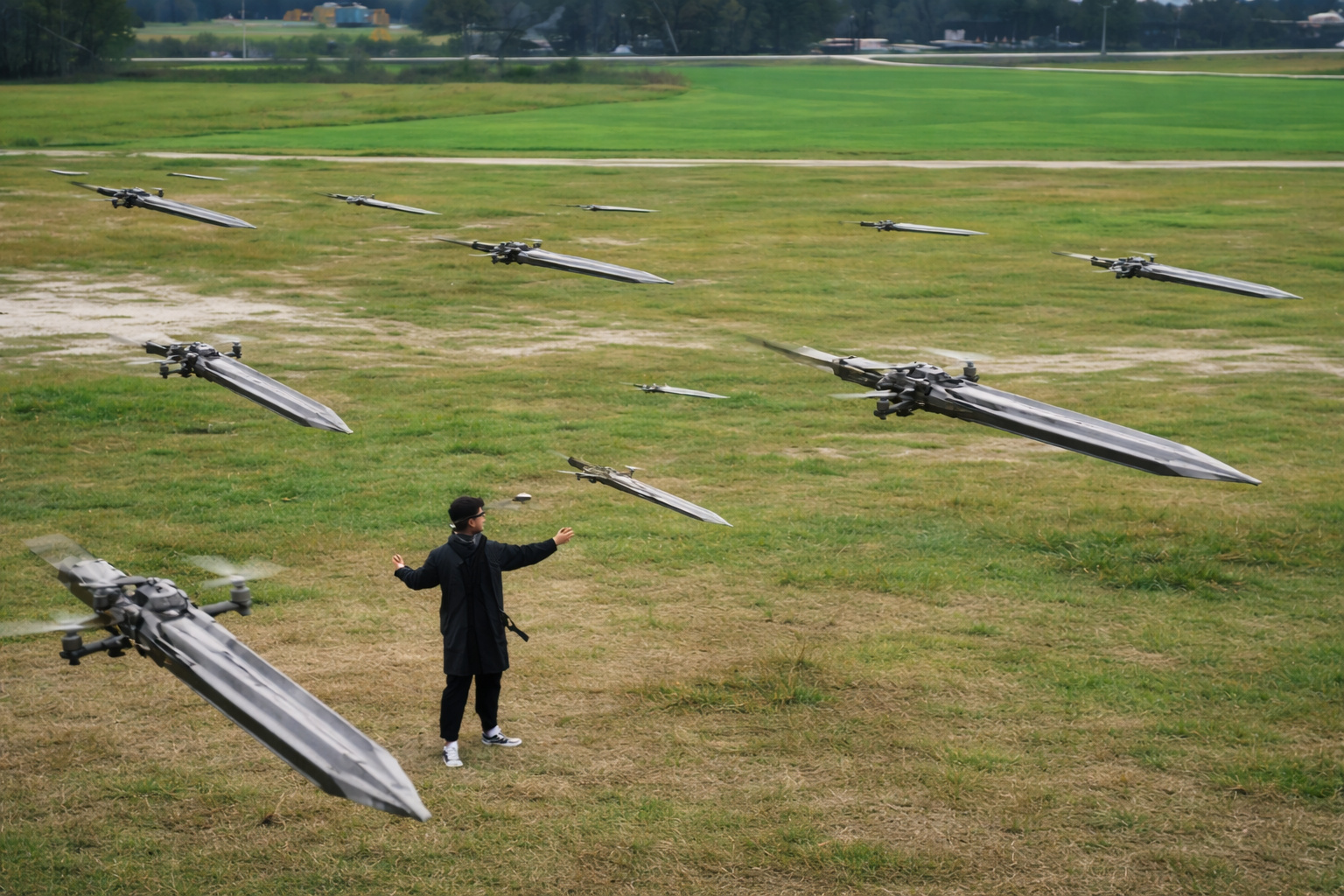
Inventor in China creates sword-shaped drones controlled by gestures, sensor-based technology brings fiction closer to reality.
In 2025, in the city of Chengdu, in Sichuan province, China, an independent creator gained international attention by developing sword-shaped drones capable of responding directly to hand movements. According to a report from the portal TecMundo, the project went viral on social media by presenting “flying swords” that are, in practice, customized drones capable of moving in a coordinated manner and responding to the creator’s gestures, inspired by wuxia cinema.
The key difference of the system lies in the method of control. Instead of a conventional remote control, the drones use a motion-based system, allowing them to be guided by hand gestures in real-time, as if the user were commanding an aerial swarm.
This type of interaction eliminates traditional physical interfaces and brings technology closer to scenarios previously seen only in fiction, especially in narratives of Chinese martial arts, where flying weapons respond directly to the user’s will. The result is a concrete example of how motion control systems and customized drones are expanding the limits of human-machine interaction.
-
100 times less energy consumption: the innovation that could solve the huge energy crisis of AI.
-
Scientists reveal a new method using solar light that transforms plastic into vinegar and could change the game against pollution, converting waste into a sustainable solution with future global impact.

-
3,500-year-old tear discovered reveals a textile technique much more advanced than previously thought in the Bronze Age.

-
One of the largest manufacturers of military ammunition in the world is Brazilian and has just signed an agreement with the Navy to develop national ammunition for the frigates built in Santa Catarina that will protect the Blue Amazon.


How sword-shaped drones manage to fly with stability
Despite their unusual appearance, the drones follow classic principles of flight engineering. The sword-shaped structure is made of lightweight materials and is distributed in a way that maintains a balanced center of gravity, allowing for stability during flight.
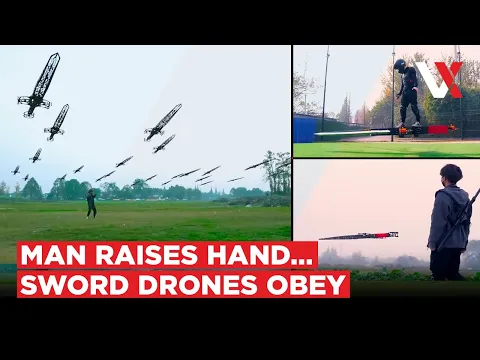

Each unit has multiple rotors strategically positioned along the body, ensuring lift and directional control. The elongated geometry requires fine adjustments in weight distribution and electronic control to avoid oscillations.
Even with a shape that completely deviates from traditional drones, the system manages to maintain stability in the air, demonstrating an advanced level of engineering applied to unconventional structures. This aspect is one of the most striking points of the project.
Gesture control completely replaces the remote control
The most relevant difference of the technology lies in the method of control. Instead of using joysticks or physical interfaces, the system interprets the operator’s hand movements in real-time.
Sensors capture the movement, and algorithms convert this data into flight commands. Simple movements like raising an arm, rotating a hand, or pointing in a certain direction are translated into specific actions of the drone.

This interaction eliminates the need for complex technical learning, making control more intuitive and bringing operation closer to natural human behavior. This represents a significant change in how flying devices can be operated.
The technology behind the system involves sensors and real-time processing
The operation of the drones depends on a combination of technologies that work simultaneously. Inertial sensors capture acceleration and orientation, while motion capture systems interpret gestures with precision.
The collected data is processed by algorithms that identify movement patterns and translate them into commands. This process occurs in real-time, requiring low latency and high reliability.
The system does not respond directly to the gesture itself, but to a digital interpretation of that movement, which ensures accuracy and avoids failures during control. This level of technological integration is essential for the functioning of the project.
Inspiration from wuxia cinema connects cultural tradition and technological innovation
The project was directly inspired by wuxia cinema, a traditional Chinese genre that depicts warriors capable of controlling weapons from a distance. These productions are part of the region’s popular culture and have influenced various generations.
By transforming this concept into a real system, the inventor creates a connection between cultural tradition and contemporary technology. The result is a practical application of an idea that was previously considered purely fictional.
This fusion of culture and engineering contributed to the project’s viral spread, making it an example of how technology can reinterpret historical and cultural elements.
Operation with multiple drones increases the complexity of the system
The tests demonstrate that the system is not limited to a single drone. In various demonstrations, multiple units operate simultaneously, executing coordinated movements in the air.
This type of operation requires precise synchronization and collective control. Each drone needs to maintain a relative position to the others, avoiding collisions and ensuring the stability of the group.
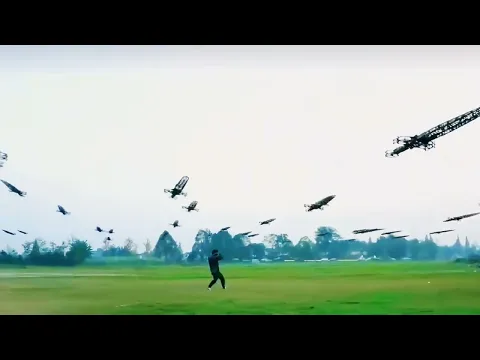
The simultaneous control of multiple units through gestures represents a significant advancement, indicating that the system can evolve into more complex applications in the future.
Current limitations show that the technology is still experimental
Despite the visual and technical impact, the project is still in an experimental stage. It is not a commercial solution or a product available on the market.
The drones do not have direct military or industrial applications, being developed mainly for technological demonstration and entertainment.
This means that, although functional, the system still depends on improvements to achieve practical large-scale applications. The evolution of the technology will depend on advancements in sensors, artificial intelligence, and data processing.
Potential for future application in various technological areas
Even as a prototype, the concept paves the way for future applications. Gesture control can be used in scenarios where speed and precision are essential.
Industrial environments, rescue operations, and entertainment interfaces are examples of areas that could benefit from this technology.
The elimination of physical controls could reduce usage barriers and make interaction with drones more accessible, especially in situations that require quick responses.
The evolution of human-machine interfaces points to more intuitive systems
The project is part of a larger trend towards the development of natural interfaces. Gesture, voice, and motion-based technologies are gradually replacing traditional controls.
This evolution seeks to reduce the complexity of use and bring technological interaction closer to human behavior. The use of gestures represents an important step in this process.
By allowing direct control through movement, the system demonstrates how the relationship between humans and machines can become more fluid and intuitive.

The development of sword-shaped drones controlled by gestures represents a concrete example of how concepts from fiction can be transformed into functional technology.
By combining sensors, data processing, and flight engineering, the project demonstrates new possibilities for interaction with machines.
Even in the experimental stage, the technology indicates a path where devices will increasingly be controlled by natural movements, reducing the need for physical interfaces and expanding the possibilities of use in different contexts.





Seja o primeiro a reagir!