





 Portuguese
  English
  Spanish
  4 min of reading
  0 comments


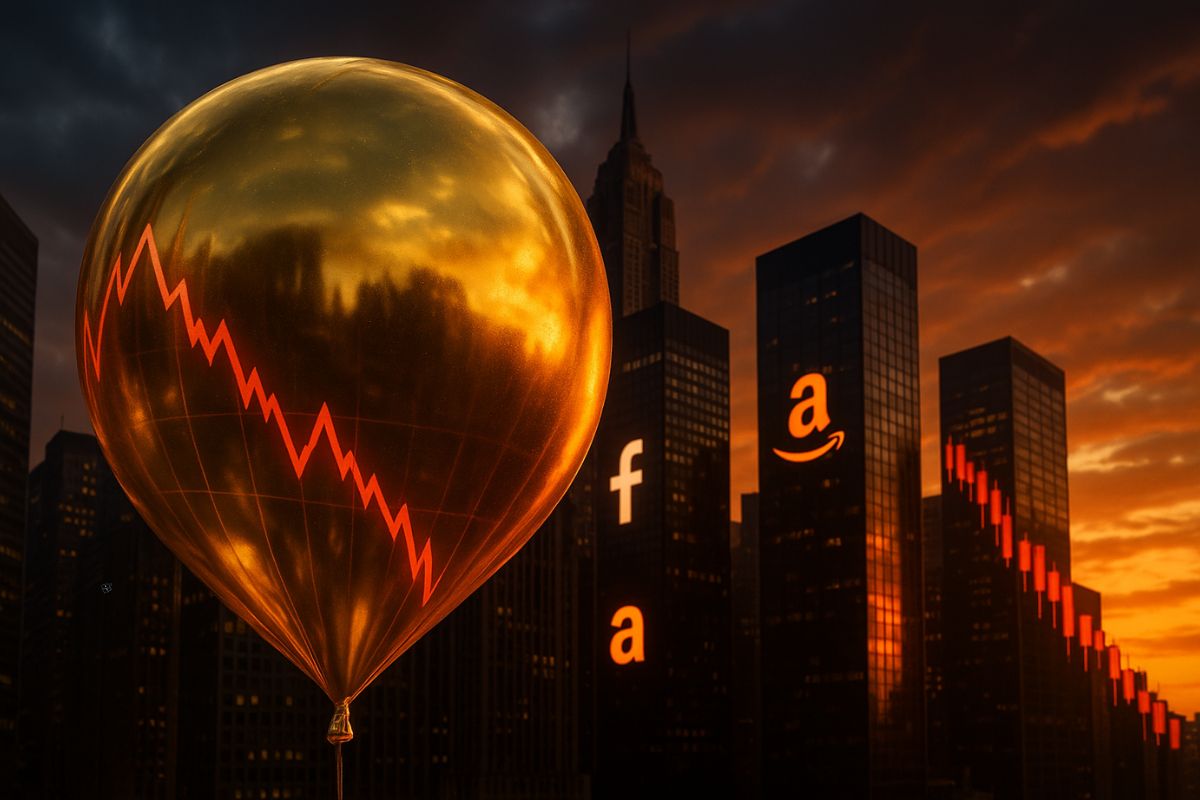
Record High Valuations, Extreme Concentration in Big Techs, Elevated Long-Term Interest Rates, and U.S. Debt Near 120% of GDP Raise Alarm Bells About the Biggest Bubble in History.
The discussion about the biggest bubble in history gained momentum in 2025, driven by analyses from experts like Bruno Perini, who highlight not only the elevated stock prices but also the rare combination of structural factors. The warning is not limited to multiples: it involves the unprecedented concentration of the S&P 500 in a few companies, long-term interest rates at 2008 levels, and an increasingly fragile U.S. fiscal picture.
The central thesis is simple: when prices, concentration, and macroeconomics move in the same direction, the market becomes vulnerable. A small trigger may be sufficient to cause a significant correction.
Record Concentration and Dependence on Big Techs
One of the most highlighted points is the concentration of the S&P 500 index.
-
The largest food company on the planet, JBS, has just opened a 4,000 square meter laboratory in Florianópolis to develop customized proteins that modulate muscle mass gain, immune response, and metabolic performance.

-
After nearly 30 bids and competition among industry giants, a Spanish company purchases one of the largest airports in Brazil for almost R$ 3 billion and takes over the management of Galeão in a concession that will last until 2039.

-
The Federal Revenue Service now automatically cross-references everything you declare with data from banks, credit cards, brokerage firms, and insurance companies, and any discrepancy between your income and your expenses triggers an alert in seconds.

-
Amid global tensions, Brazil blocks the United States’ proposal at the WTO and paves the way for a trade crisis and possible retaliations.

According to recent data, 10% of stocks account for 76% of the total index value, an unprecedented level.
Companies like Apple, Microsoft, Nvidia, Amazon, Google, and Meta drove much of the average return, while most stocks lagged behind.
This imbalance creates systemic risk: just one earnings revision or a slowdown in any of these giants can drag down the entire index.
The scenario repeats patterns seen in previous crises, but on an even sharper scale.
Lessons from History: Bubbles Are Not New
Historical comparisons reinforce the concern. In 1929, excessive credit led to an 83% market crash and a 25-year wait for recovery.
In 2000, the dot-com bubble burst, taking the Nasdaq down by 80%. In 2008, subprime mortgages and rising interest rates caused 50% losses in the S&P 500.
The conclusion is clear: bubbles seem rational until the moment they stop being so.
And while declines of 10% to 20% are common in market cycles, deeper crashes, although rare, destroy wealth in no time.
The Weight of Long-Term Interest Rates and U.S. Debt
Another factor fueling the debate about the biggest bubble in history is the behavior of interest rates in the U.S.
While the Federal Reserve discusses cuts to the base rate, 30-year bonds remain around 5%, a level not seen since 2008.
High long-term interest rates make mortgages more expensive, pressure indebted companies, reduce liquidity in banks, and increase the cost of U.S. public debt itself.
The U.S. Treasury is already spending over US$ 1 trillion per year just on interest, almost matching the defense budget.
With debt close to 120% of GDP, each issuance requires higher premiums, feeding back into the cycle of pressure.
Gold on the Rise and Distrust in the Dollar
A symbolic data point of the moment is the shift in the composition of global reserves: for the first time since 1996, foreign central banks hold more gold than Treasuries.
The metal has appreciated about 35% in a year and 109% over three years, reflecting the search for protection amid instability.
This movement signals distrust in the dollar as a benchmark asset and reinforces the perception of structural fragility in the international financial system.
What Could Be the Trigger for the Explosion?
Experts emphasize that a collapse in profits is not necessary to burst the bubble.
A specific disappointment in a big tech, an unfavorable macro data point, or a new shock in long-term interest rates could be enough to trigger a wave of selling.
With such concentration, the domino effect spreads quickly.
What starts as an adjustment in one sector can turn into a widespread correction, increasing global volatility.
How Investors Can Protect Themselves


The analyzed material suggests three practical defenses to face uncertainty:
Emergency fund in liquid assets, such as Selic Treasury or daily liquidity CDBs, to avoid selling in panic moments.
Real diversification, combining fixed income, stocks from different markets, real estate funds, gold, and even cryptocurrencies, reducing correlations.
Contribution discipline, remembering that the best market days often occur right after the worst — trying to hit the “timing” can be costly.
The debate about the biggest bubble in history is not a prophecy of an immediate collapse, but a warning that price, concentration, and macroeconomic fundamentals are at a rare tension point.
The market could stay stretched for months or years, but the likelihood of correction has increased.
And you, do you believe we are really facing the biggest bubble in history, or do you think the market still has the strength to rise further? Leave your opinion in the comments — we want to hear the views of those who invest and monitor the market daily.








-

-

-

5 pessoas reagiram a isso.