





 Portuguese
  English
  Spanish
  4 min of reading
  0 comments


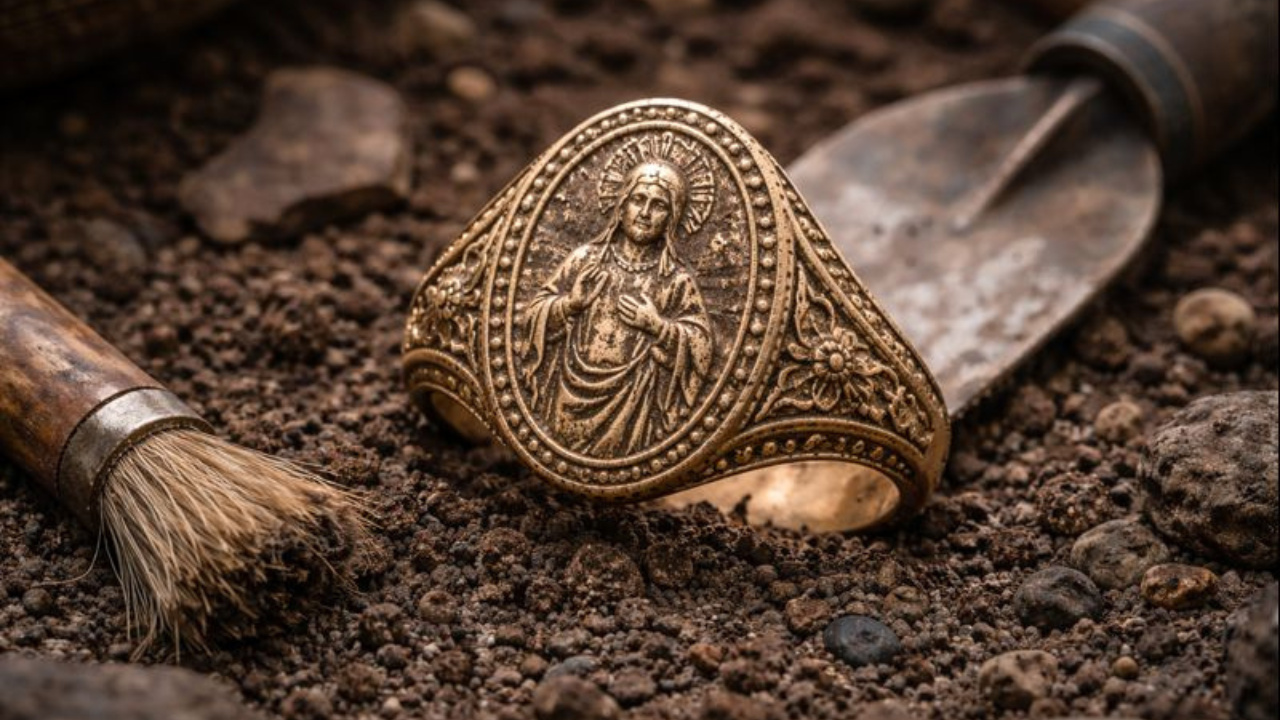
15th Century Jewel Found in Excavations in Kalmar Intrigues Archaeologists and Reinforces the Importance of the Medieval Religious Artifact.
A medieval gold ring, dated to the 15th century, was recently identified during an archaeological discovery in Sweden, more precisely in the excavations in Kalmar, in the southern part of the country.
Researchers found the artifact featuring the image of Jesus Christ in an ancient urban waste deposit and raised questions about faith, daily life, and religious practices of the medieval population.
Local archaeologists analyzed the piece and expanded the understanding of personal devotion objects between 1401 and 1500 by highlighting its state of preservation and the unexpected context of the discovery.
-
Spain surprises the world by erecting 62 artificial dunes, mixing sand with natural remains of posidonia, and causing the structure to lose only 1.4% of its volume in 1 year.

-
With 16 Bulava missiles, improvements in acoustic stealth, and a design focused on silent patrols, Russia’s nuclear submarine was born to ensure Moscow’s invisible retaliation and has become one of the pillars of its maritime strength.

-
‘Populous’ city in Rio among the worst in Brazil in national ranking and exposes silent development crisis.

-
Couple buys house in the South Zone of São Paulo, opens a hidden door in the garage, and finds a secret wine cellar with dozens of old wines forgotten since the 1970s.

Since the official announcement, researchers have begun to consider the 15th century jewel one of the most symbolic finds in the region in recent years.
Moreover, researchers assess that the object may have belonged to an ordinary person, which reinforces its historical and social relevance.
Medieval Religious Artifact Surprises by the Location of the Find
What intrigues specialists the most is the location where the medieval gold ring was found.
The piece emerged in an area that functioned as an ancient urban dump, used during the Middle Ages for discarding household waste.
This detail raises important hypotheses. On one hand, the ring may have been accidentally lost.
On the other hand, there is the possibility that it was discarded in an unknown context, perhaps linked to religious changes or economic difficulties of the time.
According to archaeologists involved in the research, “many are considering the discovery a true miracle,” a phrase used to highlight the symbolic value of the find and its preservation after centuries beneath the soil.
Characteristics Indicate That the 15th Century Jewel May Have Been Feminine
Preliminary analyses indicate that the 15th century jewel has reduced dimensions, compatible with jewelry worn by women in the medieval period.
This factor reinforces the thesis that the object did not belong to the noble elite, but possibly to someone from the common people.
Additionally, the simple yet refined style suggests intense personal devotion, something common in times of strong religious influence.
The use of sacred images in rings was a way to express faith in daily life, functioning both as adornment and spiritual protection.
Thus, the medieval religious artifact confirms its historical roots and broadens the understanding of individual faith practices in medieval Sweden.
Excavations in Kalmar Reveal Other Religious Remnants
The excavations in Kalmar were not limited to the discovery of the ring.
During the archaeological work, researchers also found an alsengem, an ancient amulet used by pilgrims in the Middle Ages.
Although the object is broken, it provides valuable information about religious practices and spiritual displacements of the time.
This type of amulet was common among believers who traveled long distances in search of sacred sites.
On the other hand, researchers emphasize that, despite the significance of the find, it is still not possible to confirm Kalmar as a major site of medieval pilgrimage.
Even so, the evidence points to a city more connected to religious routes than previously thought.
Archaeological Discovery in Sweden Broadens Perspective on Medieval Kalmar
In total, research teams have already cataloged more than 30,000 objects during the current phase of the archaeological discovery in Sweden.
Among them are remnants of buildings, household utensils, and marks of historical conflicts.
One of the most relevant episodes associated with the region is the Kalmar War, fought between Sweden and Denmark starting in 1611.
Remnants from this period help to contextualize the challenges faced by the local population over the centuries.
Therefore, each new find contributes to reconstructing the urban, social, and religious history of the city.
Historical Importance of the Medieval Gold Ring
The medieval gold ring stands out not only for its precious material but mainly for its symbolic value.
It represents everyday religiosity, access to faith outside large institutions, and the lives of ordinary people in the Middle Ages.
Moreover, the find reinforces how seemingly simple objects can offer complex answers about the past.
Together with other artifacts, the ring helps to paint a more human and detailed portrait of medieval Swedish society.
Meanwhile, studies continue, and new revelations may arise from laboratory analyses.
Thus, Kalmar continues to establish itself as one of the most significant archaeological sites in contemporary Sweden.








Seja o primeiro a reagir!