





 Portuguese
  English
  Spanish
  4 min of reading
  1 comment


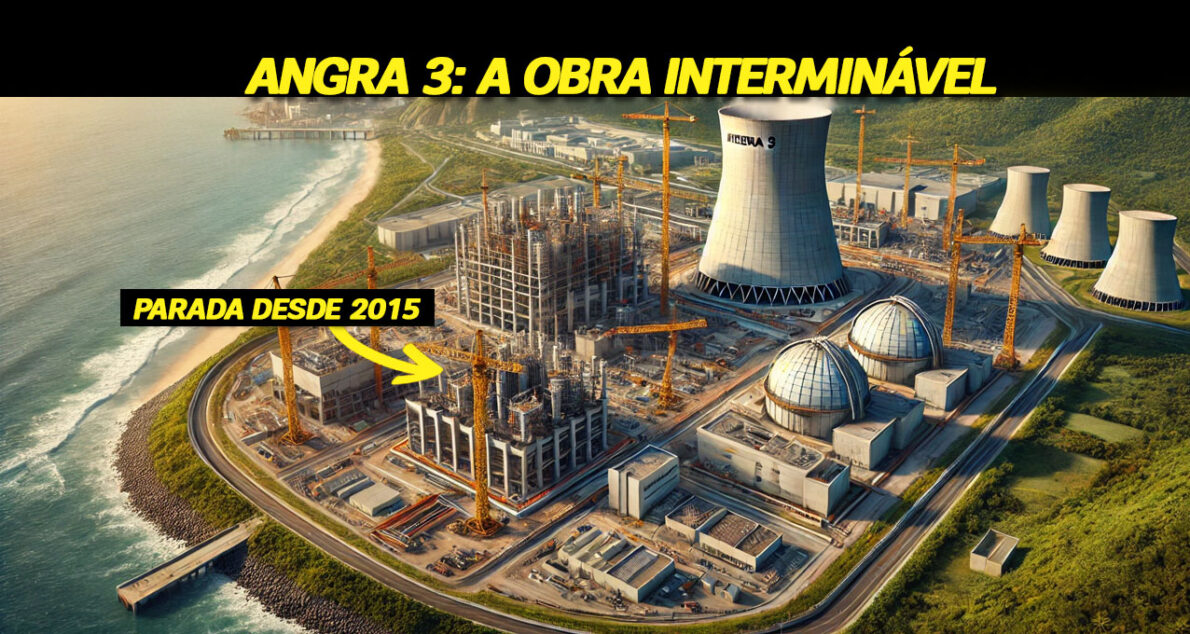

Angra 3, The Brazilian Nuclear Power Plant That Promises 1.4 Gigawatts Of Energy, Remains Unfinished After Nearly A Decade. With Maintenance Costs Of R$ 250 Million Per Year, The Future Of The Project Remains Uncertain.
For nearly a decade, a sleeping giant by the seaside in Angra dos Reis, Rio de Janeiro, has remained inactive, draining millions of reais annually from the pockets of Brazilians without delivering what was promised.
The Angra 3 Nuclear Power Plant, which was to be a milestone in the country’s energy history, has become a true monument to waste and lack of planning.
Even with 65% of the construction completed and 85% of the equipment purchased, the project, which began construction back in the 1970s, stopped in 2015. But why, after so much time and money invested, has Angra 3 still not been completed?
-
A new Brazilian shopping center worth R$ 400 million will be built in an area equivalent to more than 4 football fields, featuring 90 stores, 5 cinemas, a supermarket, a college, and parking for 1,700 cars, potentially generating 3,000 jobs.

-
Larger than entire cities in Brazil: BYD is building a 4.6 km² complex in Bahia with a capacity for 600,000 vehicles per year, but the discovery of 163 workers in conditions analogous to slavery has shaken the entire project.

-
With an investment of R$ 612 million, a capacity to process 1.2 million liters of milk per day, Piracanjuba inaugurates a mega cheese factory that increases national production, reduces dependence on imports, and repositions Brazil on the global dairy map.

-
Brazilian city gains industrial hub for 85 companies that is equivalent to 55 football fields.


Stopped Works And An Uncertain Future
The Almirante Álvaro Alberto Nuclear Center, home to the only nuclear power plants in operation in Brazil, Angra 1 and 2, is also the site where construction of the third plant, Angra 3, is stalled.
Since 2015, the works have been halted, and the plant, which promised to generate 1.4 gigawatts of energy, remains as a “mausoleum” of unfinished concrete.
According to obtained information, the halt occurred in the context of Operation Car Wash, which investigated embezzlement and irregularities in the construction of the unit.
According to experts, an investment of R$ 23 to 27 billion will be necessary to complete the works, which has already consumed billions since its inception.
A Symbol Of Mismanagement And Waste
Upon visiting the site, it is possible to observe that, although the generator building is nearly finished, the structure that will house the reactor, in a spherical shape, is only halfway done.
The scene is desolate: concrete pillars that do not support anything and exposed rebar, silent witnesses of a construction that, if not completed, could become one of the largest white elephants in Brazil’s recent history.
Recently, the Minister of Mines and Energy, Alexandre Silveira, has expressed support for the resumption of the works. In a hearing at the House of Representatives’ Mines and Energy Commission, he compared the current situation to a “mausoleum” that cannot be left for future generations.
“None of us, in our right mind, will keep or carry that mausoleum (Angra 3), to serve as a visitation to the world of failure of the Brazilian government’s management,” said the minister.
Expectations For The Future
The final decision on whether to continue the works is in the hands of the National Council of Energy Policy (CNPE), which must analyze the study conducted by the National Bank for Economic and Social Development (BNDES).
According to the minister, the cost-benefit of the project should not be questioned, especially after all the investment already made.
Even without a detailed survey of the accumulated costs so far, the R$ 20 billion mentioned by the minister for the completion of the project is considered modest according to industry experts.
Moreover, the cost of discontinuing the works must also be taken into account, as sector sources estimate that cancellation could cost between R$ 12 and 17 billion in subsidies and exemptions that would have to be returned.
The Financial And Energy Impact Of Angra 3
While the decision is not made, Angra 3 continues to consume resources. According to the latest data, the annual maintenance cost of the halted works reaches R$ 250 million, a significant amount for a plant that has not yet produced a single megawatt of energy.
Brazil, which since the government of Juscelino Kubitschek has sought to dominate nuclear technology, now faces a dilemma: invest more billions into a project that has already been marred by corruption scandals or give up and bear the costs of an unfinished work.
A Crucial Decision For Brazil’s Energy Future
The completion of Angra 3 could, in theory, strengthen the Brazilian energy matrix by diversifying sources of electricity generation and reducing dependence on hydroelectric and thermoelectric plants.
However, the continuation of the work also implies high financial costs, in addition to the challenge of overcoming the distrust of the population and investors regarding the project’s safety and feasibility.
With the future of the plant still uncertain, the question remains: will Brazil have the courage to complete Angra 3, or will it become just another chapter in the book of unfinished projects in the country?
And you, do you believe that Angra 3 can still be completed, or are we facing yet another white elephant that only consumes resources without generating benefits? Leave your opinion in the comments!






Não se incomoda com isso não companheiros, sempre quê se tratar dê qualquer investimento pára o Rio dê janeiro, virão juntos todos os obstáculos possíveis dos ANTIS Rio dê janeiro, isso ocorre também com a refinaria dê Itaboraí, quase aconteceu com o aeroporto do Galeão, a tirolesa do pão dê açúcar,o estádio do Flamengo, e pôr aí vai, pois nenhum investimento é facilitado ou direcionado para o Estado do Rio dê janeiro, quê ao quê parece estão interessados em tirar o Estado do Rio dê janeiro,do mapa do Brasil, isso é mais quê visível e notório,se fosse em são Paulo, Minas,ou qualquer Estado do Sul ou nordeste já estaria funcionando dê vento em popa, mais como é no Rio dê janeiro, é bem capaz dê Nem funcionar,