





 Portuguese
  English
  Spanish
  3 min of reading
  1 comment


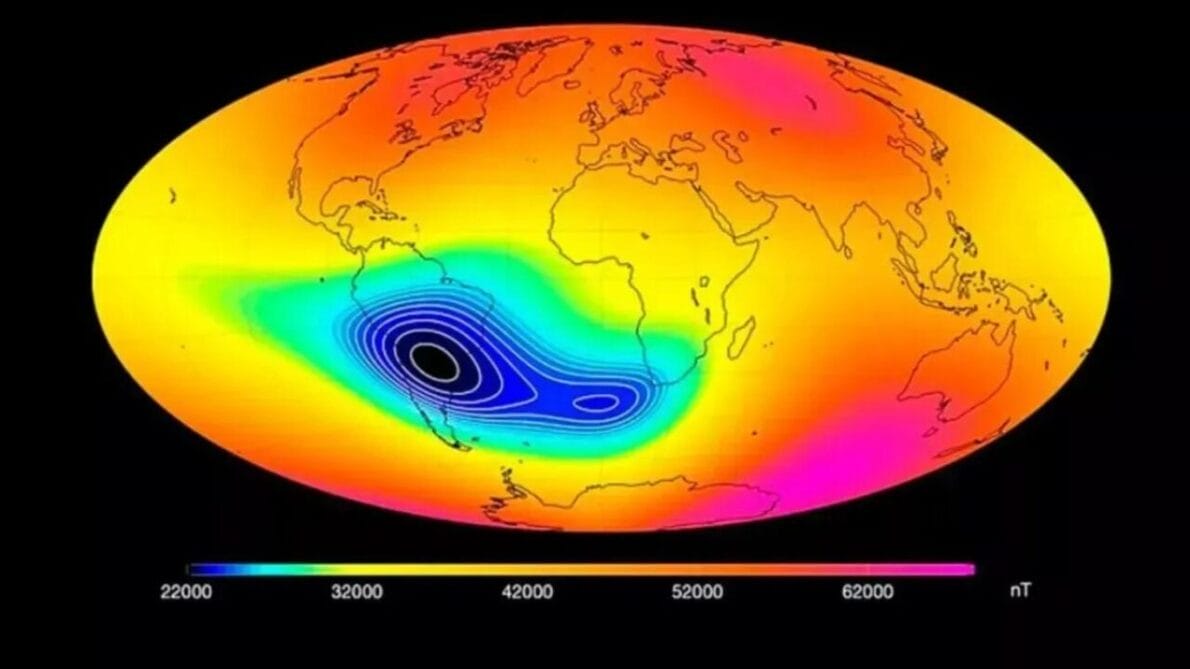

Magnetic Anomaly in Brazil: Expansion of Amas Concerns NASA and International Agencies Due to Risks to Technology and Health. Learn How Radiation Affects Satellites and Communications
The South Atlantic Magnetic Anomaly (Amas) is growing and causing international concerns. This phenomenon, which covers the south and southeast of Brazil, is expanding and may bring serious implications for human health and technology.
A recent report from the U.S. government reveals that Amas, located in the South Atlantic, is increasing by 5% and moving westward. This area is characterized by a weaker magnetic field, which facilitates the entry of solar particles into the Earth’s magnetosphere, responsible for protecting our planet from harmful radiation.

With the weakening of the magnetosphere in this region, satellites and communication systems may suffer damage. The authors of the report warn that the proximity of the anomaly to South America reduces Earth’s magnetic protection, affecting not only Brazil but also areas as far as Africa.
-
China accelerates global science and may surpass the United States in 2 years with increased public investment, continuous growth, and direct impact on the global technological competition.

-
Scientific studies indicate that drought may be strengthening a much greater silent threat: more resistant superbugs.

-
Man builds functional 5-meter submarine in his garage using gas cylinders, PVC pipes, and a refrigerator motor, and navigates with the vessel on a lake in Colombia.

-
Millions of people have been eating yam for centuries without knowing that this humble tuber contains a compound called diosgenin, which scientists have now discovered can improve memory and help control blood sugar levels.


The magnetic field in the Amas area is about one-third of the global average, making the region more vulnerable. In 2020, NASA highlighted that research teams are monitoring Amas to anticipate potential challenges for satellites and humans in space.
Although the anomaly does not pose an immediate risk to human health in daily life, its expansion could severely impact technology. Interference in radio wave propagation and potential damage to satellites are growing concerns. The European Space Agency (ESA), NASA, and Brazil, with the launch of the nanosatellite NanosatC-BR2, are closely monitoring the evolution of this anomaly.
Marcel Nogueira, a doctor in Physics and researcher at the National Observatory, explains that the weakened magnetic field in the region facilitates the entry of particles from solar wind. This phenomenon increases the flow of charged particles that traverse the area, forcing satellites to temporarily disable some components to avoid damage.
Intense radiation, especially from electrons, in this region worries space agencies. The constant evolution of the magnetic anomaly is monitored, especially in the central band where risks are higher. This continuous monitoring is crucial to prevent significant damage to satellites and other space technologies.
Impacts and Risks of the Magnetic Anomaly
Amas causes a series of problems for space technology and communication. Satellites passing through the region face elevated radiation risks, which can result in temporary or permanent failures. The interference in radio communications may also affect various sectors, from aviation to telecommunications.
The growth of Amas also raises concerns about the protection of astronauts on space missions. With the weakened magnetosphere, exposure to cosmic radiation increases, making the safety of these missions an even greater challenge.
Moreover, the expansion of the magnetic anomaly may have unknown effects on the climate and other natural phenomena. Continuous studies are necessary to fully understand the scope and consequences of this phenomenon. Space agencies and researchers remain vigilant, utilizing advanced technology to monitor and mitigate risks.
Monitoring and Prevention Measures
Brazil, along with international agencies, is intensifying monitoring efforts. The nanosatellite NanosatC-BR2 is a key piece in this strategy, allowing for the collection of precise data on the evolution of Amas. This international collaboration is essential to develop effective mitigation strategies.
In addition to monitoring, research in space physics aims to understand the causes and possible solutions for the magnetic anomaly. Investments in technology and research are fundamental to protect both terrestrial infrastructure and future space missions.
In summary, the expansion of the South Atlantic Magnetic Anomaly is a growing concern that demands continuous attention. International cooperation and technological advancement are crucial to facing the challenges posed by this phenomenon. We will continue to closely monitor this situation to ensure technological safety and the integrity of global communications.







Como essa anomalia e prejudicial a satélites e aos astronautas? Ambos estão no espaço fora da atmosfera terrestre, claro, sujeito a radiação, etc .. entendo não ter nada haver, agora com a comunicação aqui na terra, acredito que possa ocorrer.