





 Portuguese
  English
  Spanish
  8 min of reading
  0 comments


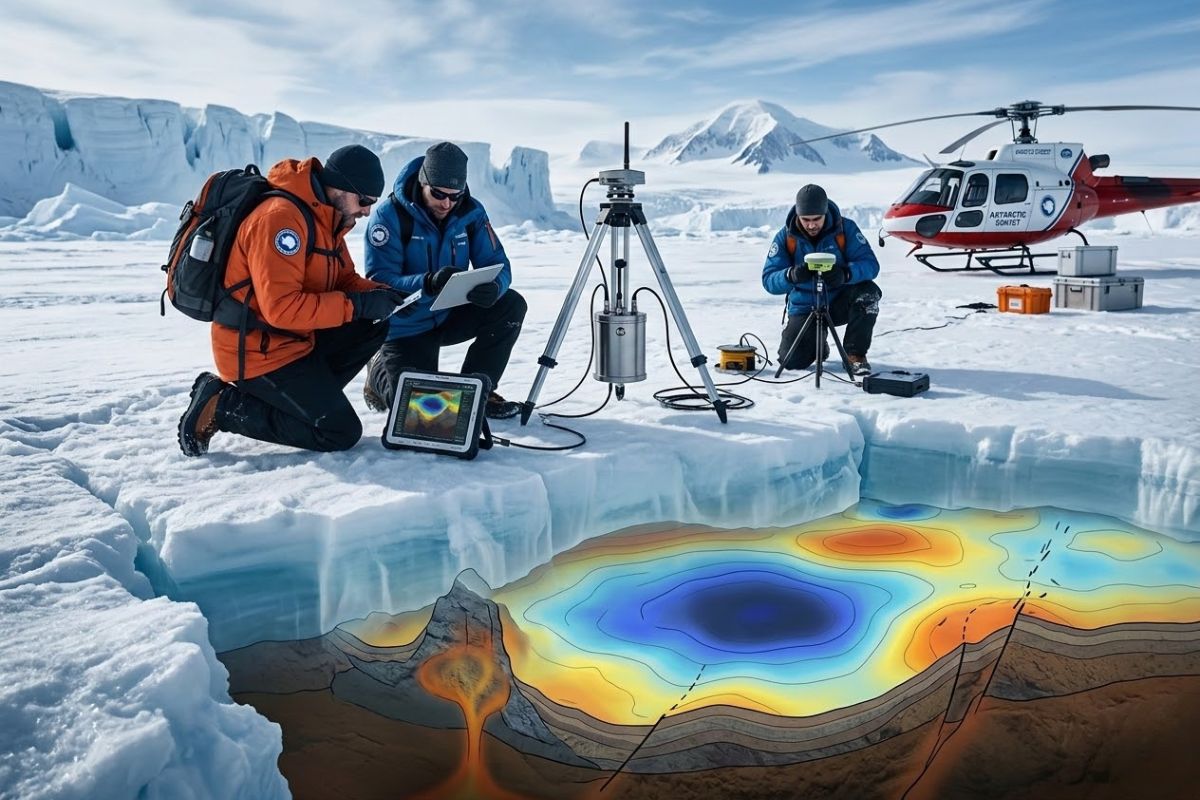
Under Antarctica, gravity is slightly weaker than in other parts of the planet because deep rocks have moved slowly over millions of years, forming an anomaly that also affects sea level around the continent and helps explain an ancient scientific doubt.
The Antarctica has always been observed as an extreme continent, covered by ice, intense winds, and conditions that challenge human presence. Now, it also emerges as the stage for an important answer about the interior of the planet: beneath the continent lies a gravitational anomaly formed by slow, deep, and ancient geological processes.
This discovery helps explain why the force of gravity is not exactly the same at all points on Earth. What seemed to be an enigmatic irregularity in the planet’s gravitational map has come to be understood as a result of movements of rocks in the Earth’s interior, with effects that reach not only the structure of Antarctica but also the behavior of the sea around it.
What Is Different Under Antarctica
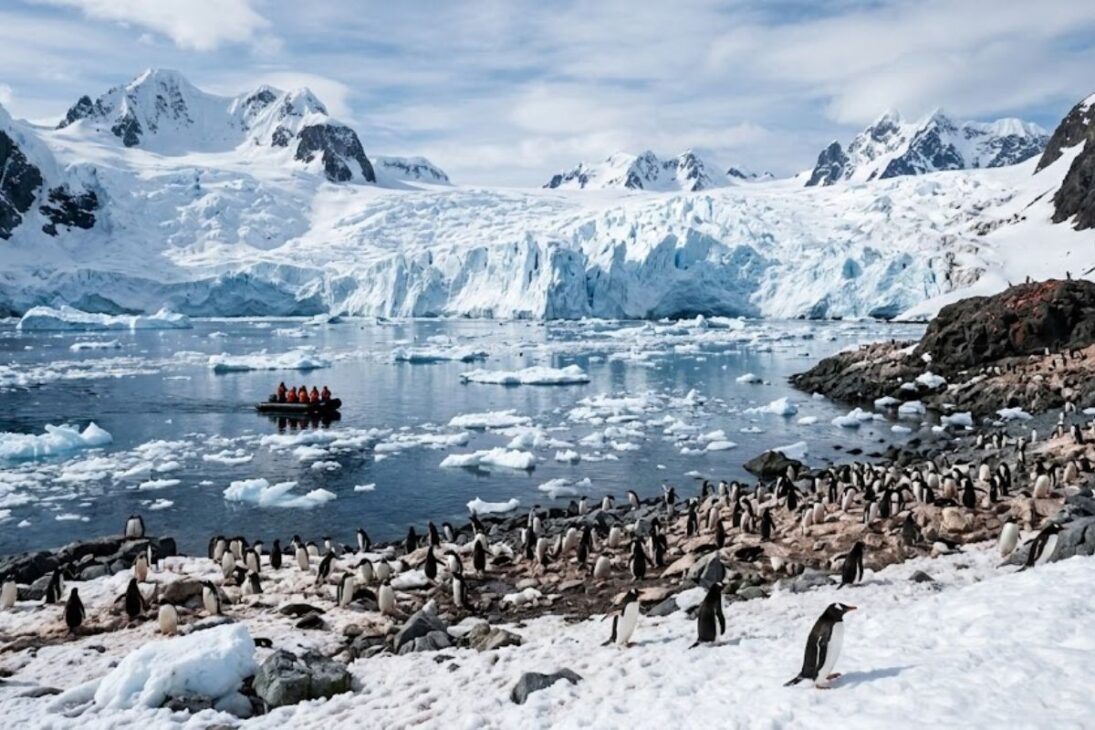
Gravity is often treated as a stable, almost immutable force in everyday perception. However, it varies subtly around the globe because it depends on the distribution of mass in the Earth’s interior. Where there are differences in rock density at depth, slight differences in gravitational attraction measured at the surface also arise.
-
An inventor in China creates flying drones shaped like swords that respond to hand gestures in real time, with technology based on motion sensors transforming interaction into a scene worthy of a movie and redefining the control of machines in the air.

-
100 times less energy consumption: the innovation that could solve the huge energy crisis of AI.

-
Scientists reveal a new method using solar light that transforms plastic into vinegar and could change the game against pollution, converting waste into a sustainable solution with future global impact.

-
3,500-year-old tear discovered reveals a textile technique much more advanced than previously thought in the Bronze Age.


In the case of Antarctica, scientists identified the area of the weakest gravity on the planet when considering the effect of Earth’s rotation. This region is described as a gravitational “hole,” not because there is a literal void under the ice, but because gravitational attraction there is less than in other parts of the world. It is a physical anomaly, not an open abyss in the ground.
This distinction is important because the phenomenon cannot be seen with the naked eye and does not directly and dramatically alter daily life. Still, it reveals something decisive about the internal architecture of the planet. What lies beneath Antarctica is not a gigantic cavity, but rather a configuration of materials and densities that, over a long time, has slightly reduced the force of gravity in that area.
The latest explanation indicates that this scenario was shaped by extremely slow movements of deep rocks that occurred over tens of millions of years. Rather than a sudden event, Antarctica carries the results of a prolonged, silent, and cumulative geological history, built long before human presence on the continent.
Why Weaker Gravity Interferes with Sea Levels
Differences in gravity on Earth are small but not irrelevant. When gravitational force is slightly weaker in a given area, ocean water tends to move toward areas where attraction is relatively greater. This means that the sea does not reach exactly the same height everywhere compared to the center of the planet.
In practice, the anomaly under the Antarctica causes the surface of the sea around the continent to be lower than it would be under other conditions. The ocean responds to gravity as a sensitive system, adjusting its distribution according to subtle variations in the Earth’s gravitational field. This detail helps explain why sea level maps and gravity maps may be closely linked.
This point is relevant because Antarctica is not just a continental mass covered by ice. It is surrounded by an ocean that continuously participates in exchanges between climate, ice, terrain, and gravity. When researchers observe that the height of the sea surface around the continent is considerably lower than it would be without this anomaly, they show that the Earth’s interior also indirectly participates in organizing the polar environment.
It was precisely this connection that caught scientists’ attention. Understanding better how gravity and sea level relate can offer clues about important factors for the growth and stability of large polar ice sheets. In this context, Antarctica ceases to be seen merely as a frozen surface landscape and is understood as a system connected to the depths of the planet.
How Researchers Reconstructed the Deep Interior of the Earth
The study was conducted by Alessandro Forte, a professor of geophysics at the University of Florida, and by Petar Glišović, a PhD in Physics from the Institute of Earth Physics in Paris. The two researchers worked on reconstructing the past of the gravitational anomaly of the Antarctica from a scientific effort that gathered seismic records from around the world and computational models guided by physical principles.
The logic of the method is sophisticated but can be understood clearly. Earthquakes produce seismic waves that travel through the Earth’s interior. By observing how these waves propagate, slow down, or change behavior as they cross different layers, scientists can infer the internal structure of the planet. It’s like creating an image of the Earth’s interior without drilling through its deep layers.
Forte compared this procedure to a sort of computed tomography of the entire Earth. Instead of X-rays, seismic waves generated by earthquakes come into play. They function as the “light” that allows us to see what is hidden in the depths, revealing contrasts in density, composition, and temperature that would not be detected by simple surface observation.
After combining seismic data with physical models, the researchers produced a detailed gravitational map. The results proved to be very close to the high-precision measurements made by satellites, which strengthened confidence in the portrait obtained. This alignment between independent observations was decisive, as it showed that the explanation found for Antarctica is not based on a loose hypothesis, but on a coherent set of evidence.
What Happened in the Depths Over Millions of Years
After mapping the current anomaly, scientists took an even bolder step: attempting to reconstruct its formation. To do this, they used advanced simulations capable of reversing, in model, the slow movement of rocks in the Earth’s interior. With this procedure, it was possible to track the evolution of the system back to about 70 million years ago, still in the era of the dinosaurs.
The simulations showed that the gravitational “hole” of the Antarctica did not always have the same intensity. In the distant past, the anomaly was weaker. However, between approximately 50 million and 30 million years ago, it began to intensify. This temporal detail changed the scientific debate because it revealed that the anomaly is not only ancient, but it has also undergone a phase of significant strengthening.
The interval is noteworthy because it coincides with major climatic changes in Antarctica, including the onset of widespread glaciation. This does not mean, for now, that gravity was the direct cause of these transformations. What the study shows is a relevant temporal coincidence between the intensification of the gravitational anomaly and a decisive period for the formation of the polar environment we know today.
This relationship opens up a particularly interesting line of investigation. If the configuration of the Earth’s interior influenced regional gravity, and if this gravity helped shape sea level around the continent, then the history of Antarctic ice may have been conditioned by deeper processes than previously imagined. Antarctica thus appears as a meeting point between deep geophysics and long-term climatic evolution.
Why This Discovery Matters for Understanding Ice, Climate, and Polar Stability
The great relevance of the research lies in the fact that it unites layers of the Earth that are often studied separately. On one side are the slow movements of rocks in the Earth’s interior. On the other are the behavior of the sea, continental elevation, ice stability, and climate changes. Antarctica shows that these systems can communicate with each other more closely than previously thought.
By suggesting that gravity and sea level need to be observed together, the study broadens how scientists think about the formation and maintenance of large ice sheets. The idea is not to replace already-known factors but to add an important piece to the puzzle. The Earth’s interior ceases to be just a backdrop and is treated as an agent that can influence fundamental conditions on the surface.
Alessandro Forte indicated that the next models should investigate precisely this interaction between gravity, sea level, and changes in continental elevation. The central question is broad and powerful: how does Earth’s climate connect with what happens inside the planet? In the case of Antarctica, this question gains importance because it involves one of the most sensitive places on the globe for climate balance.
There is also a gain in perspective. For decades, the gravitational anomaly beneath Antarctica has been treated as a persistent mystery.
Now, it is interpreted as the result of a long, traceable geological process consistent with the dynamics of the planet. The riddle has not disappeared completely, but has changed levels: it has moved from the realm of simple strangeness to the field of a robust physical explanation.
Antarctica as a Border Between the Surface and the Depths
There is something especially symbolic about this discovery. The Antarctica, often imagined merely as a territory of ice and isolation, also reveals itself as an active record of what happens in the depths of the Earth. Beneath its frozen surface, there is not only extreme cold, but also the signature of geological movements that have unfolded over millions of years.
This helps explain why the continent continues to arouse such scientific interest. Antarctica intrigues not only because of its landscape or the impact of climate change. It also concentrates signs of internal processes that help understand how the planet organizes on a deep, slow, and global scale. Every answer obtained there seems to open an even bigger question.
By connecting gravity, deep rocks, sea, and ice, the research shows that the Antarctic continent is more than just a geographical extreme. It functions as a kind of natural laboratory where different systems of the Earth meet. And precisely for this reason, understanding Antarctica means better understanding the functioning of the planet itself.
If this discovery changes the way you view Antarctica, it’s worth discussing one point: in your opinion, what is most surprising in this story—the weaker gravity, the influence on the sea, or the fact that it all began in the depths of the Earth millions of years ago?






-

-

-

5 pessoas reagiram a isso.