





 Portuguese
  English
  Spanish
  4 min of reading
  0 comments


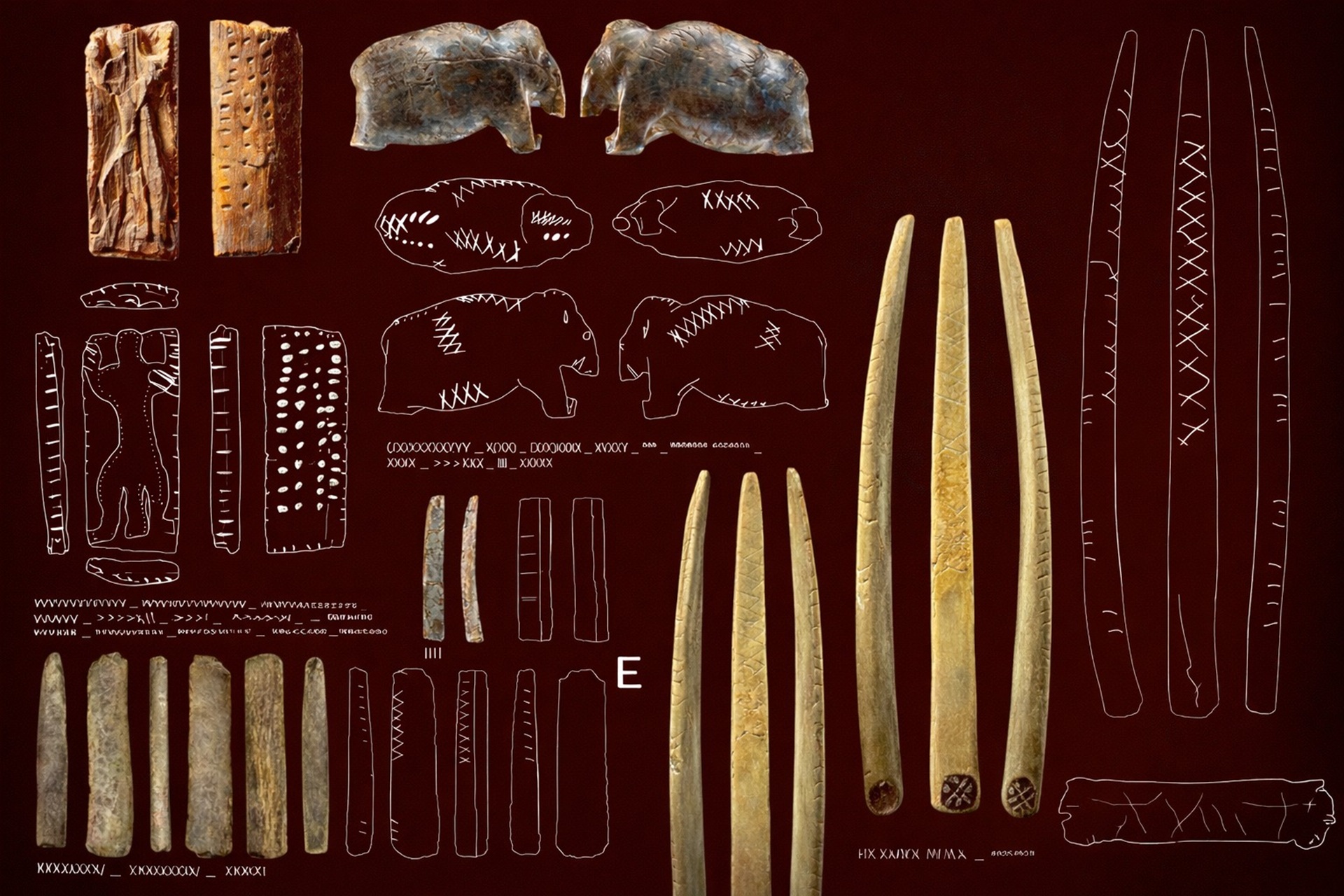
Study Published In The Proceedings Of The National Academy Of Sciences Analyzed 260 Artefacts From The Aurignacian, Dated Between 43,000 And 34,000 Years, And Identified More Than 3,000 Symbols Carved In Ivory, Bone, And Horn, Indicating A Structured System Preceding Formal Writing
A study published in the Proceedings of the National Academy of Sciences analyzed 260 artefacts from the Aurignacian, dated between 43,000 and 34,000 years, and identified a conventional system of symbols, visual writing, and repeatable geometric signs used by humans in Europe.
The research indicates that the first modern humans who lived in Europe around 40,000 years ago developed structured symbols and visual writing, composed of deliberate marks that went beyond decoration. The work was conducted by Dr. Christian Bentz from the University of Saar and the University of Passau, and Dr. Ewa Dutkiewicz from the State Museums of Berlin.
According to the authors, around 45,000 years ago, modern humans arrived in Eastern and Central Europe, where they encountered Neanderthals. During this period of migration and population changes, they began to produce movable objects such as tools and statuettes made of ivory, bone, and horn.
-
Motorola launched the Signature with a gold seal from DxOMark, tying with the iPhone 17 Pro in camera performance, Snapdragon 8 Gen 5 that surpassed 3 million in benchmarks, and a zoom that impresses even at night.

-
Satellites reveal beneath the Sahara a giant river buried for thousands of kilometers: study shows that the largest hot desert on the planet was once traversed by a river system comparable to the largest on Earth.

-
Scientists have captured something never seen in space: newly born stars are creating gigantic rings of light a thousand times larger than the distance between the Earth and the Sun, and this changes everything we knew about stellar birth.

-
Geologists find traces of a continent that disappeared 155 million years ago after separating from Australia and reveal that it did not sink, but broke into fragments scattered across Southeast Asia.

These objects belong to the Aurignacian techno-complex, the oldest phase of the Upper Paleolithic. Regions such as Dordogne in southwestern France, the Swabian Jura in southwestern Germany, and sites in Belgium revealed hundreds of pieces adorned with sequences of geometric signs.
Symbols And Visual Writing In The Aurignacian Analyzed In 260 Artefacts
In the study, researchers examined 260 movable artefacts from caves in the Swabian Jura. The pieces were carved between 43,000 and 34,000 years ago from mammoth ivory, bone, and horn, including tools, beads, musical instruments, and statuettes of animals and humans.
Many of these pieces feature sequences of dots, lines, crosses, and other geometric shapes. The peoples who inhabited the caves during this period produced specialized tools for cutting meat, working hides, and making clothing and ropes, as well as the first flutes made from bones and ivory.
To evaluate the symbols and visual writing carved, the authors applied tools from information theory and quantitative linguistics. More than 3,000 geometric signs were analyzed for repetition, diversity, and information density in the recorded sequences.
Dr. Bentz stated that there were many theories, but little empirical work on the measurable characteristics of the signs. Statistical analyses showed that Paleolithic signs did not resemble modern writing, which tends to avoid repetitions and condense information densely.
Comparison Between Paleolithic Symbols, Modern Writing, And Protocuneiform
The results indicated that Aurignacian signs differ from modern writing, which encodes spoken language. Writing, in the strict sense, represents spoken languages, while the signs analyzed do not fulfill this function.
Despite this, the sequences bore a strong resemblance to the earliest known accounting signs, the protocuneiforms, used in Mesopotamia about 5,500 years ago. The protocuneiform sequences were also repetitive, with individual signs repeated with similar frequency.
This comparison does not imply that Ice Age Europeans practiced formal writing. The carvings represent a stable and conventional system of signs capable of storing and transmitting information visually, but without encoding spoken language.
The researchers noted that repetitive sequences, such as cross, cross, cross, line, line, line, do not correspond to features of spoken language. Nevertheless, in terms of complexity and information density, they are comparable to the earliest protocuneiform tablets.
Shared Rules And Stability Of Symbols And Writing Over 10,000 Years
The location of the application of symbols and visual writing was also considered relevant. Statuettes carved from ivory exhibited denser and more complex sequences than everyday tools.
Certain symbols were associated with specific themes. Dots were often carved on human and feline figures, while crosses appeared on mammoths and horses, but never on human figures. These standardizations indicate shared rules transmitted across generations.
Over approximately 10,000 years, the structure of the sign system remained remarkably stable. Unlike protocuneiform, which rapidly evolved into complete writing systems as ancient economies became more complex, Aurignacian signs maintained consistent patterns.
The findings reinforce the view that symbolic communication did not emerge suddenly with writing, but gradually emerged through systems intended to record numbers, events, or social knowledge.
Some marks may have recorded seasonal cycles, hunting information, or ritual concepts, although their exact meanings remain unknown. Even without complete decipherment, the symbols and visual writing indicate a structured capacity for recording.
Cognitive Ability And Portable Production Of Symbols And Visual Writing
Dr. Dutkiewicz stated that anatomically, Stone Age humans had already reached a developmental stage similar to that of modern humans. This suggests cognitive abilities comparable to current ones.
The ability to record and transmit information was considered extremely important for Paleolithic humans. This resource may have allowed them to coordinate groups or contribute to survival in contexts of migration and population change.
The analyzed objects demonstrate a high level of craftsmanship. Many fit in the palm of the hand and were carried by their producers, a characteristic also observed in protocuneiform tablets.
Thus, the collection of 260 artefacts and more than 3,000 signs reveals that early European humans developed a conventional system of repeatable and structured symbols and visual writing, maintaining stability over millennia and demonstrating informational organization in the Upper Paleolithic, even though it does not constitute writing in the strict sense of the word.








-

Uma pessoa reagiu a isso.