





 Portuguese
  English
  Spanish
  5 min of reading
  0 comments


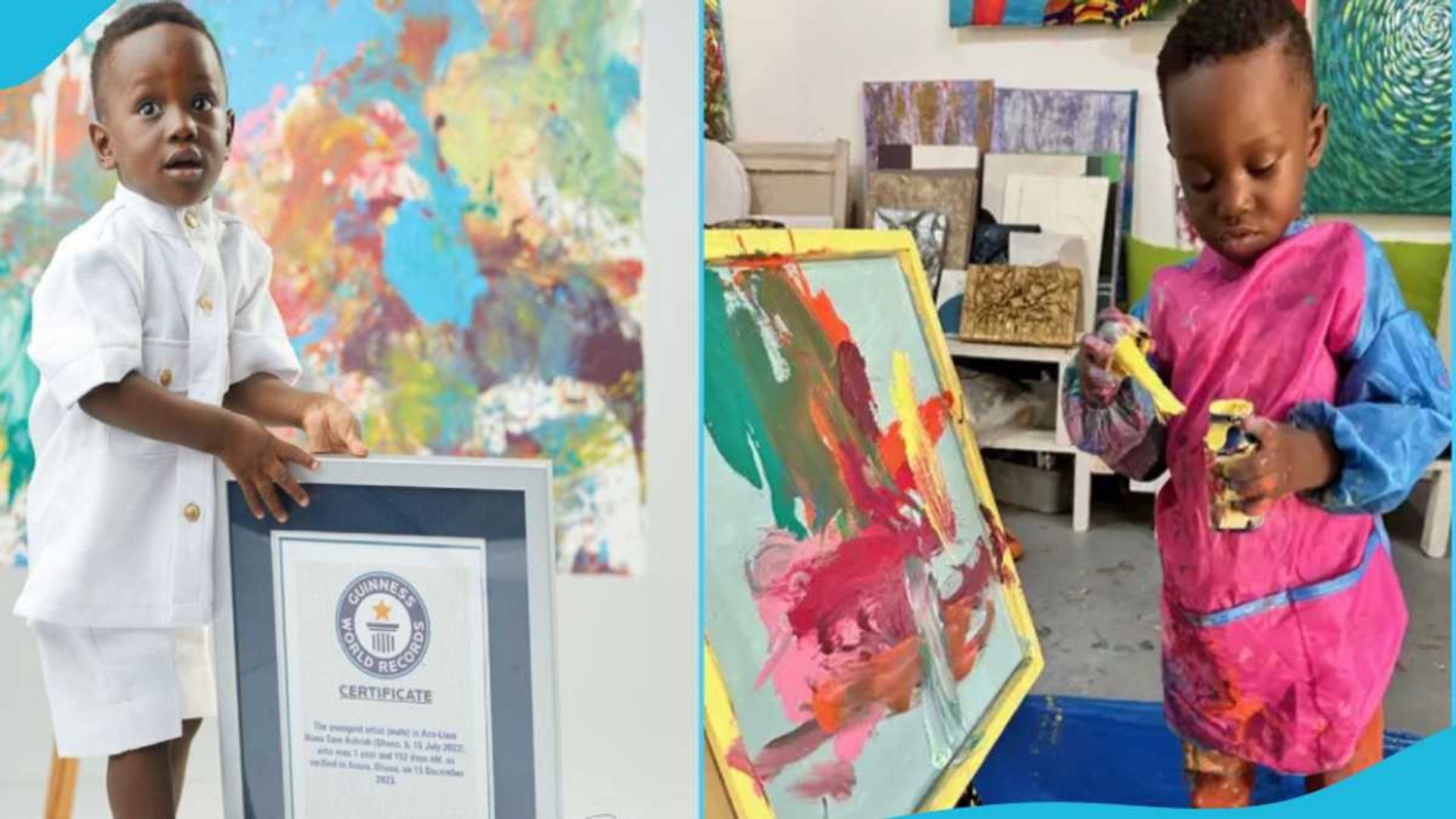
Guinness-Approved Record Transforms Ghanaian Baby Into Youngest Artist in the World After Exhibition with Paintings Sold in Museum, Sparking Global Debate on Early Talent and the Impact of Children’s Digital Footprint on Social Media and Ongoing Public Exposure.
A Ghanaian baby has made it into the Guinness World Records after having his artistic production recognized as a world record in the category of youngest male artist.
The record goes beyond the certificate. It involves public exhibition in a museum, with works available for sale, and an unusual commercial result for someone in this age group — nine paintings sold out of ten displayed, according to the organization itself.
Guinness World Records and the Validation of the Youngest Artist
The artist is Ace-Liam Nana Sam Ankrah from Accra, and Guinness describes that he had already produced more than 20 paintings when he participated in his first group exhibition at the Museum of Science and Technology in the Ghanaian capital.
-
Friends have been building a small “town” for 30 years to grow old together, with compact houses, a common area, nature surrounding it, and a collective life project designed for friendship, coexistence, and simplicity.

-
This small town in Germany created its own currency 24 years ago, today it circulates millions per year, is accepted in over 300 stores, and the German government allowed all of this to happen under one condition.

-
Curitiba is shrinking and is expected to lose 97,000 residents by 2050, while inland cities in Paraná such as Sarandi, Araucária, and Toledo are experiencing accelerated growth that is changing the entire state’s map.

-
Tourists were poisoned on Everest in a million-dollar fraud scheme involving helicopters that diverted over $19 million and shocked international authorities.


During the event, called Soundout Premium Exhibition, ten works were presented to the public and made available for purchase, with nine sales recorded during the exhibition.
The case’s impact often relies on two elements that easily circulate on social media: images of the baby in front of the canvases and the idea of an achievement “officially” validated by a global institution.
The Associated Press, in an internationally distributed report, stated that Ace-Liam debuted with a piece titled The Crawl, and noted that his mother, visual artist Chantelle Kuukua Eghan, describes her son’s interest in colors and paints as the starting point for his first paintings.
According to AP, the family sought to meet the requirements for the record’s validation, which included the need for a public presentation with the sale of the artworks.
In a version of the same report published by VOA Learning English, also attributed to the agency’s coverage, the mother says she started preparing the application about a year prior and received guidance that it would be necessary to exhibit and sell the paintings for the title to be recognized.

Guinness records that Ace-Liam achieved the milestone at the age of 1 year and 152 days, the age used to characterize the record.
The organization also describes the process as one associated with encouragement and an artistic environment since the mother is a painter, and exposure to studio materials was part of the home routine cited in the reports.
Early Talent and the Debate on Child Exposure
The episode has garnered a dual interpretation outside the realm of curiosities.
On one hand, it joins the repertoire of stories about very early skills, focusing on visual language, motor coordination, and attention.
On the other hand, it provokes debate on how “child prodigy” narratives are formed when there are cameras, interviews, posts, and continuous circulation of images, creating a permanent record of someone who does not yet have the capacity to choose what they want to make public.
It is at this point that the theme of children’s digital footprint resurfaces strongly, as the content associated with the achievement may remain online indefinitely.
UNICEF treats “sharenting” as the practice of guardians sharing information and images of children online and recommends making conscious decisions to protect privacy, respect boundaries, and avoid unnecessary exposure.

In materials geared toward families, the organization emphasizes the importance of being cautious with personal data and making choices that reduce risks when publishing photos and everyday details.
The American Academy of Pediatrics follows a similar line by advising guardians to reflect before posting and to establish family rules regarding media, adjusting habits as the child grows.
In a specific text about “sharenting,” the AAP suggests practical questions to evaluate the purpose, reach, and potential impacts of each post, as well as encourages family discussions when the child is old enough to understand what is being shared.
Record Surpassed and Historical Permanence in Guinness
In Ace-Liam’s case, visibility intertwines with market dynamics as part of the story includes the sale of artworks and public events.
Guinness reports that the boy “enjoys the feeling of paint on his hands” and associates his interest with pleasure in colors and the ability to express himself through painting, a type of description that tends to work well in short profiles, captions, and quick-share reports.
There is also an institutional component that helps explain why the story transcends borders.
The validation of a record creates an objective “milestone” that is easily understood by readers in different countries, even when the subject — childhood development and artistic encouragement — is complex.
Thus, the debate often shifts from being just “the baby paints” to involving what public exposure does to childhood when an achievement becomes a brand, content, and social expectation.

However, Guinness itself does not aim to function as a development evaluator.
It records records and feats, while diagnoses and analyses about exceptional abilities depend on specific clinical and educational criteria, prolonged observation, and familial and educational context.
Another notable aspect that alters how the public interprets the case is that Guinness has indicated on a page aimed at young audiences that Ace-Liam’s record was subsequently surpassed by another child, citing John Christian Caldeira Weibull, with a registered mark at 10 months and 7 days on October 19, 2024.
Even so, the achievement remains as a historical record in Guinness and continues to be referenced for having combined age, public exposure, and sales results in a museum.
When stories of this nature circulate, the discussion tends to focus on the feat while sidelining everyday decisions about limits, routines, and privacy.
The central question for families and educators who monitor similar cases is often less about denying talents and more about preserving space for childhood to exist outside of the spotlight, with gradual autonomy and protection of data and images, as health and childhood organizations advise.
How to balance encouraging a real talent that attracts public interest with a child’s right not to turn every phase of their life into permanent content on the internet?









-

-

-

-

-

-

91 pessoas reagiram a isso.