





 Portuguese
  English
  Spanish
  5 min of reading
  1 comment


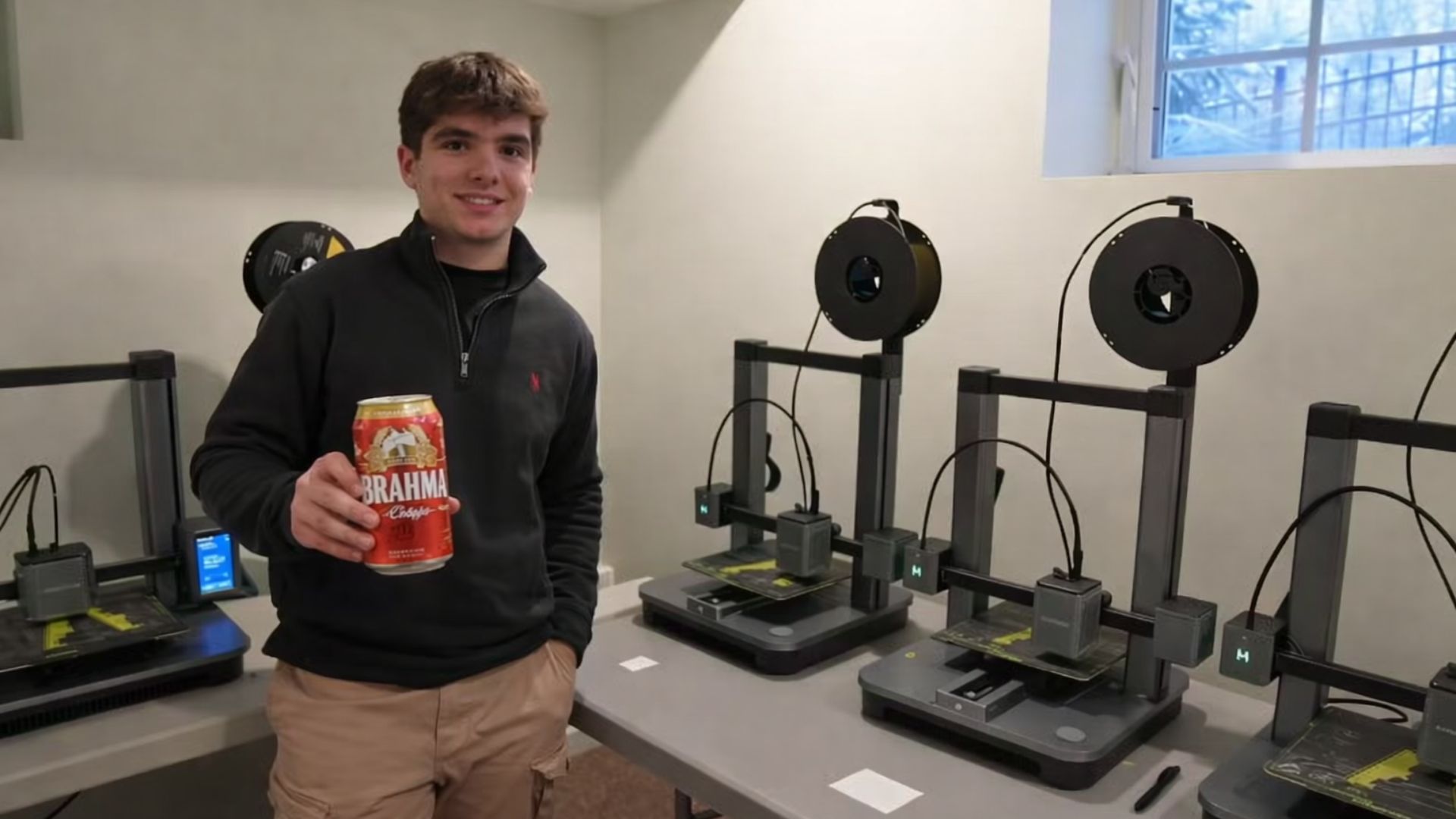


Viralization on Social Media, 3D Printing, and E-Commerce Strategy Intersect in the Story of a Young Man from New York Who Transformed a Can Accessory into a Sought-After Product. Behind the Scenes Show How Rapid Prototyping, Online Community, and Lean Logistics Fueled a Sudden Surge in Orders.
At 18 years old, American Michael Satterlee from Clifton Park, New York, turned a 3D-printed product into a revenue peak of US$ 315 thousand in a single month, an amount that was reported as approximately R$ 1.6 million in Brazilian news articles covering the case.
The brand behind the sales is Cruise Cup, creator of the Beerzooka, a can holder with a mechanism for automatic ejection that gained traction on TikTok and other social networks.
The result was attributed to the impact of viral videos and the ability to produce quickly with 3D printers, in a lean operation financed by the company’s own cash flow.
-
Pix in installments, international Pix, and contactless payment without internet: the Central Bank revealed the new features coming to the tool that is already used by almost every adult in Brazil.

-
Mercado Livre has just started selling medications with delivery in up to three hours to your door, and this move could completely change the way Brazilians buy medicines on a daily basis.

-
In Dubai, rising tensions from the war in the Middle East are causing super-rich individuals to leave the Gulf and direct their fortunes to a new financial refuge in Asia.

-
“No one will make us change the Pix,” says Lula after the US report.


The story of the product and the business’s growth was originally reported by Entrepreneur magazine, according to Brazilian publications that covered the figures.
First Businesses and the Turn to Beerzooka

Before Beerzooka, Satterlee had already tested the entrepreneurial path with Solefully, a company selling customized accessories for Crocs made through 3D printing.
While still in high school, he claimed to have reached six-figure revenues with his first business, supported by a mix of his own designs and organic reach on social media.
After graduating, he decided to focus his energy on a new venture.
The shift occurred when demand for Solefully decreased and some of the printers were left unused, creating space for a different product, one with direct appeal for video sharing.
It was in this context that Cruise Cup emerged, initially structured as an online store focused on items that could be produced with the machines already available.
Instead of buying new equipment to start from scratch, the strategy was to repurpose what was sitting idle and find an item with scaling potential.
Can Holder Design and the Automatic Ejection Mechanism
The idea began with a common item at parties and gatherings: covers and holders for beverage cans.
Instead of replicating existing models, Satterlee sought a more practical use, with a detail that would look good on video and elicit an immediate reaction.
The design of the Beerzooka allows inserting the can from the top or from underneath, making it easier to fit and remove.
The element that became a trademark came later, in prototype tests: when placing a new can, the system automatically pushes the previous one out, in a motion that the creator himself compared to reloading mechanisms.
With experience in CAD, the young man reported reaching a functional prototype in one day.
From then on, he applied what he had already learned from his first business: e-commerce structure on Shopify, constant content production, and quick adjustments in communication based on audience feedback.
TikTok, Viral Videos, and Community Strategy
The launch of Beerzooka was designed for social media from the start.
The strategy began with organic posts on TikTok and Instagram, focusing on short videos that showcased the mechanism in action, with repetition of the gesture and audience reaction.
One single piece of content reached tens of millions of views, according to reports that supported the case’s spread.
Following that, the product began to receive waves of orders, and the company attributed the best performance of the period to November 2025, a month in which sales reportedly exceeded US$ 300 thousand.
Meanwhile, the brand management moved closer to a content creator format, encouraging comments, responses, and requests for improvements.
Satterlee also mentioned using audience suggestions as a guide for product adjustments and to decide which variations were worth producing.
Warehouse, Small Team, and Cash Reinvestment
The operation was described as self-financed, with revenue reinvested back into the business.
Cruise Cup operates in a warehouse of approximately 140 square meters and, at the peak of its growth, employed two full-time employees for repetitive tasks in the process.
This team was responsible for removing supports from printed pieces, applying labels, packaging, and shipping orders.
The entrepreneur pointed out hiring as one of the most challenging aspects, especially during high-demand periods, when volume increases faster than the capacity to package and ship.
Nonetheless, the operational logic remained the same: delegate the routine to free up the founder’s time for product, marketing, and scaling decisions.
During peak demand times, such as the end of the year in the northern hemisphere, the priority shifted to meeting deadlines and maintaining the delivery flow.
3D Printing, Production Capacity, and Bottlenecks

3D printing appears in the story as a tool for speed.
Among the equipment mentioned by the entrepreneur is the Bambu Lab A1, described as a printer that costs less than US$ 300, an amount reported as approximately R$ 1,596 in reports about the case.
In terms of capacity, Satterlee stated that one printing cycle can produce three units in about 15 hours, which requires multiple machines to keep up with demand spikes.
On the other hand, this same structure allows testing formats and responding to trends quickly, without relying on industrial batches and long supplier lead times.
In marketing, the reported method was progressive.
First, the brand measures performance with organic posts; then, when a piece of content “takes off,” it scales ads, primarily on Facebook.
Within this logic, the business reportedly generated about US$ 100 thousand at launch in August, dropped in September, returned to the previous level in October, and peaked in November, with the decision to pause ads in December to manage deliveries.
Migration to Metal, Stainless Steel, and Intellectual Property Protection
To reduce typical bottlenecks of a production based on 3D printers, the entrepreneur stated plans to migrate the Beerzooka to metal.
The proposal is to work with suppliers and produce large batches in advance, reducing losses from printing errors and enhancing the finish.
The promise is to maintain the product’s concept but with a more premium look, in stainless steel, and with greater thermal performance.
At the same time, Satterlee reported focusing on protecting intellectual property, with trademark registrations and patents related to the design.
Youth Entrepreneurship in Brazil and Sebrae’s Figures
The American’s journey fits into a movement also observed in Brazil, where millions of young people seek self-employment as a source of income.
A survey by Sebrae based on PNAD Contínua indicated 4.9 million business owners aged 18 to 29, with a growth of 25% over 12 years and an average income of R$ 2,567 in 2024, the highest in the historical series for this age group.
In this context, the Beerzooka case highlights a recurring point in digital businesses: reducing the cost of testing.
Describing his own strategy, Satterlee summed up the logic with a straightforward phrase: “Even if an idea seems bad at first, it doesn’t hurt to try. You never know what will work,” he said.








A galera acredita em tudo hoje em dia kkkkkkkkkkk